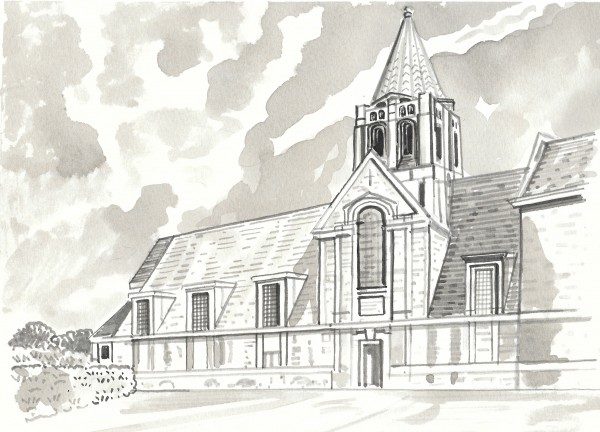






Lutyens’s pick ’n’ mix
Church architecture in the early 20th century threw away the rulebook and drew from a mishmash of sources St Jude’s, Hampstead Garden Suburb And so, after 1,000 years, we come to the end of our whistlestop guide to British churches. Funnily enough, St Jude’s, Hampstead Garden Suburb – built by the great Sir Edwin Lutyens in 1911 – is not so far removed from the Norman churches of a millennium before. Lutyens, who could turn his hand to any style, has inserted layers of round-headed arches into the spire. These are echoes of Byzantine architecture, which chime with those round-arched Norman churches. But St Jude’s isn’t just Byzantine; it’s a clever combination of lots of styles. Lutyens himself called the St Jude’s look “Romantic Byzantine-cum-Nedi” – Nedi was Lutyens’s nickname. That pointed spire, with its chevron leading, is Gothic in inspiration, at the behest of Dame Henrietta Barnett. She was the visionary behind Hampstead Garden Suburb – the first of the garden suburbs, developments with a rural feel attached to ancient cities. Dame Henrietta – whose father made a fortune out of Macassar oil for men’s hair – thought, like Pugin, that Gothic was the one true style for churches. Lutyens was far too inventive to follow her favoured style throughout the building. He daringly combines that Gothic outline with distinctively classical details – like those skilfully grouped pilasters either side of the main window, with classical entablatures above and classical bases below. Lutyens’s pick ’n’ mix approach was symptomatic of church style in the early 20th century. It wasn’t quite a free-for-all. Architects were still being given rigid training in traditional building styles. But they were free to choose Gothic or classical, or combine them in one building, as Nedi did here. That freedom has reigned ever since in church style, notwithstanding the fact that fewer churches are now being built. The Gothic Revival had petered out in the 1870s. The so-called Queen Anne Revival followed, even if there were few details in common with the buildings of that queen’s reign from 1702 to 1714. A better name for the style was Sweetness and Light, which neatly captured its jaunty, multi-coloured, rules-free air. It borrowed from all sorts of influences – the 17th and 18th centuries, Elizabethan, Old English, Japanese, Dutch, farmhouse vernacular, Palladian. It’s hard to pin down any ruling credo behind the style. If anything, the most important elements were its lack of rules and its eclecticism. The 1840s had seen an obsession with Decorated Gothic churches; the 1850s and 1860s turned towards Early French Gothic churches. How slavish all this imitation was, thought the architects of the Queen Anne Revival. Why follow the French, when you had inspirational native Early English features on your doorstep? Half-timbered, tile-hung and weather-boarded buildings flourished in the late 19th century, so the movement also got called “Olde English”. To make things even more complicated, the style overlapped with elements of the Arts and Crafts movement. John Ruskin (1819–1900) inspired the Arts and Crafts style, particularly in The Stones of Venice (1851–3) and Unto This Last (1860). The principles were pretty amorphous – the general idea was to connect the country’s moral and social health to the qualities of its architecture and design. The answer came, Ruskin thought, from a society full of creative, skilful workers. The movement was rooted in the desire to expose the natural surfaces of ordinary materials, such as stone and hanging tiles, and to throw them together into an asymmetrical, jumbled composition. To get a feel for Arts and Crafts interiors, it’s worth joining Charles Ryder and Sebastian Flyte in the Catholic chapel at Brideshead: