



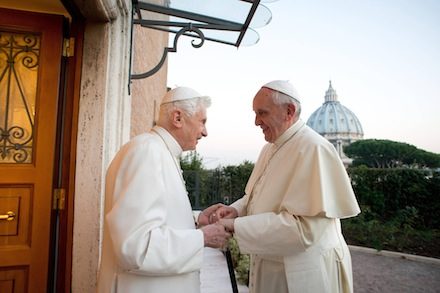
I begin with a piece, spotted by Fr Tim Finigan and reported in his indispensable blog The Hermeneutic of Continuity, which had been published in Sandro Magister’s blog—not his English one, Chiesa, but his Italian language blog for L'Espresso, Settimo Cielo. A few days ago, Magister told the story of a parish priest in the Italian diocese of Novara, Fr Tarcisio Vicario, who recently discussed the question of Holy Communion for the divorced and remarried. This is how he explained the Church’s teaching on the matter: "For the Church, which acts in the name of the Son of God, marriage between the baptised is alone and always a sacrament. Civil marriage and cohabitation are not a sacrament. Therefore those who place themselves outside of the Sacrament by contracting civil marriage are living a continuing infidelity. One is not treating of sin committed on one occasion (for example a murder), nor an infidelity through carelessness or habit, where conscience in any case calls us back to the duty of reforming ourselves by means of sincere repentance and a true and firm purpose of distancing ourselves from sin and from the occasions which lead to it." Pretty unexceptionable, one would have thought. His bishop, the Bishop of Novara, however, slapped down Fr Tarcisio’s “unacceptable equation, even though introduced as an example, between irregular cohabitation and murder. The use of the example, even if written in brackets, proves to be inappropriate and misleading, and therefore wrong." Fr Tim comments that “Fr Vicario did not ‘equate’ irregular cohabitation and murder. His whole point was that they are different - one is a permanent state where the person does not intend to change their situation, the other is a sin committed on a particular occasion where a properly formed conscience would call the person to repent and not commit the sin again.” It was bad enough that Fr Tarcisio should be publicly attacked by his own bishop simply for propagating the teachings of the Church. Much more seriously, Fr Tarcisio was then slapped down from Rome itself, by no less a person than the curial Cardinal Lorenzo Baldisseri, who said that the words of Fr Tarcisio were "crazy [‘una pazzia’], a strictly personal opinion of a parish priest who does not represent anyone, not even himself." Cardinal Baldisseri, it may be remembered, is the Secretary General of the Synod of Bishops, and therefore of the forthcoming global extravaganza on the family. This does not exactly calm one’s fears about the forthcoming Synod: for, of course, it is absurd and theologically illiterate to say that Fr Tarcisio’s words were “a strictly personal opinion of a parish priest who does not represent anyone, not even himself” (whatever that means): for, on the contrary, they quite simply accurately represent the teaching of the Magisterium of the Roman Catholic Church. Sandro Magister tellingly at this point quotes the words of Thomas, Cardinal Collins, Archbishop of Toronto, who was appointed in January this year as one of the five members of the Commission of Cardinals Overseeing the Institute for the Works of Religion, and who at about the same time as Fr Tarcisio was being slapped down from the beating heart of curial Rome, was saying almost exactly the same thing as he had:
4:35 PM
Fr Blake says that in order to maintain the unity of the Church loyalty to the pope is now best expressed through silence. I fear he may be right
We are in such an atmosphere of uncertainty that even Jane Fonda can love the pope because she thinks he hates dogma: something has to give
William Oddie

7 min read



Already a subscriber? Sign in
5freearticles every month
Continue reading with a free account. No card needed.
- Five free articles every thirty days, on any device you sign in on
- The Catholic Herald newsletter, every morning
- Subscribe whenever you like for everything: every article and the magazine
Related articles
 Newsroom
Church leaders urge Drumcree dialogue: ‘Too much is at stake’
The Catholic and Church of Ireland Archbishops of Armagh have urged a renewed commitment to peace and reconciliation amid the Drumcree stand-off
Corrie Douglas-Young Newsroom
Thousands of Irish children to join global Rosary campaign
Corrie Douglas-Young Newsroom
TikTok priest urges young people to stand with persecuted Christians
Nathalie Raffray Newsroom
Baby born at 25 weeks reunites with neonatologist two years after leaving hospital
The Catholic Herald Newsroom
Joe Biden honoured by Planned Parenthood after defending abortion rights
Christine Rousselle
subscribe to the catholic herald today
Our best content is exclusively available to our subscribers. Subscribe today and gain instant access to expert analysis, in-depth articles, and thought-provoking insights—anytime, anywhere. Don’t miss out on the conversations that matter most.
Subscribe



