




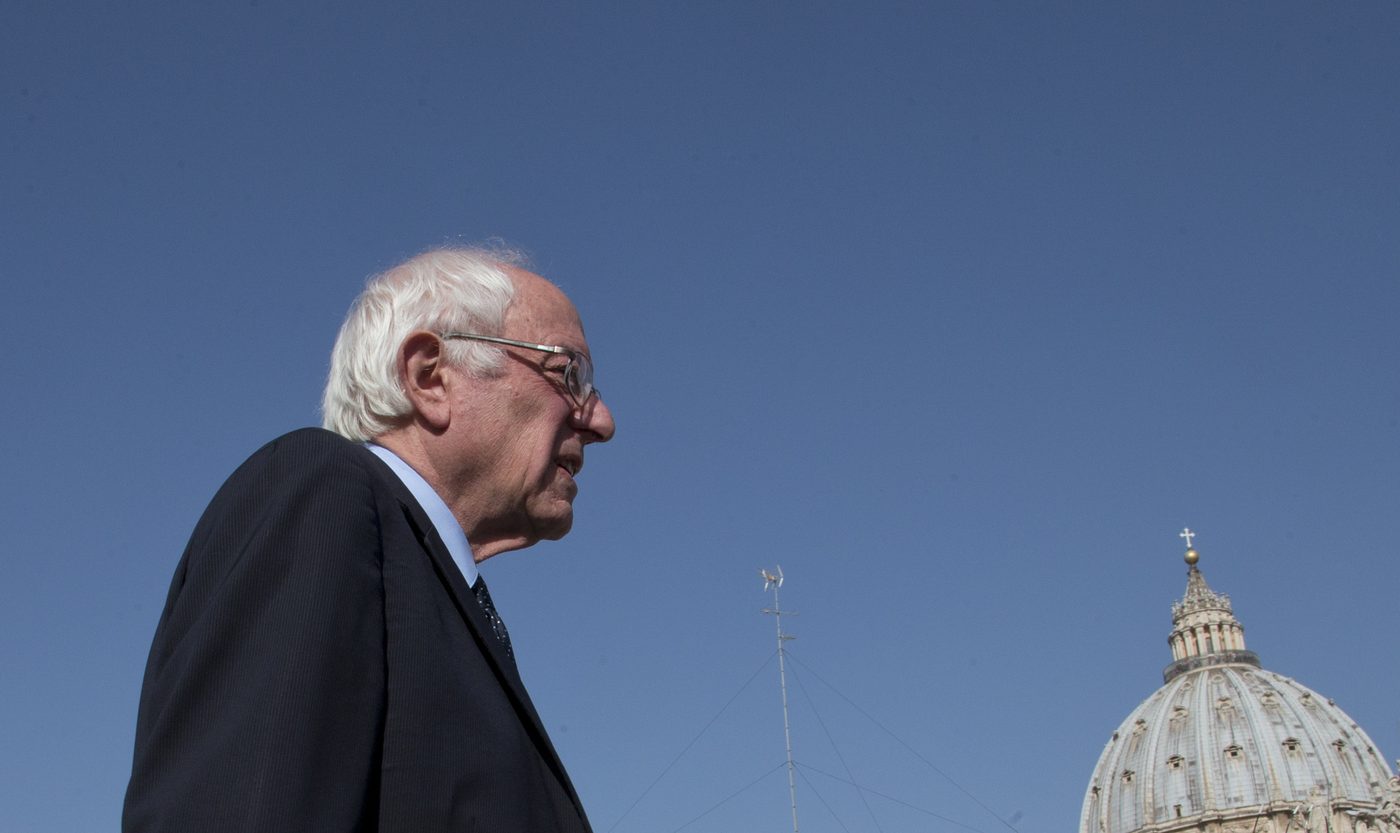
Pope Francis defended his meeting with US presidential hopeful Bernie Sanders last week, saying it was a “polite” gesture. The Pope met the Democrat senator last Saturday before flying to Lesbos. Mr Sanders was staying in the Domus Sanctae Marthae guesthouse, where Francis lives. The Pope told reporters on the flight home from Greece: “If someone thinks greeting someone is to get involved in politics, I recommend he see a psychiatrist.” A day earlier, Mr Sanders had spoken at a conference organised by the Pontifical Academy of Social Sciences to commemorate the 25th anniversary of Centesimus Annus, Pope St John Paul II’s teaching on the economy and social justice. His speech quoted heavily from Pope Francis, Pope St John Paul II and even Pope Leo XIII, who more than a century ago “highlighted economic issues and challenges in Rerum Novarum that continue to haunt us today, such as what he called ‘the enormous wealth of a few as opposed to the poverty of the many’.” The situation is worse today, Mr Sanders said. “In the year 2016, the top one per cent of the people on this planet own more wealth than the bottom 99 per cent, while the wealthiest 60 people – 60 people – own more than the bottom half – 31⁄2 billion people,” he said. He quoted Pope Francis: “We have created new idols. The worship of the golden calf of old has found a new and heartless image in the cult of money and the dictatorship of an economy which is faceless and lacking any truly humane goal.” He continued: “Pope Francis has called on the world to say: ‘No to a financial system that rules rather than serves’ in Evangelii Gaudium. And he called upon financial executives and political leaders to pursue financial reform that is informed by ethical considerations. He stated plainly and powerfully that the role of wealth and resources in a moral economy must be that of servant, not master.” Mr Sanders concluded: “Our challenge is mostly a moral one, to redirect our efforts and vision to the common good. Centesimus Annus ... and Laudato Si’ are powerful, eloquent and hopeful messages of this possibility. It is up to us to learn from them, and to move boldly towards the common good in our time.”
1:00 PM
Francis defends Sanders meeting
Staff writers

4 min read



Already a subscriber? Sign in
5freearticles every month
Continue reading with a free account. No card needed.
- Five free articles every thirty days, on any device you sign in on
- The Catholic Herald newsletter, every morning
- Subscribe whenever you like for everything: every article and the magazine
Related articles
 Newsroom
Church leaders urge Drumcree dialogue: ‘Too much is at stake’
The Catholic and Church of Ireland Archbishops of Armagh have urged a renewed commitment to peace and reconciliation amid the Drumcree stand-off
Corrie Douglas-Young Newsroom
Thousands of Irish children to join global Rosary campaign
Corrie Douglas-Young Newsroom
TikTok priest urges young people to stand with persecuted Christians
Nathalie Raffray Newsroom
Baby born at 25 weeks reunites with neonatologist two years after leaving hospital
The Catholic Herald Newsroom
Joe Biden honoured by Planned Parenthood after defending abortion rights
Christine Rousselle
subscribe to the catholic herald today
Our best content is exclusively available to our subscribers. Subscribe today and gain instant access to expert analysis, in-depth articles, and thought-provoking insights—anytime, anywhere. Don’t miss out on the conversations that matter most.
Subscribe



