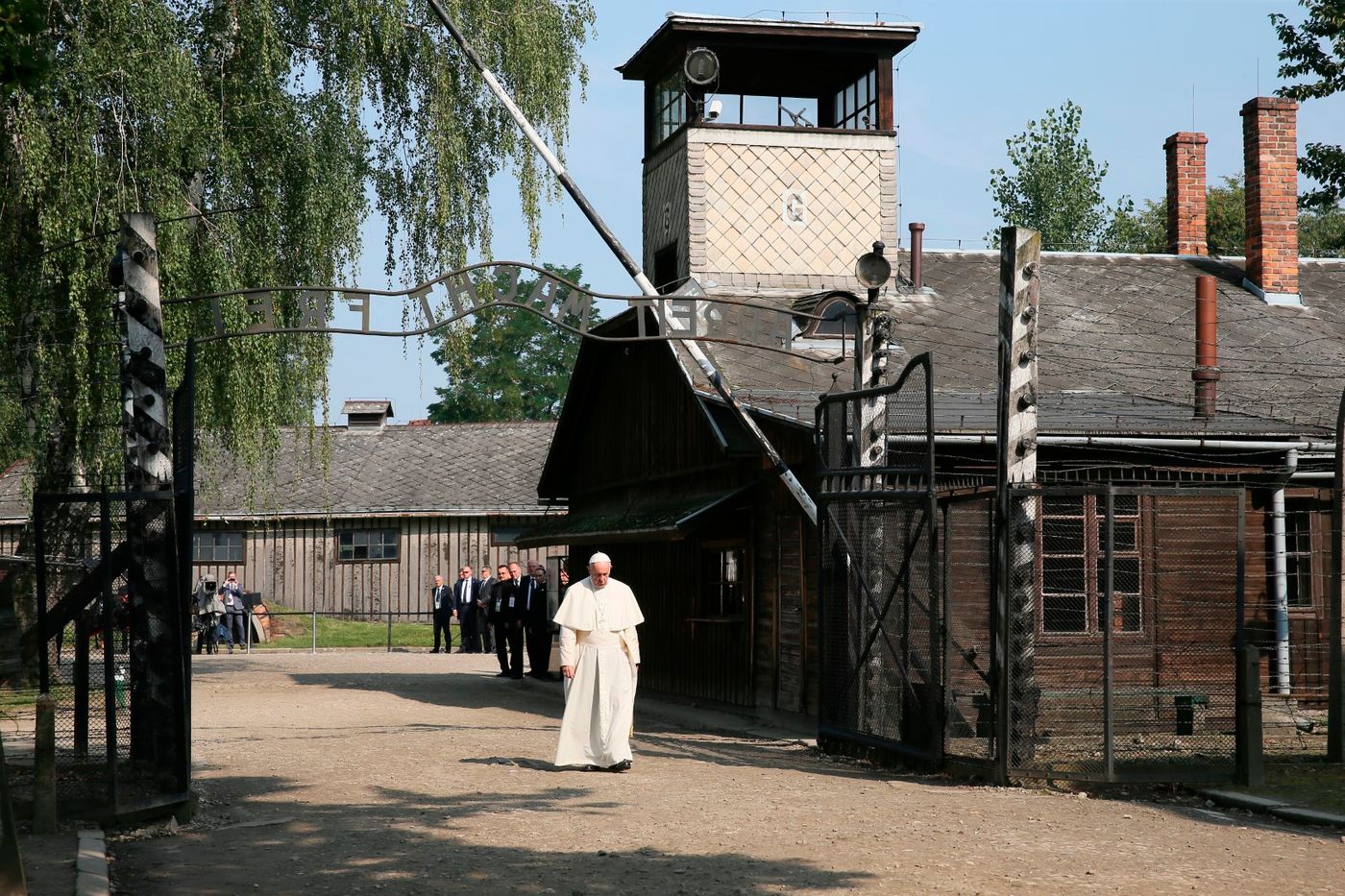

Sitting with head bowed and eyes closed, Pope Francis has paid silent tribute to the victims of one of the worst atrocities of the 20th century. The Pope arrived on Friday at the Auschwitz-Birkenau Nazi death camp, an area now blanketed by green fields and empty barracks lined by barbed wire fences.
The camp was the Nazis’ largest and consisted of three parts: Auschwitz I, where many were imprisoned and murdered; the Birkenau extermination camp, also known as Auschwitz II, and Auschwitz III (Auschwitz-Monowitz), an area of auxiliary camps that included several factories.
In 1942, Auschwitz became the site of the mass extermination of more than a million Jews, 23,000 Roma, 15,000 Soviet prisoners of war and thousands of Polish citizens.
Among those killed were St Maximilian Kolbe, a Polish Conventual Franciscan friar, and Edith Stein, a Jewish philosopher who converted to Catholicism and became a Carmelite nun with the name St Teresa Benedicta of the Cross.
Crossing the gate inscribed with the infamous motto Arbeit macht frei (“Work sets you free”) the Pope quietly sat on a small bench for 10 minutes with his head bowed, occasionally glancing sombrely around before closing his eyes in silent prayer.
He stood up, and slowly walked up to the wooden post of one of the barracks, reverently touching and kissing it.
The Pope then made his way to Block 11 to greet a dozen survivors of the camp, including a 101-year-old violinist who survived by being in the camp orchestra. Pope Francis greeted each survivor individually, gently grasping their hands and kissing their cheeks.
Francis then made his way toward the “death wall” where thousands of prisoners were lined up and shot in the back of the head before their bodies were sent to the crematoria.
Candle in hand, the Pope lit an oil lamp in front of the wall, before praying and laying his hand on the wall. He then turned around and entered the barracks of Block 11, which houses the cell where St Maximilian Kolbe spent his final hours, starved and dehydrated, before being given a lethal injection of carbolic acid.
Pope Francis entered the darkened cell, illuminated by a faint light from the corridor, revealing a candle, an engraved plaque marking the site of the Franciscan friar’s death, and countless words, even a cross, etched on the walls by those who spent their final moments in the starvation cell.
Once again Pope Francis sat in silence with his head bowed, remaining there for eight minutes. Outside the cell, he signed the visitors’ book, writing a simple message: “Lord, have mercy on your people. Lord, forgive so much cruelty.”
On the Friday evening, the Pope told a crowd gathered outside the archbishop’s residence in Kraków where he was staying that humankind’s cruelty did not end with the Holocaust, but rages on in the suffering of those living through war, homelessness and persecution.
He said: “This cruelty exists today. We say: ‘Yes, we have seen cruelty, 70 years ago; how they died shot, hanged or gassed.’ But today, in so many places in the world where there is war, the same thing happens.”
Young pilgrims urged 'to leave their mark on history'
Pope Francis has told young people they are not called to be couch potatoes, living boring lives, but should leave their mark on history and not let others determine their future.Like a football match, life “only takes players on the first string and has no room for bench-warmers,” the Pontiff told young people at the World Youth Day prayer vigil on Saturday evening.
“Today’s world demands that you be a protagonist of history, because life is always beautiful when we choose to live it fully, when we choose to leave a mark.”
Organisers said up to 1.6 million youths from around the world – many of whom walked more than four miles to the Field of Mercy – attended the prayer vigil with the Pope.
Arriving in his Popemobile, Francis waved at the throngs of young people who stretched out their hands.
Stopping at a wooden Door of Mercy inscribed with the words “Jesus, I trust in you” in five languages, he was greeted by several young men and women. Hand-in-hand with the Pope, they entered through the door. The Pope then surprised the young people by inviting them aboard the Popemobile. Visibly emotional and wide-eyed, they boarded the vehicle and joined Pope Francis, waving at the crowd.
After he took his place on the stage, young people from Poland, Syria and Paraguay gave their experiences of finding hope in the midst of disbelief, war and addiction.
Meanwhile, on Sunday Pope Francis thanked World Youth Day organisers and volunteers and urged them to be “the hope of the future.” He thanked more than 15,000 organisers and volunteers gathered at Tauron Arena for their “hours of prayer”.
Priests must ‘go out into world’
Catholic priests and nuns must renounce their personal interests and help to shape a Church that “goes into the world” with “living writers of the Gospel”, Pope Francis has said.The Pontiff was speaking on Saturday morning during a Mass with Polish religious, priests, seminarians and bishops at Kraków’s St John Paul II Shrine on the fourth day of his visit to Poland for World Youth Day.


.jpg)