




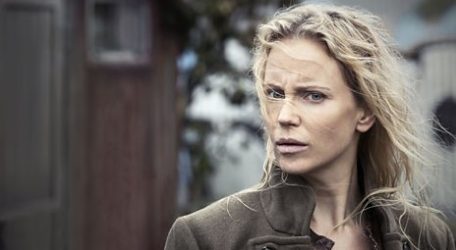
The BBC has recently come up with a new cop show called Cuffs for Wednesday nights, a very good thing for those of us who are addicted to police procedurals and are still in mourning for The Bill, and who, up to now, have only really had the delights of the Saturday evening 9pm slot on BBC4 with its Scandinavian fare to keep us going. Cuffs is good. It is fast-moving, it brings genuine pathos to many of the troubled scenes that contemporary police officers encounter, and the characters are interesting. Policemen and women today are not far removed from social workers or indeed clergy: they need human sympathy to survive in the job. Particularly fine is the actress Amanda Abbington, whom many viewers will remember from Sherlock. Her life is a mess, but she is slowly learning that compassion for the suffering is essential to any life. While Ms Abbington is a delight, the character played by Paul Ready is quite extraordinary. Misnamed Felix, this man is a walking misery, and yet a credible one too, a reminder to us all that so many of our fellow citizens in Britain are not in the least bit happy, but are weighed down by intolerable interior burdens. I am not sure quite what the matter is with Felix, but somehow he sums up what is existentially wrong with all of us: our failure to be happy despite living in one of the most advanced and comfortable societies that the world has ever known. Middlebrow viewing, like middlebrow reading, along with cheap music, has the ability to put its finger on the pulse of the culture. Cuffs is set in Brighton, a place with which I am familiar and of which I am fond, a place by no means typical of Middle England, yet one that provides lots of credible storylines for a scriptwriter. It would be pushing it to see Brighton as Britain in miniature, but one thing is for sure: Brighton is a prosperous town, a desirable place to live, and yet home to so many social problems. Why? Meanwhile, on Saturday nights, on BBC4, Saga is back. If you have been watching The Bridge, the Swedish-Danish production, for the last two series, you will know just how deeply thrilling this is. Saga is a brilliant detective but a difficult person, to put it mildly. She is, as a result, mesmerising, the best thing that’s ever been on television, with the possible exception of Carrie from Homeland. Of course, all three of these characters – Felix, Carrie, Saga – have a common factor to them: they are agents of truth and justice, but psychologically flawed. This is clearly a winning formula with the viewers – but why? The answer lies in the figure whom TS Eliot called “the wounded surgeon” in his poem Little Gidding. The wounded surgeon is of course Christ the Lord, and Eliot’s phrase recalls the words of the first letter of St Peter: “By his wounds you have been healed.” (I Peter 2:25.) I am not saying that Saga and the rest are Christ figures, but rather they represent a distant cultural echo not just of the wound from which we all suffer, that of sin, but also of the one who can heals us, the Son of God, who became wounded for our sakes.
10:19 AM
From Homeland to The Bridge, we're drawn to TV's wounded heroes
Why do crime fighters with psychological flaws continue to captivate television viewers?
Fr Alexander Lucie-Smith

3 min read



Already a subscriber? Sign in
5freearticles every month
Continue reading with a free account. No card needed.
- Five free articles every thirty days, on any device you sign in on
- The Catholic Herald newsletter, every morning
- Subscribe whenever you like for everything: every article and the magazine
Related articles
 Newsroom
Church leaders urge Drumcree dialogue: ‘Too much is at stake’
The Catholic and Church of Ireland Archbishops of Armagh have urged a renewed commitment to peace and reconciliation amid the Drumcree stand-off
Corrie Douglas-Young Newsroom
Thousands of Irish children to join global Rosary campaign
Corrie Douglas-Young Newsroom
TikTok priest urges young people to stand with persecuted Christians
Nathalie Raffray Newsroom
Baby born at 25 weeks reunites with neonatologist two years after leaving hospital
The Catholic Herald Newsroom
Joe Biden honoured by Planned Parenthood after defending abortion rights
Christine Rousselle
subscribe to the catholic herald today
Our best content is exclusively available to our subscribers. Subscribe today and gain instant access to expert analysis, in-depth articles, and thought-provoking insights—anytime, anywhere. Don’t miss out on the conversations that matter most.
Subscribe



