

February 12, 2026

Germany: A shade of green

Jon Anderson
More
Related
Min read
share

Merkel’s hand is weakened as her CSU ally loses power in its Catholic heartland

Angela Merkel’s faltering government has been dealt another blow by the defeat of her Bavarian ally, the Christian Social Union (CSU), in state elections. With its vote dropping from 48 per cent to 37 per cent, the CSU scored its worst result since 1950 and will now have to form a coalition government. Merkel’s other coalition partners, the Social Democrats (SPD), slumped from second place to fifth with under 10 per cent support.

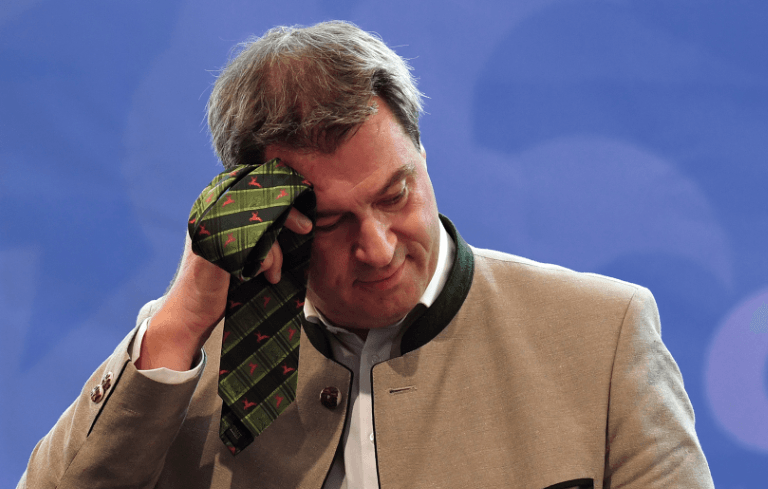
The CSU stands only in Bavaria, where it has formed the government since 1957, for much of the time as a virtual one-party state. It allies on the federal level with the Christian Democrats, but has a distinct identity based on Bavaria’s Catholic traditions – more conservative on cultural issues and law and order, more interventionist in the economy. State premier Markus Söder (pictured) has recently tried to stress that background by reintroducing the Kreuzpflicht – the compulsory display of the cross on public buildings – despite the opposition of Cardinal Reinhard Marx, the Archbishop of Munich and Freising.

The winners in Bavaria have been the Greens, who have displaced the Social Democrats and now dominate urban Munich; the nationalist and anti-immigration Alternative for Germany (AfD); and the Free Voters of Bavaria (FW), who are the CSU’s most likely coalition partners.

The FW emerged from local government, which in rural Bavaria has often been a contest between the CSU and independent councillors. It does not impose a whip on its parliamentarians, so it is difficult to pin down ideologically. It describes itself as pragmatic, and is called opportunist by critics. But most of its support comes from the broader CSU gene pool, and that is reflected in its positions. It is relatively conservative on crime and immigration, but advocates for the small business sector against the CSU’s alliance with big business – and, importantly, it has opposed the CSU’s plan for a third runway at Munich Airport.

The FW is not known for explicitly stating its Catholic identity. But it does place a strong stress on defending Bavaria’s local traditions, and its main base is in the rural districts where the Church remains strongest. If there are conflicts over cultural or moral issues, the CSU will find the FW much easier to deal with than the Greens, who are culture warriors for the other side.

The CSU’s defeat also weakens the hand of party leader and federal interior minister Horst Seehofer, Merkel’s most formidable ally and occasional critic. The coalition is likely to be undermined further by forthcoming elections in the central state of Hesse, where polls suggest the CDU and SPD will lose support heavily to the Greens, AfD and the post-communist Die Linke. Last year, the grand coalition of the CDU/CSU and SPD could barely put together a majority across Germany. Now that majority has eroded, but there is no obvious alternative.

Merkel’s hand is weakened as her CSU ally loses power in its Catholic heartland

Angela Merkel’s faltering government has been dealt another blow by the defeat of her Bavarian ally, the Christian Social Union (CSU), in state elections. With its vote dropping from 48 per cent to 37 per cent, the CSU scored its worst result since 1950 and will now have to form a coalition government. Merkel’s other coalition partners, the Social Democrats (SPD), slumped from second place to fifth with under 10 per cent support.
The CSU stands only in Bavaria, where it has formed the government since 1957, for much of the time as a virtual one-party state. It allies on the federal level with the Christian Democrats, but has a distinct identity based on Bavaria’s Catholic traditions – more conservative on cultural issues and law and order, more interventionist in the economy. State premier Markus Söder (pictured) has recently tried to stress that background by reintroducing the Kreuzpflicht – the compulsory display of the cross on public buildings – despite the opposition of Cardinal Reinhard Marx, the Archbishop of Munich and Freising.

The winners in Bavaria have been the Greens, who have displaced the Social Democrats and now dominate urban Munich; the nationalist and anti-immigration Alternative for Germany (AfD); and the Free Voters of Bavaria (FW), who are the CSU’s most likely coalition partners.

The FW emerged from local government, which in rural Bavaria has often been a contest between the CSU and independent councillors. It does not impose a whip on its parliamentarians, so it is difficult to pin down ideologically. It describes itself as pragmatic, and is called opportunist by critics. But most of its support comes from the broader CSU gene pool, and that is reflected in its positions. It is relatively conservative on crime and immigration, but advocates for the small business sector against the CSU’s alliance with big business – and, importantly, it has opposed the CSU’s plan for a third runway at Munich Airport.

The FW is not known for explicitly stating its Catholic identity. But it does place a strong stress on defending Bavaria’s local traditions, and its main base is in the rural districts where the Church remains strongest. If there are conflicts over cultural or moral issues, the CSU will find the FW much easier to deal with than the Greens, who are culture warriors for the other side.

The CSU’s defeat also weakens the hand of party leader and federal interior minister Horst Seehofer, Merkel’s most formidable ally and occasional critic. The coalition is likely to be undermined further by forthcoming elections in the central state of Hesse, where polls suggest the CDU and SPD will lose support heavily to the Greens, AfD and the post-communist Die Linke. Last year, the grand coalition of the CDU/CSU and SPD could barely put together a majority across Germany. Now that majority has eroded, but there is no obvious alternative.

subscribe to
the catholic herald

Continue reading your article with a subscription.
Read 5 articles with our free plan.
Subscribe

subscribe to the catholic herald today

Our best content is exclusively available to our subscribers. Subscribe today and gain instant access to expert analysis, in-depth articles, and thought-provoking insights—anytime, anywhere. Don’t miss out on the conversations that matter most.
Subscribe