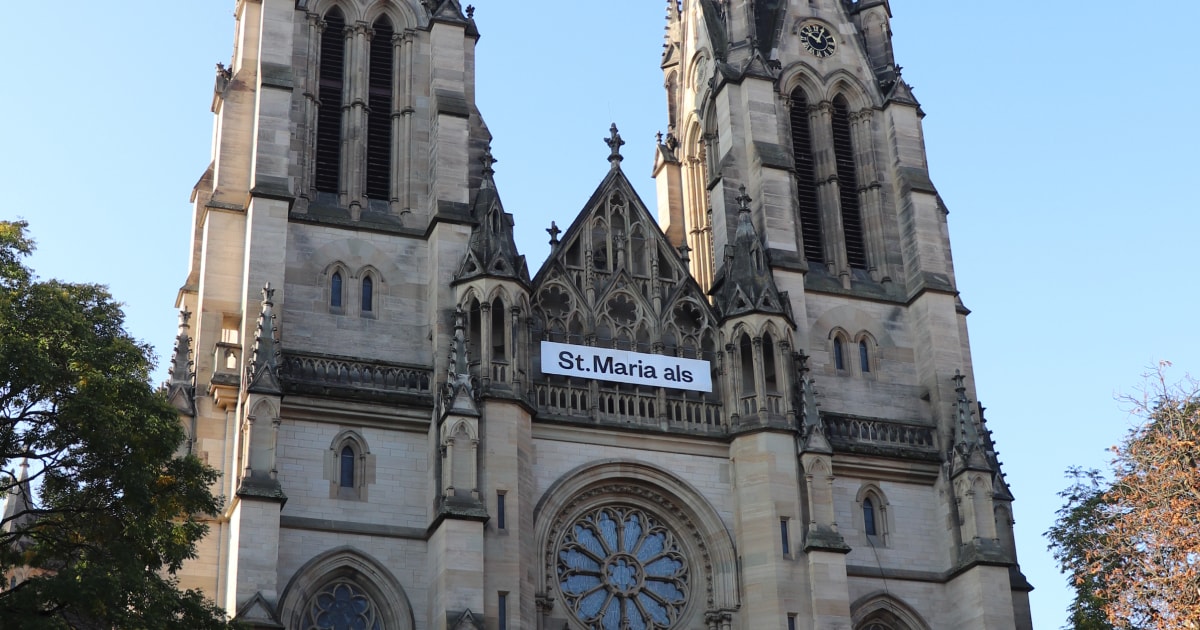
A Catholic diocese in Germany has issued a formal apology after a televised Christmas Eve Mass from Stuttgart provoked a storm of criticism over an unconventional Nativity scene broadcast nationwide on public television.
The Mass, aired on ARD from St Mary’s Church in Stuttgart, featured an artistic portrayal of the newborn Christ by an adult female performance artist curled in a foetal position and covered with sticky rice paper, intended to evoke the vernix of a newborn child. It was quickly dubbed “slime Jesus”. The broadcast was produced by the Catholic Broadcasting Service at SWR, which was responsible for the concept and presentation.
In a statement published on its website, the Diocese of Rottenburg-Stuttgart said that Bishop Dr Klaus Krämer and the diocesan leadership had reviewed the reaction to the Mass and accepted that it had caused offence. “The reactions to the broadcast have shown that religious sensibilities were offended,” the diocese said, adding that those responsible for the conception and broadcast “deeply regret this” and insisting that “at no point was any provocation or denigration of central tenets of the faith intended”.
The diocese acknowledged that the chosen presentation had led to “irritation, incomprehension and anger in many people”, particularly given the importance of Christmas as a major feast day. It also admitted that the liturgy had been adapted too freely for television, noting deviations from the established liturgical order, including the interpretation of certain roles and the language and performative elements used during the service. “These deviations were not correct and will be addressed,” the statement said.
As a consequence of the controversy, the diocese announced that voting and decision-making processes for future televised services would be tightened to reflect the Church’s responsibility and the sensitivity required when broadcasting worship on a national platform. The apology marked a clear attempt by diocesan authorities to draw a line under a broadcast that had become a national talking point well beyond church circles.
The Christmas Eve Mass was shown on ARD, Germany’s main public television channel, and quickly attracted hostile commentary from sections of the media and from political figures. SWR said it had received more than 1,400 comments about the broadcast, many of them critical.
The Stuttgart “slime Mass” unfolded amid growing tensions within German Catholicism, where disputes over liturgy, doctrine and culture have become increasingly visible within the episcopacy. A recent meeting with Pope Leo XIV and Bishop Rudolf Voderholzer brought those divisions into sharper focus.
After an audience with Pope Leo XIV, the Diocese of Regensburg said the Pope had encouraged Bishop Voderholzer to give particular support to Catholics who remain faithful to the Church’s traditional teaching. According to the diocesan statement, the Pope urged him “to especially support those faithful who remain faithful to the traditional teachings and who sustain the life of the Church through prayer and works of charity”, while also encouraging continued efforts towards evangelisation.
The Regensburg statement said Bishop Voderholzer had conveyed greetings from his diocese, presented work from the Pope Benedict XVI Institute and thanked the Holy Father for his appreciation of the theological legacy of Joseph Ratzinger. It added that their discussion touched on “current challenges in theology”, focusing particularly on questions of Christian anthropology. “Similar to Christology in the 4th century, anthropology is currently the place where the fate of faith and the Church is decided,” the diocese said.
These exchanges come as the German Church remains sharply divided over the Synodal Path, a reform process that has proposed changes on issues such as sexual morality, clerical life and the role of women. Several bishops, including Voderholzer, have distanced themselves from aspects of the process after repeated interventions from Rome warning against departures from Catholic teaching.
Ultimately, this divide raises questions of authority and identity within the Church: who decides how the faith is expressed, and according to what theological vision. The uproar over the “slime Mass” has exposed a Church unsure whether it understands itself primarily as a guardian of received truth or as a cultural institution negotiating its meaning by committee.
How Christ is presented in the liturgy shapes how the human person, the Incarnation and salvation itself are understood. When the Church’s central mysteries are filtered through contemporary sensibilities without clear theological discipline, the risk is not merely offence but damage to the faithful through confusion about what Christianity claims to be.
This leads back to Germany’s experiment with synodality, intended to preserve growth through dialogue and democratic process, but which has now, more clearly than ever, sharpened divisions and weakened confidence in the German Church’s own theology.
However, the response from the Diocese of Rottenburg-Stuttgart, promising tighter decision-making procedures, raises further difficulties. The instinct to respond by refining voting and approval mechanisms assumes that the problem is procedural. It is not. The difficulty is substantive: a willingness to entertain expressions of faith that sit uneasily with Catholic theology, and then to treat disagreement as something to be resolved by process rather than judgment.
The German Synodal Path has normalised this logic. By framing contested theological and moral questions as subjects for debate and ballots, it has encouraged the belief that doctrine is sustained by consensus rather than received as a gift. That approach has made it harder, not easier, to hold a coherent centre. The result is a Church increasingly polarised between those pressing for radical reinterpretation and those insisting on continuity, with little space left for genuine moderation.
Seen in this light, the Pope’s reported encouragement to support the faithful who remain loyal to traditional teaching, and to engage seriously with the theological foundations of Christian anthropology, reads less as a factional intervention than as a reminder of first principles. The Church does not renew herself by improvisation, but by returning to the sources of her faith.