

Gwen John converted to Catholicism around 1913 and it had a profound effect on her art. The new exhibition on the artist, which opens in Cardiff, is striking in that it places the religious aspect of her work where it belongs, at the centre of her art and her vision of the world. In one way that isn’t surprising, for among her best known works is the series of Dominican nuns from the convent of Meudon, culminating in the wonderful images of their founder, Mère Poussepin, taken from a prayer card. But it can’t always be taken for granted that contemporary curators will be unabashed by religion (I remember a collection of David Jones paintings presented without reference to their religious aspect), so it is rather wonderful that the curators of this excellent show, Lucy Wood and Fiona McLees, give Gwen John’s faith the significance she gave it.
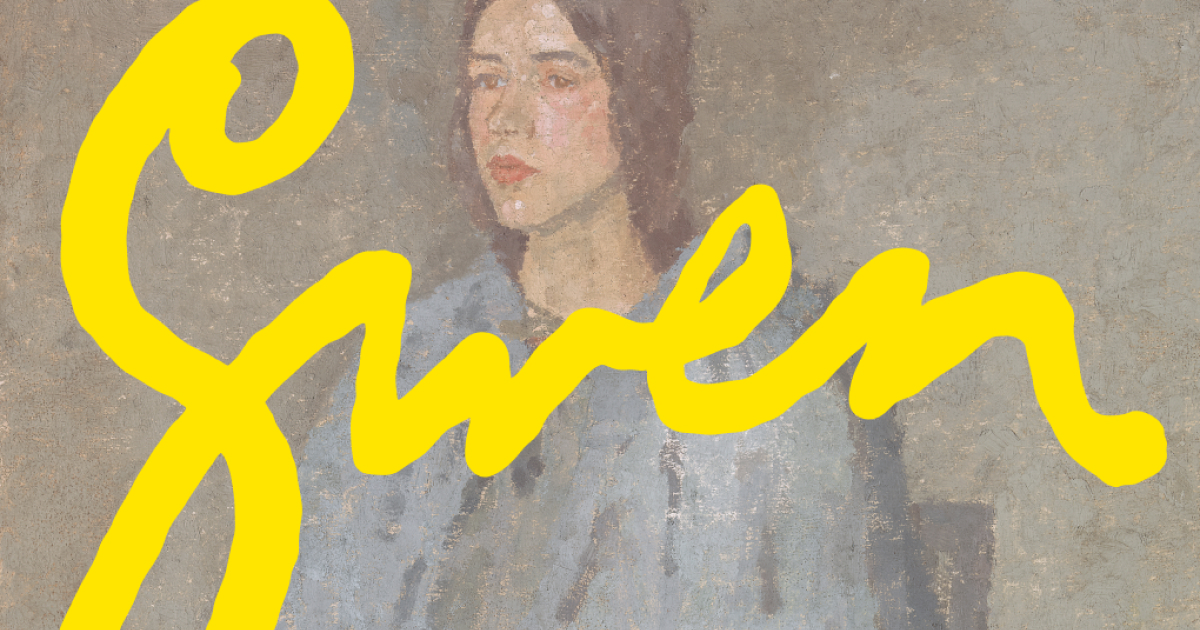
But there is another respect in which her faith could be downplayed; none of her work is overtly religious in terms of subject matter. It’s oblique in that respect and it’s expressed – infused, if you like – in her style. After her conversion, her style becomes steadily simpler, more pared back: the paint is often chalkier, the brushwork more austere. That’s very evident in her later portraiture, for instance, of a girl in a blue cloak, which is a harmony of blue and grey. Utterly simple, on first view. It seems to bear out the influence of Maurice Denis; he felt that “Christian truth defines not only the purpose of art but also the means that must be used”.
Gwen John was the sister of Augustus John, a more prolific artist and a flamboyant character, and her fame now overshadows his. They were Welsh, though Gwen seems to have got out of Wales at the first opportunity, and gravitated to the Slade, where her tutors included the wonderful and idiosyncratic Henry Tonks. In Paris she encountered Whistler; though a woman of her toughness of mind, who was quite certain of the value of her work, would never simply channel her masters.
But the figure who did dominate her world and influence her art was Auguste Rodin, for whom she modelled and with whom she had a passionate affair, though, Rodin being Rodin, she was never the exclusive object of his attention. There are works here from her time as a student, including a wonderful image of her friend Dorelia as “The Student”, looking thoughtfully at a stout, dog-eared Russian book. Her subjects were almost all women, and most seem to have a striking quality of introspection, though she was also terrific when she turned to children and cats (she owned one called Edgar Quinet, after her street). There are interesting drawings from her time with Rodin where she does seem to echo her master’s style, though she was never overtly erotic as he was. Rodin broke her heart, and the pain of his withdrawal from their affair (Gwen was nothing if not intense in her relationships) seems to have been one factor that drew her to the Church. Her diary suggests that she had a decisive experience in Notre-Dame. In the Paris suburb of Meudon, where she lived until her death, she attended Mass, and she took instruction in the faith from the Dominican sisters.
Even before her conversion, there is, arguably, a religious dimension to her work. There are two striking pictures, A Lady Reading, from 1910, and Girl Reading at a Window, 1911, which show exactly that: a woman intent on the book she is holding, with light coming through the window and the long curtain drawn or blown back. It is a quiet interior, the second image sunlit, and it signals one thing. As one biographer, Alicia Foster, suggests, it would appear to be a depiction of the Annunciation, with the Virgin reading, as she is invariably depicted as doing, except the angel is here invisible. Interestingly, the early image uses a face from a Madonna of Albrecht Dürer; the woman in the second picture is Gwen herself. If it is indeed, as it seems, the Annunciation, giving the Virgin her own face is a sign of supreme spiritual self-confidence.
Nearby are two sunlit interiors, pictures of her room in Montparnasse: a wicker chair, a table, an umbrella, an open window, all invested with a sublime quietude.
Gwen’s portraits of the Dominican nuns in Meudon – part of the series that culminates in the shrewd, amused portrait of Mère Poussepin – are splendidly characterful; less well known are the pictures of a nun on her deathbed, in which the viewer is struck both by the sister’s expression – it seems she sleeps – and by her magnificent sculptural head-dress; what a loss there was to fashion when the Second Vatican Council saw off the old Dominican habit.
As the exhibition makes clear, Gwen John had a devotion to the Little Flower, St Thérèse of Lisieux, and the striking image of her here is of a perky, funny, self-confident young woman, not a saint in any conventional sense. Indeed, Gwen makes a succession of drawings later based on a photograph of St Thérèse and her little sister; the girls are presented in different colourways, with different emphases. And it is here that we see most strikingly her later tendency towards abstraction. There is a strong triangular shape; is it fanciful to see the Trinity? She was, says the curator, obsessed with triangles in later work.
Indeed, perhaps the most striking, because little known, aspect of the show is the wonderful works on paper, from the museum’s own large archive, some semi-abstract, many sketches of her fellow parishioners at Meudon whom she drew from behind. When one curate remonstrated with her for drawing in church, she refused to stop, for without it “there would be too little joy in my life”. One room is given a title taken from Gwen’s own description of herself as God’s Little Artist. It is plain that for this woman artist, to pray and to paint were two parts of a whole.