


In an era when Church leaders urge the faithful, without qualification, to embrace the migrant as the salvific face of Christ Himself, it is tempting to dismiss any resistance as uncharitable, or worse. Yet true charity demands wisdom, and wisdom sometimes requires confronting uncomfortable truths.
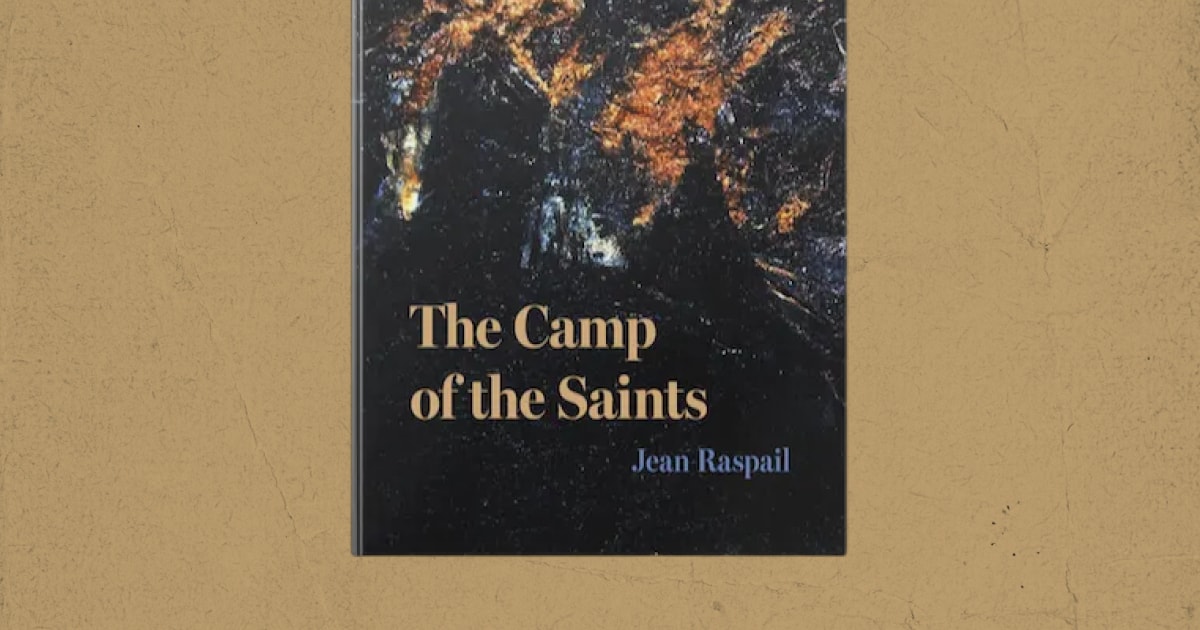
Jean Raspail’s 1973 novel The Camp of the Saints offers precisely that confrontation, at a time when we need to hear it. For believers grappling with the influx of millions into the European first world, often contributing little to the common good of host societies, Raspail’s work illuminates how a Christianity reduced to boundless empathy can lead to disaster and spiritual betrayal. It warns that mass migration, when met with unchecked sentiment, exposes fractures in a gospel misinterpreted as pure self-abnegation, turning the virtues of mercy and hospitality into instruments of self-destruction.

The Camp of the Saints is not a book one soon forgets. In its cynicism it occasionally verges close to blasphemy, and for that reason I initially hesitated even to recommend it. Its tone is conspicuously severe. I would not advise the faint-hearted, or those whose faith is not already strong, to read it. Yet for those willing to endure its chill, it performs a necessary and unrivalled service. It steels the consciences of Western Christians and Europeans who find themselves, in this existential moment, at genuine risk of cultural and demographic submersion. It fortifies resolve. Above all, it delivers a mental and emotional cleansing of extraordinary potency against the pervasive, autoimmune-deficient sentimentalisms of the 1960s “John Lennon Christianities” and the equally untenable secular humanitarianisms with which we have been relentlessly bombarded since childhood. For precisely this reason, despite its harshness, the book is excellent.
Raspail himself was a traditionalist, Latin Mass-attending Catholic, though his philosophical and political journey was complex. An explorer who traversed remote corners of the globe, from the rivers of North America to the icy slopes of Patagonia, he dedicated much of his life to defending the rights of indigenous peoples threatened by modernity. As the translators of his magnum opus note in the new edition published by Vauban Books, had his career ended there he would be remembered favourably by the left and by humanists. But he later committed the unforgivable error of extending the same concern for survival to the peoples of Europe.
Decorated by the French state and its presidents, and esteemed by intellectuals on both left and right, Raspail was no fringe crank. He recognised the nobility and humanity of all peoples, having lived among Native Americans, about whom he wrote with admiration. Above all, having witnessed the heartbreaking decline and near-extinction of the Kawésqar in Chile, he recognised the fragility of cultures, including his own. In The Camp of the Saints, he channels this insight into a narrative that is prophetic and prescient, pushing the West’s post-colonial guilt and humanitarian impulses to their breaking point.
The tale opens in the quiet opulence of a Riviera villa, where an ageing intellectual, Professor Calguès, stoically observes a fleet run aground on a beach in southern France through his telescope. What he sees is the arrival of a million desperate souls from India’s Ganges region, who months earlier had clambered aboard a ragtag flotilla of ageing vessels, symbolically the discarded remnants of the British Empire, and charted a course to Europe, lured by visions of paradise and plenty. Their voyage carries the raw momentum of human need, amplified by numbers that defy containment.
Along the way, attempts at benevolence are rebuffed. Relief packages are cast aside, and emissaries of aid are even killed by the passengers. Europe, stirred at first by genuine sorrow for their suffering, soon descends into a collective mania of infatuation and adulation. Broadcasters flood the airwaves with musical and political propaganda, while schools rally children to produce extravagant tributes to the newcomers.
As the ships approach, having been turned away by Australia and South Africa, who are relentlessly vilified for their defiance, the continent’s defences collapse from within. A French head of state, intellectually acute yet lacking the fortitude to issue orders that would contradict the humanitarian sentiments of the age, summons the army and dispatches them to meet the fleet on the beach. He recognises the threat, but at the final moment cannot bring himself to give the order to fight or deport these pitiable arrivals. He tells each soldier to act as he sees fit. Without leadership or courage, the ranks dissolve, paralysed by fear of public condemnation.
The beaches become scenes of surrender as a handful of holdouts clash with left-wing agitators. Barely fifty soldiers remain at their posts. Frightened locals abandon their homes and flee northward en masse. The migrants pour in and claim what remains. The ripple spreads as the third world, witnessing this capitulation, dispatches its own armadas, realising Europe will offer no resistance.
In the novel’s bleak conclusion, a small, motley group refuses to yield. Guided by Calguès, who at the outset dispatches an opportunistic rioter with a shotgun, they embody the final flicker of resolve. Among them is Monsieur Hamadura, an Indian who harbours no illusions about the societal, behavioural and cultural ills of his ancestral homeland, which he warns will follow in their wake. He names arbitrary caste hierarchies, fatalistic resignation, kin-bound morality prioritising clan over common good, and, as the novel controversially asserts, poor hygiene. Hamadura genuinely loves the French and European society he has made his home.
Their stand ends in obliteration, carpet-bombed by the remnants of French authority now operating under new occupation. The tragedy is complete. The migrants do not find the utopia they sought, and the native peoples lose their homelands forever. What follows is anarchy: rape, gangster tyranny, ruthless seizure of property, racial brutality, and the total collapse of ordered society.
Raspail’s hand is heavy at times. His depictions are unvarnished and profane, sparing few from scrutiny. Many object to his portrayal of the migrants, for which the book has been labelled racist by publications such as The New York Times. This charge is unfair. Raspail is a gruff, clear-eyed observer who spares no group, native or newcomer alike. His most savage descriptions are reserved for the native enablers of the catastrophe: heretical clergy, vain humanitarian journalists, politicians, and self-loathing fanatics. These figures are drawn with weary precision and lived observation.
Nor does Raspail place blame solely within. He identifies external enemies, figures he portrays as servants of the apocalyptic “Beast” of Revelation, including the media personality Clement Dio, who conceals his Algerian origins beneath a French façade while seething with contempt for tradition, Western man, and the patriotic Frenchman.
For Catholic readers, the novel’s power lies in its theological critique of a Christianity misunderstood as little more than sentimentality, and in its interpretation of events as the unfolding of end-times prophecy.
The title invokes Revelation 20: “When the thousand years are ended, Satan will be released from his prison and will come out to deceive the nations at the four corners of the earth, Gog and Magog, in order to gather them for battle; they are as numerous as the sands of the sea. They marched up over the breadth of the earth and surrounded the camp of the saints and the beloved city.”
In Raspail’s reading, the “camp” is Christendom’s European heartland, encircled and overwhelmed by forces that may not actively hate it, but whose sheer numbers, cultural dissonance, alienation and economic opportunism drown and replace it with astonishing speed.
Some enthusiasts even blaspheme by calling the migrants’ arrival a “Second Coming”. Almost everyone senses something apocalyptic in it. Leftists interpret it as reckoning for imperial sins, enacted through masochistic, godless piety.
Here Raspail exposes the danger of a faith poorly understood. Catholicism has always taught that virtues are interdependent. Mercy tempers justice, but justice anchors mercy, which becomes lawless without it. GK Chesterton captured this in Orthodoxy, writing that “the modern world is full of the old Christian virtues gone mad. The virtues have gone mad because they have been isolated from each other and are wandering alone.”
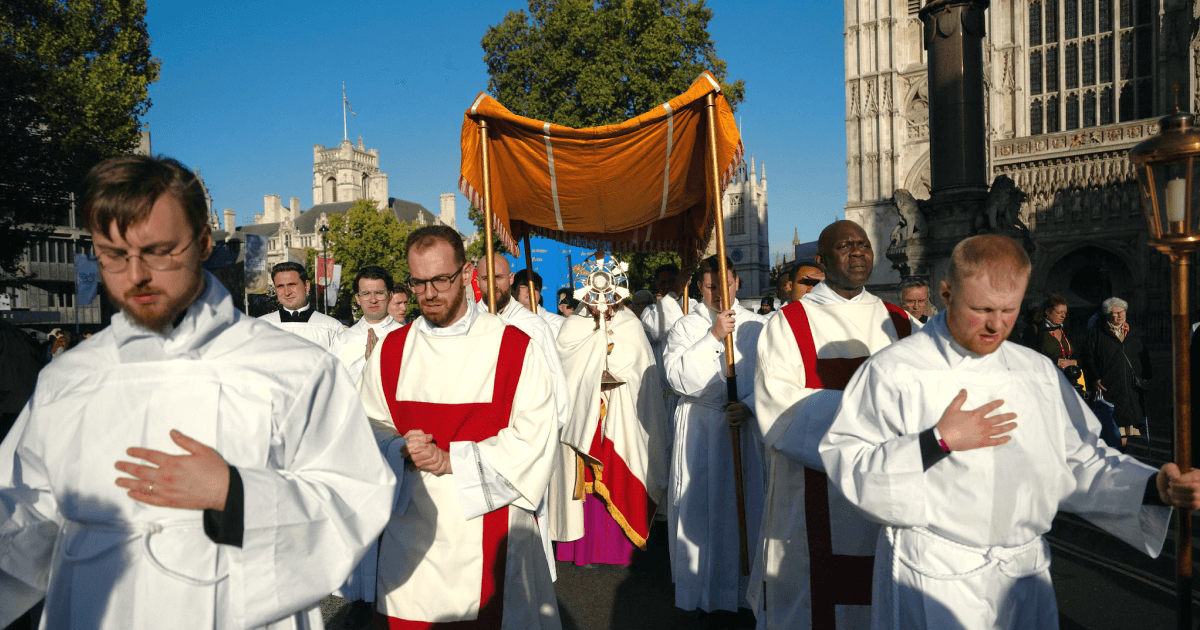
In Raspail’s hands, this madness manifests as a Church captive to post-conciliar excess, where clerics trade rigour and orthodoxy for feel-good altruism. Priests, mortified by their own patrimony, abandon the cassock and celibacy for secular activism. A fabricated pontiff from the global south auctions ecclesiastical riches to subsidise the tide, calling the migrants “poor unfortunates whom God has sent knocking at our doors”, only for the multitudes to smash the sacerdotal greeters to a pulp, including those bearing the Eucharist. The Pope, despite his virtue-signalling, is merely resented for having been rich in the first place, rather than welcomed as one of their own. He too meets a sorry end.
Such scenes sting because they are not a million miles from an all-too-real crisis: the cannibalism within the Catholic world after Vatican II and throughout the 1970s, during which Raspail appears to have temporarily lost his faith.
Raspail, perhaps writing from a place of personal disillusion, implies a God who has stepped back, allowing His people to reap the fruits of their laxity and incur His retributive wrath. The tale is almost entirely without hope. The resistors of Europe’s destruction, including Hamadura, respond only with nihilistic irony at the futility of their stand.
Yet, fortunately, Raspail was too cynical, and this is not the whole Catholic, nor indeed the whole European, story. Cardinals such as Gerhard Müller, Raymond Leo Burke, and Robert Sarah have openly decried mass migration. Even Popes Francis and Leo XIV, often characterised as liberal or moderate, have acknowledged the right of states to enforce border defences. Resistance is more widespread than Raspail feared, though time will tell whether it will prove sufficient.
Tradition has not been lost. The Church has emerged, battered and bruised, from its worst period in the 1970s doctrinally intact. Humanitarian sentiment still abounds, but the Church’s ancient teaching offers counterweights. Saints Ambrose and Augustine taught that just war is possible and that the borders of the Empire and the civilised world may be defended, even violently, against those who accused Christianity of pacifism or anarchism. Saint Thomas Aquinas affirmed that removing a communal threat, even lethally, can safeguard the greater good. Our Lord Himself fashioned a scourge to cleanse the Temple and praised the Roman centurion’s faith as greater than any other. Dante, in the Divine Comedy, begins overwhelmed with pity for the damned but matures into alignment with the divine will, unhesitatingly seizing the hair of the traitor Bocca in the Inferno.
Catholic teaching makes clear that pity is not the only virtue. At times, softness must be set aside and hearts must be steeled when survival or righteousness is at stake.
Mass migration, as Raspail illustrates, becomes the litmus test of this imbalance. The migrants are made in the image and likeness of God. They are human, capable of kindness and vice alike.
Raspail’s choice of Indians as the invaders, rather than the more obvious historical adversary from the Islamic Middle East or North Africa, is both interesting and significant. The migrants often carry a sentiment that their triumphal arrival is justified retribution for European colonialism. Yet they range from mildly hostile to largely indifferent, and at times even superficially friendly, towards the Europeans they encounter. A deluded old clergyman is rewarded with gratuitous sexual favours from elderly women aboard the ships. They harbour no absolutised racial or religious hatred for their hosts. They simply see them as alien, as obstacles whose destruction may be shrugged off as collateral. Raspail’s point is incisive: one need not hate someone to cause their death. One need not be demonic to drown another.
This is made explicit in the novel’s imagery. Many European deaths occur not through targeted violence but by being crushed to pulp beneath an unstoppable stampede. The victims are often fanatical and well-meaning left-wing agitators who simply stood in the way of a mass that could not be halted.
The novel attracts its fiercest criticism for these portrayals of the migrants. Yet Chesterton once again proves prescient. In The Everlasting Man, he rebukes Western hypocrisy that readily condemns European colonial barbarities, such as those of the Spanish, which is fair and reasonable, while absurdly portraying non-Europeans as morally immaculate beings. This becomes untenable when one recalls the documented cruelty, torture and human sacrifice endemic to Aztec, Inca and many other Amerindian cultures.
Westerners readily acknowledge a flawed humanity within themselves, including a capacity for domination, theft and cruelty. To deny that same capacity to non-Europeans, non-whites or non-Christians is presented as moral virtue, yet it strips them of their humanity. If we can be evil, so can they. Raspail’s provocation is that even the genuinely needy and destitute can behave unjustly, selfishly and destructively.
There is a curious inverse parallel with JRR Tolkien’s The Lord of the Rings, which I have come to appreciate more in later years. Tolkien likewise depicts threatened realms weakened by hesitant rulers confronting an existential invasion. Yet his protagonists retain moral fortitude, capable of mercy without hesitation to strike down orcs. Raspail’s Europe lacks this capacity for self-defence.
Raspail’s newcomers are not orcs, and their shared humanity must be upheld as a matter of Christian belief. Even so, they offer ample evidence that not all arrivals align with the common good, a reality that psychologically fragile Europeans ignore, believing that positive perception alone can avert harm. Tolkien’s Éowyn warns that “it needs but one foe to breed a war, and those without swords can still die upon them”. Laying down weapons does not halt the force advancing towards you. It guarantees you will be crushed by it. Both stories feature a small band resisting overwhelming odds. Tolkien grants a happy ending. Raspail does not.
Raspail’s lesson for Catholics is stark: recover the integrated virtues. Mercy must at times submit to justice. Charity, he writes, becomes a “handy weapon” when “employed in just one direction”. The downtrodden and mistreated may also be white and Christian. Suicidal empathy, he shows, must be abandoned before Christendom, and our homes, are forfeited.