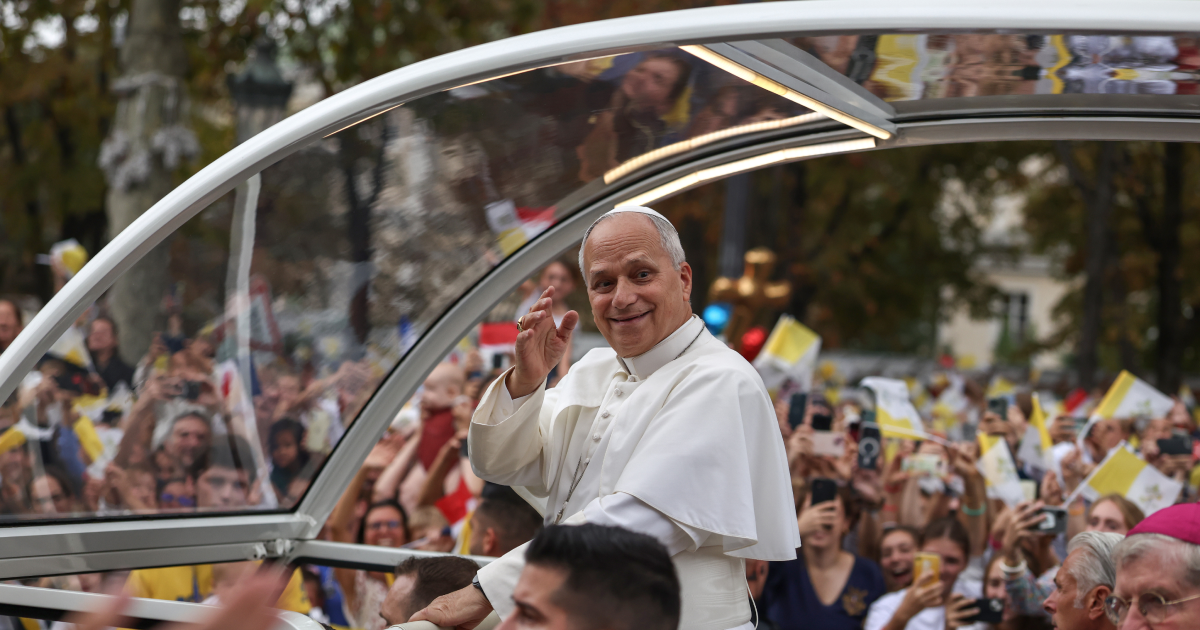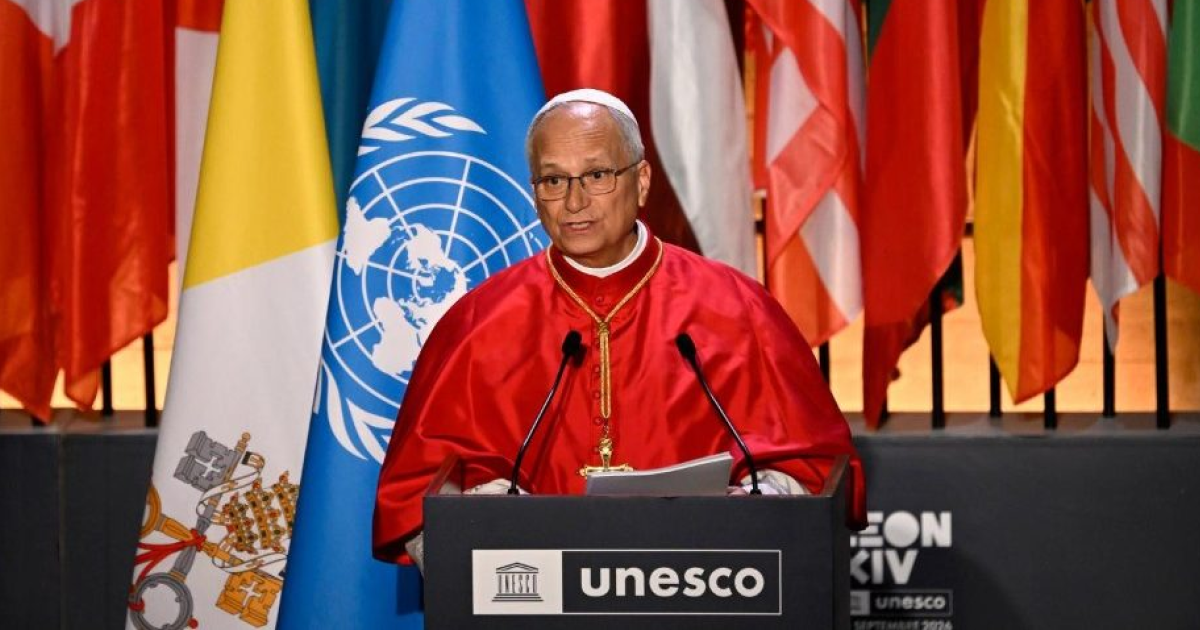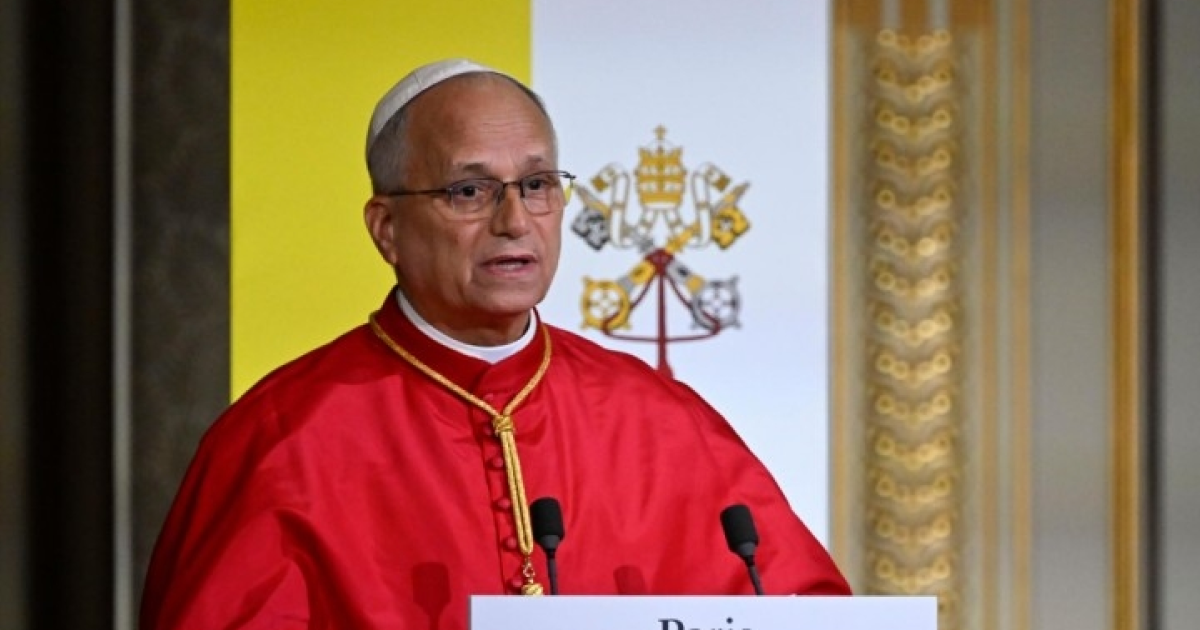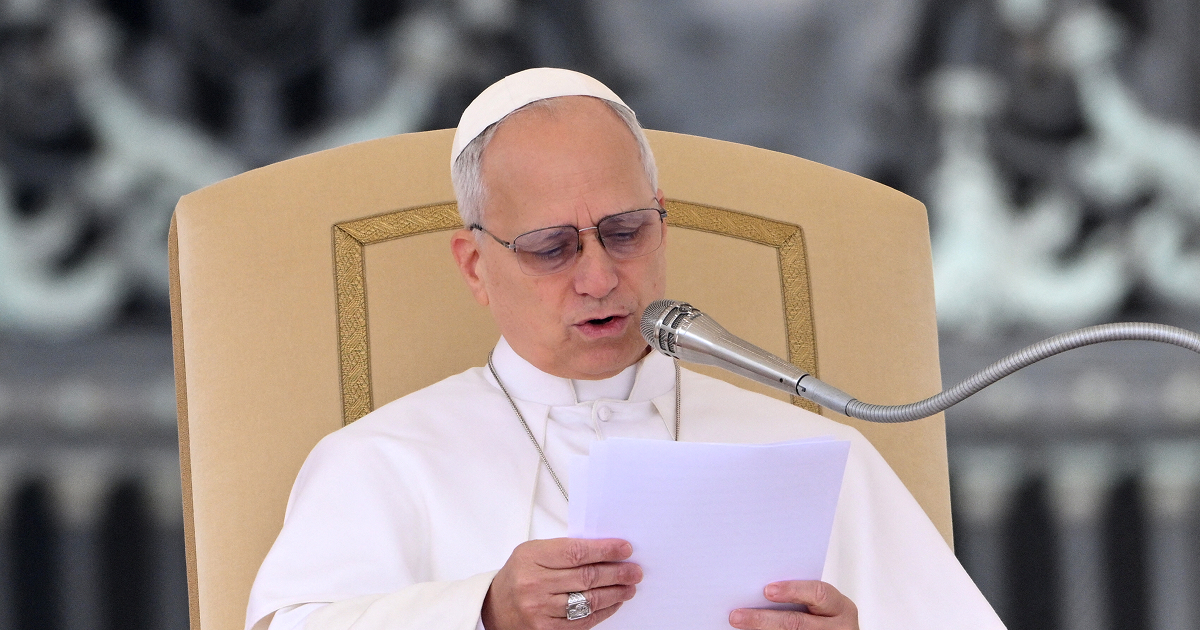


Stepping out onto the loggia for his Urbi et Orbi blessing on the evening of May 8 last year, the newly elected Pope Leo XIV extended his arms in that characteristic greeting to proclaim: ‘Peace be with you all’. Some 10 months later Leo finds himself repeating the same words once again.
Leo’s first words as Pope were not a simple platitude. They were those first uttered by the risen Christ, and so the fresh-faced Pontiff made them his own, asking for ‘this greeting of peace to resound in your hearts, in your families, among all people, wherever they may be, in every nation and throughout the world. Peace be with you!’
Both then and now, Leo has made peace his most consistent papal message, whether peace in the Church or in secular society. ‘A peace that is unarmed and disarming, humble and persevering,’ he said in May. ‘A peace that comes from God, the God who loves us all, unconditionally.’
Leo renewed his appeal on a number of occasions following the instigation of US–Israeli joint strikes on Iran beginning February 28. All eyes in Rome turned to the window of the papal apartments the next day to hear what Leo’s Sunday Angelus response would be.
The American Pope – who has told his nation’s ambassador to the Holy See he intends to avoid national politics – spoke forcefully and deliberately, in a tone he has used sparingly: ‘Stability and peace are not achieved through mutual threats, nor through the use of weapons, which sow destruction, suffering and death, but only through reasonable, sincere and responsible dialogue,’ he said.
Mentioning his ‘deep concern’ at the situation, Leo called upon ‘all the parties involved to assume the moral responsibility of halting the spiral of violence before it becomes an unbridgeable chasm’, and for diplomacy to resume its ‘proper role’.
Time and again, year after year, one Pope after another has made a similar appeal from the same window. Papal secretaries are well briefed on what to write, with Leo’s Angelus addresses often highlighting the plight of warring nations about whom many in the West have lost concern. On Sunday, however, though his words were only as strong as the limits of Vatican diplomacy allowed in such a setting, they swiftly made international waves.
Leo had the opportunity to repeat his appeal upon leaving Castel Gandolfo on Tuesday evening. Fielding a question from journalists for the first time since late December, he replied simply: ‘Let’s pray for less hatred and more peace. And work for authentic dialogue.’
As if the message had not been made enough in one week, the Pope’s prayer intention for March – arranged many months in advance – was issued on Thursday, calling for ‘disarmament and peace’.
‘Lord enlighten the leaders of the nations so they may have the courage to abandon projects of death, halt the arms race and place the lives of the most vulnerable at the centre,’ he said.
Such messages have become so expected that they can easily be taken for granted and overlooked. Any international hostility between nations, national disaster or terrorist attack is bound to receive a proportionately measured response in the Angelus address. It is left to the quieter arm of the Holy See’s diplomatic service to ensure the Pope’s message does not remain a merely rhetorical appeal.
One revealing moment came when Leo was asked to comment on the life sentence handed down to Catholic journalist and democracy activist Jimmy Lai. Beginning to answer, and shaking his head in what resembled sorrowful agreement, Leo checked himself and replied simply: ‘I can’t comment on that.’
The Holy See’s silence in the face of Lai’s plight in recent years has been widely criticised. Leo’s response appeared more sincere than the hush emanating from Pope Francis’s Vatican, prompting some to suggest that Leo feared still greater repercussions for Lai were he to speak out. This has not satisfied all observers, however, with China expert Steven Mosher describing the moment as ‘very disappointing’, since ‘your silence is deafening’.
Another notable moment of silence was Leo’s decision to leave the controversial 2016 statutes of the Pontifical Academy for Life virtually unaltered when he promulgated a new version recently. The only change was the creation of a category of ‘supporters’. Otherwise the academy continues much as it has since Pope Francis overhauled it in 2016, removing the entire body of members and the pro-life oath, leading to the appointment of members who reject the teaching the academy was originally established to defend.
Meanwhile the increasingly online General Secretariat of the Synod of Bishops – the team behind the Synod on Synodality – has begun to publish the results of the various study groups established by Pope Francis during the synod process. The Catholic Herald’s coverage can be found here, but like much of the synod, the majority of the study groups’ activity appears chiefly to interest the clerics who comprise them. Even during the synod most journalists focused on only a few contentious issues, and few Vaticanists or bishops have paid close attention to the study groups themselves.
In recent days the new bishop of the Irish diocese of Raphoe warned in a homily that ‘synodality, if not anchored in scripture and doctrine, risks endless discussion without direction’. Vocal factions within the synod attempted to argue that such rhetoric was confined to figures such as Cardinal Gerhard Müller, but many prelates in the Anglosphere appear weary, confused and keen to return to practical pastoral duties rather than navigating the synod teams’ ever-growing paperwork.
The only people eagerly awaiting Leo’s thoughts on the study groups’ reports may be the polyester-wearing prelates in the synod office, hoping that the 1970s will never end.