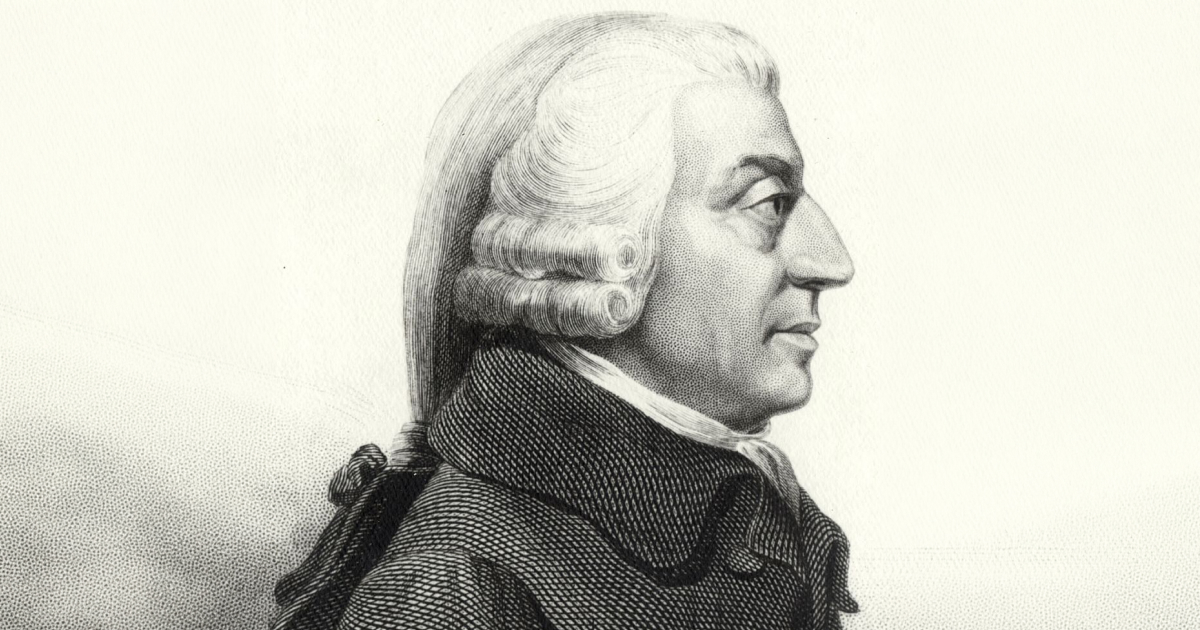


Few years have reshaped the modern world as decisively as the twelve months of 1776. James Watt’s improved steam engine went into commercial operation for the first time, lighting the fuse of the Industrial Revolution. The American colonies were accelerating toward a Declaration of Independence grounded in the natural rights of man. And on March 9, 1776, a Scottish professor published a book that changed the world: An Inquiry into the Nature and Causes of the Wealth of Nations appeared in two volumes from a London bookseller, and nothing was quite the same afterwards.
Of the three, Smith’s contribution is the most easily misunderstood and the most in need of rescue for a Catholic audience. There is a persistent anxiety among some Catholics that the free economy is somehow incompatible with their faith, that the Church’s social teaching demands a more interventionist, more collectivist approach. It does not. But to see why, one must first understand what Smith actually argued.
Before The Wealth of Nations, there was no real economics. There were pamphleteers and mercantilists, royal advisers and moral philosophers, but nobody had attempted to describe systematically how wealth is actually created and exchanged. Smith was the first to synthesise scattered observations about trade, prices and labour into a coherent discipline, and in doing so he changed how we understand civilisation itself. He was no Catholic: his religious views are still debated by scholars. But his insights belong to a tradition deeper than the Scottish Enlightenment alone.
Consider some of Smith’s greatest insights, beginning with the power of the division of labour. Smith offered the deliberately mundane example of a pin factory: one worker, labouring alone, might produce a single pin in a day. Ten workers, each concentrating on one stage of the process, could produce 48,000. We grow richer by becoming more specialised as producers and more diversified as consumers. This was not abstract theory. It would have been familiar to St Thomas Aquinas, who argued five centuries earlier that society exists precisely because no individual can meet all his own needs. The division of labour, for Aquinas, was part of God’s design for human flourishing. Smith gave that intuition its scientific expression.
Then there is the insight that has been most relentlessly caricatured. Smith famously wrote: ‘It is not from the benevolence of the butcher, the brewer or the baker that we expect our dinner, but from their regard to their own interest.’ This was not a call for selfishness or sin. It was a precise observation about how human beings actually behave. The butcher feeds you not because he loves you – love you though he may – but because, by serving you well, he earns his living. Any Catholic should recognise this motivation: the ordinary desire to provide for oneself and one’s family through honest work. There is a world of moral difference between selfishness and self-interest. The selfish person hoards and defrauds. The self-interested person trades, and in trading, serves those around him.
Each individual, Smith wrote, is ‘led by an invisible hand to promote an end which was no part of his intention’. By pursuing their legitimate interests within a framework of law and rights, millions of people generate an order more prosperous than the grandest designs of central planners. Prices set by free exchange carry more information than any bureaucrat could ever gather. When demand rises, prices rise too, drawing in new producers without anyone issuing an order. When supply is plentiful, prices fall, and resources shift to where they are needed more. No Politburo, no planning committee, no five-year programme has ever come close.
Smith also demolished the case for protectionism that remains seductive to this day. The mercantilists of his era believed nations grew rich by hoarding gold. Smith pointed out that bullion has no value except as a means to acquire what you actually want. The purpose of production is consumption. A country that refuses to buy from others is choosing to make its own people poorer and calling it patriotism.
Long before Smith, Catholic thinkers were grappling with these same truths. The late Scholastics of the School of Salamanca, Dominican and Jesuit theologians of the 16th century, developed theories of just pricing and exchange that foreshadowed much of what Smith would later argue. Smith built on their foundations, going beyond their insights to give the first systematic account of economics as a discipline. The Catholic tradition did not merely tolerate the ideas behind free economics; it helped give birth to them.
The free economy is more deeply rooted in the Catholic tradition than many suppose. Catholic social teaching, properly understood, is not a recipe for socialism. The principle of subsidiarity, articulated from Leo XIII’s Rerum Novarum in 1891 through to John Paul II’s Centesimus Annus, holds that matters should be handled by the smallest, most local authority competent to address them. Higher authorities should intervene only when lower ones genuinely cannot cope. This cornerstone of Catholic social teaching is, in its economic implications, remarkably close to what Smith advocated.
Pope St John Paul II, writing Centesimus Annus in the aftermath of communism’s collapse, recognised what the catastrophe of Marxism had demonstrated beyond doubt: that the suppression of economic freedom leads not to justice but to misery, and to the tyranny of the state over the individual. Economic liberty is not merely one freedom among many. It is foundational. Where men and women can own property, start businesses and trade freely, they build independent institutions – like churches, schools, charities and families – that hold the state in check. Where the state controls the economy, it invariably reaches for the soul. It is no coincidence that religious freedom and the flourishing of Catholic life have been most secure in societies that also embrace a free economy.
Catholics should not be embarrassed by Adam Smith: they should claim him. Not as one of our own, but as a man who, in describing how the world actually works, confirmed what the best Catholic thinkers had long understood. The desire to provide for one’s family is not a sin but a vocation. Free exchange among free people is an expression of human sociability, not its negation. Prosperity is not a zero-sum game but a shared endeavour, in which my neighbour’s flourishing contributes to my own. That is a legacy worth defending, and on this 250th anniversary of the invention of economics, worth giving thanks for.
James Lawson is the chairman of the Adam Smith Institute