


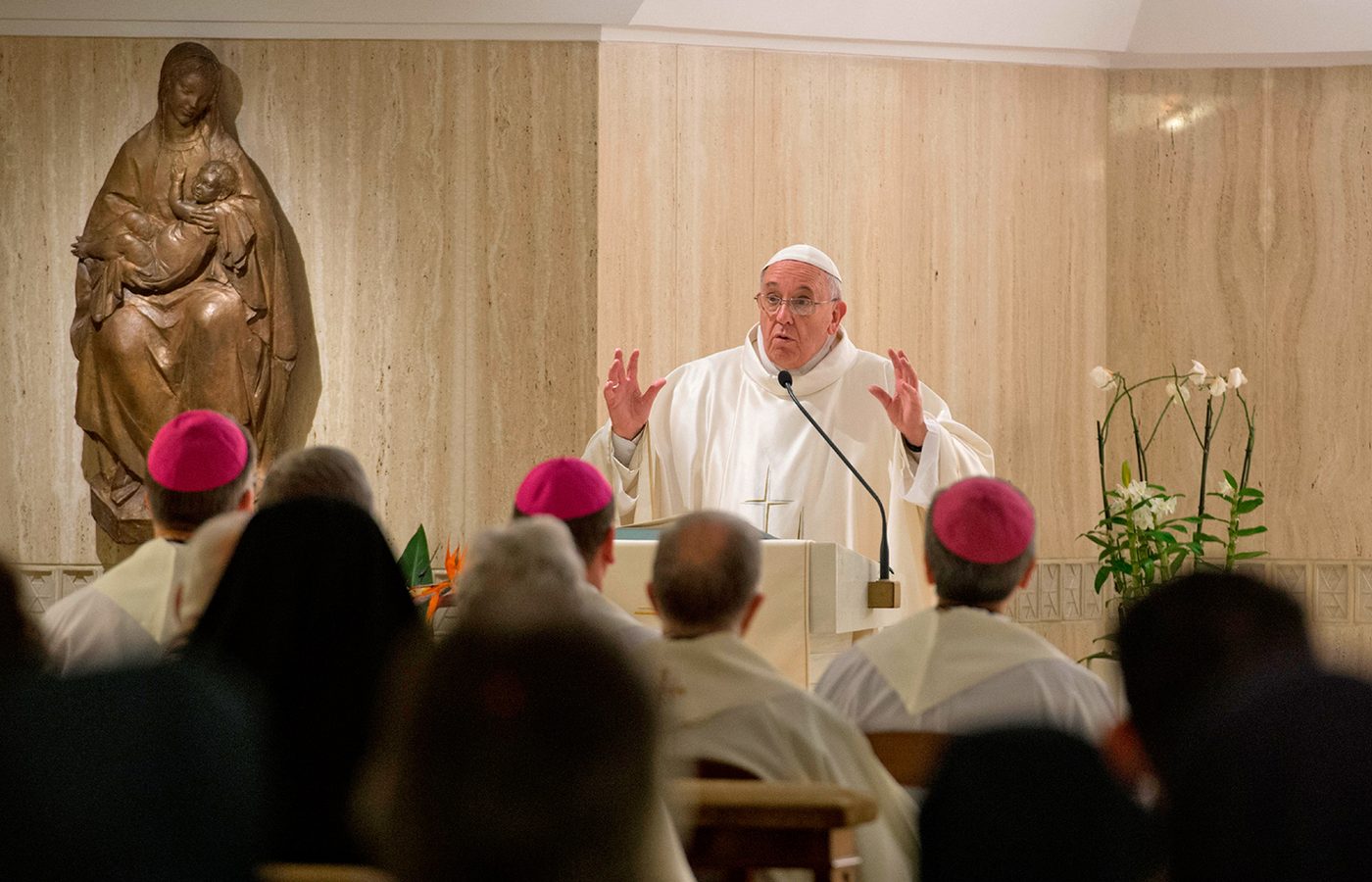
Roma locuta est, causa aperta est? Disputa est? Confusa est? The eruption over Pope Francis’s comments about marriage – that the “great majority” of sacramental marriages are null and that some cohabiting couples “have the grace of marriage” – was just the most recent example of the Bishop of Rome speaking not to resolve a matter, but to stir it up. I sympathise with the Holy See press office after the recent question-and-answer session. How to explain that? Better just to make it disappear in the “official” text. What Pope Francis plainly said in front of thousands of witnesses simply disappeared and was replaced for official purposes with something he did not say. During my time as a member of the Holy See press corps some 15 years ago, L’Osservatore Romano would sometimes be jokingly referred to as Pravda, likening it to the Kremlin’s propaganda sheet. There would have been more than a touch of truth – pravda – in applying that name to what the press office did last week. Again, I sympathise. When the Holy Father says that most sacramental marriages are null, it undermines both the Church’s canonical position that marriages enjoy the presumption of validity, as well as her sacramental theology that people are ordinarily capable of entering natural marriage which, between two baptised Christians, is also a sacrament. So the press office, eager to clarify that what the Holy Father said was not contrary to what the Church holds, simply made the former disappear. Pope Francis apparently found this solution attractive, and approved it. As embarrassing as it must be for the Holy Father’s spokesman to ask reporters to ignore the Pope’s actual words in favour of the Pope’s yet-to-be-determined meaning, to be furnished ex post locuta, it is necessary to do so if the premise is that what the Pope says is what the Pope teaches. I propose an easier solution, which would remove the burden from the press office of explaining, correcting, modifying or making disappear what the Pope has said. Let’s distinguish between the Holy Father’s thinking and his teaching. The former belongs to the man, to be received with respect and evaluated according to its merits; the latter is the teaching of the office, which is received as an act of the magisterium of the Church. For example, in his recent comments the Holy Father shared his thinking that most marriages are null. Yet in his annual address to the Roman Rota just earlier this year, on the same subject, Pope Francis said something quite different, and in the opposite direction, namely that various defects in understanding do not invalidate a presumed marriage. It is admittedly curious that what the Holy Father thinks is not the same as what he teaches, but better to stipulate that rather than the alternative, which would be that the papal magisterium is offering contradictory teaching. As far as the comments that some cohabiting couples are in a “real marriage” and “have the grace of a real marriage” the distinction between thinking and teaching is more essential. The Holy Father, no doubt expressing himself casually, appears to think that some unmarried people are really married, and have the grace of a sacrament they did not receive. He could never teach such a thing, because it is logically impossible. If the press office would simply remind reporters that the Holy Father’s thinking – offered in impromptu remarks, interviews both terrestrial and airborne, phone conversations, his daily homilies – is not his magisterial teaching, then there would be no need to pretend the Holy Father did not really say what he actually said. For example, last week at his daily Mass in the Domus Sanctae Marthae, the Holy Father said that those who are too rigid are not Catholics but “heretics”. Heresy has a specific definition in the catechism, and rigidity is not it. Pope Francis may think me or thee a heretic, which would certainly be chastening, but he is not teaching it. In adopting the distinction between teaching and thinking, the Holy Father would be following his predecessors. In the foreword to the first volume of Jesus of Nazareth, Benedict XVI wrote that “it goes without saying that this book is in no way an exercise of the magisterium” and therefore that “everyone is free, then, to contradict me”. Even more remarkable, St John Paul II made a similar distinction in a papal encyclical itself. At the beginning of Centesimus Annus, written in the immediate aftermath of the defeat of communism, he wrote that “it goes without saying that part of the responsibility of pastors is to give careful consideration to current events in order to discern the new requirements of evangelisation. However, such an analysis is not meant to pass definitive judgments since this does not fall per se within the Magisterium’s specific domain.” Even though it went without saying, John Paul and Benedict were humble enough, and careful enough, to say it explicitly. The press office needs to say it again. Fr Raymond J de Souza is a priest of the Archdiocese of Kingston, Ontario, and editor-in-chief of Convivium magazine
1:00 PM
He might think it, but he isn’t teaching it
Fr Raymond de Souza

5 min read



Already a subscriber? Sign in
5freearticles every month
Continue reading with a free account. No card needed.
- Five free articles every thirty days, on any device you sign in on
- The Catholic Herald newsletter, every morning
- Subscribe whenever you like for everything: every article and the magazine
Related articles
 Newsroom
Church leaders urge Drumcree dialogue: ‘Too much is at stake’
The Catholic and Church of Ireland Archbishops of Armagh have urged a renewed commitment to peace and reconciliation amid the Drumcree stand-off
Corrie Douglas-Young Newsroom
Thousands of Irish children to join global Rosary campaign
Corrie Douglas-Young Newsroom
TikTok priest urges young people to stand with persecuted Christians
Nathalie Raffray Newsroom
Baby born at 25 weeks reunites with neonatologist two years after leaving hospital
The Catholic Herald Newsroom
Joe Biden honoured by Planned Parenthood after defending abortion rights
Christine Rousselle
subscribe to the catholic herald today
Our best content is exclusively available to our subscribers. Subscribe today and gain instant access to expert analysis, in-depth articles, and thought-provoking insights—anytime, anywhere. Don’t miss out on the conversations that matter most.
Subscribe



