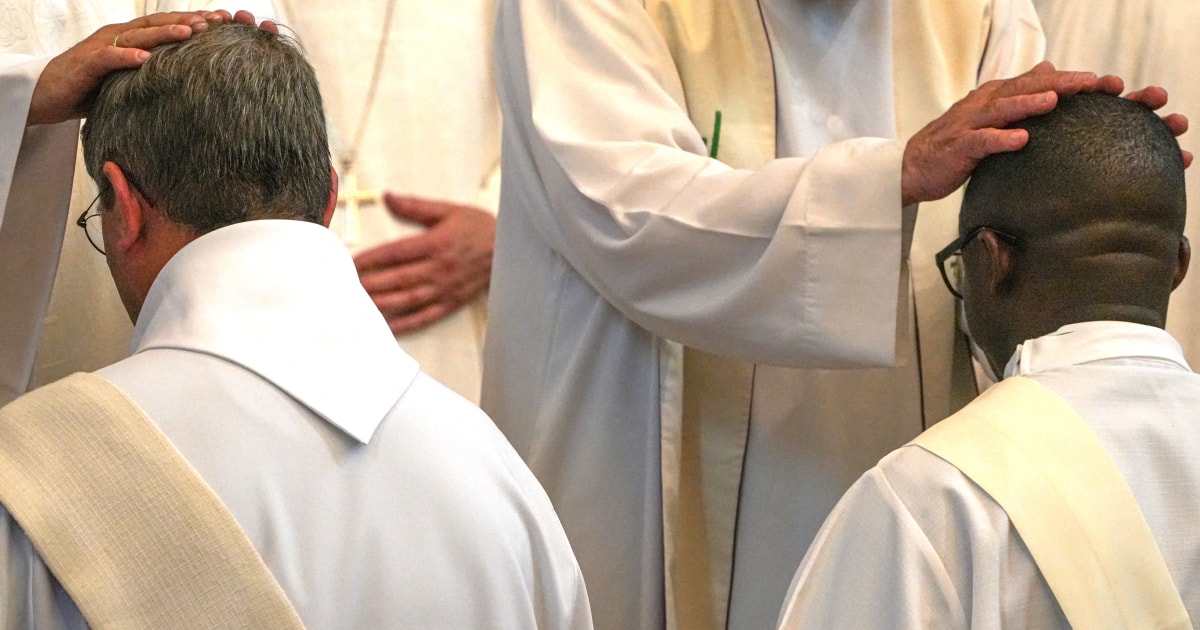


The Heralds of the Gospel have ordained 26 new priests on Divine Mercy Sunday, their first ordinations in several years after a prolonged suspension that had left dozens of vocations in limbo.
The priestly ordinations took place on April 12 during the Octave of Easter and were presided over by Cardinal Raymundo Damasceno Assis, emeritus Archbishop of Aparecida and the pontifical commissioner overseeing the institute. The ceremony followed the ordination of 31 deacons the previous day, April 11, conferred by Archbishop Fernando José Monteiro Guimarães, emeritus of the Military Ordinariate of Brazil.

The Heralds had confirmed the dates in advance, stating that “31 new deacons will be ordained on April 11, while 26 deacons will receive the priesthood on April 12, Divine Mercy Sunday”. The ceremonies were broadcast live online, offering a rare public view of an institution that has spent recent years under Vatican oversight.
For the Clerical Society of Apostolic Life of Pontifical Right Virgo Flos Carmeli, the ordinations bring to an end a standstill that had been in place since 2019. During that period, ordinations were halted following a Vatican intervention which began in 2017 and was later reinforced by the appointment of a pontifical commissioner.
The interruption directly affected candidates who had completed their formation but were unable to proceed to ordination. No detailed public explanation was given at the time for the suspension, and the situation persisted for several years without a clear timeline for resolution.
The Heralds themselves framed the resumption in ecclesial and spiritual terms. In announcing the ceremonies, they pointed to the Easter season, stating: “During the Easter Octave, the Holy Mother Church rejoices as the proclamation of the Lord’s Resurrection resounds throughout the week.” They added that “this joy will be heightened by the Diaconal Ordination of 31 acolytes and the Presbyteral Ordination of 26 deacons”.
The choice of Divine Mercy Sunday for the priestly ordinations places the event within one of the most significant moments of the liturgical calendar, concluding the Octave of Easter. The date carries particular devotional importance following its institution by St John Paul II and is closely associated with themes of renewal and reconciliation within the Church.
In its official communication, the Heralds also invoked Marian intercession, urging the faithful to turn to “the unfailing protection of the Blessed Virgin, handmaid of the Lord in the ministry and Mother of Priests”. The statement continued with a citation from Scripture: “Silence! Today is holy, do not be saddened” (Neh 8:11), presenting the ordinations as a moment of joy after a prolonged period of waiting.
The resumption of ordinations represents a concrete development after what had been widely regarded as a prolonged and opaque process. While the Vatican intervention placed the institute under direct supervision, the absence of regular public updates contributed to uncertainty about its future and the status of its members.
Responsibility for the intervention lay with the Dicastery for Institutes of Consecrated Life and Societies of Apostolic Life, which has overseen the process from Rome. Despite the practical step now taken, there has been no comprehensive public account of the reasons for the original measures or the criteria under which they have been lifted.
For those ordained, however, the ceremonies mark the completion of a process that had been indefinitely delayed. The 26 new priests now enter ministry after years in which their progression had been effectively suspended, while the 31 newly ordained deacons begin the final stage of preparation for the priesthood.
The Heralds of the Gospel, founded in Brazil and recognised as an international association of the faithful, have experienced rapid growth since their establishment, alongside periods of scrutiny. The creation of the clerical society Virgo Flos Carmeli provided a structure for priestly formation within the movement, making the suspension of ordinations a matter of particular consequence.
In 2017, the Holy See ordered an Apostolic Visitation of the Heralds of the Gospel under the then Congregation for Institutes of Consecrated Life and Societies of Apostolic Life, initiating a formal examination of the movement’s internal life and governance. On June 12 that year, Monsignor João Clá, the founder, stepped down as Superior General, though he continued to be regarded within the movement as a paternal figure until his death in 2024.
The visitation subsequently identified “deficiencies in the style of governance, in the life of the members of the Council, in the pastoral care of vocations, in the formation of new vocations, in administration, in the administration of works and in fundraising”. The process culminated on September 28, 2019, when Pope Francis appointed Cardinal Raymundo Damasceno Assis as pontifical commissioner, a move which the Heralds publicly contested, declaring that they did not recognise the legality of the appointment.
Part of the scrutiny centred on a video published by Andrea Tornielli in the Italian newspaper La Stampa, which showed members of the Heralds listening to a description of an alleged exorcism. In response, the organisation stated that the footage was old and had been improperly leaked, adding that it had arisen in the context of theological formation. The Heralds maintained that “all appropriate measures had been taken in accordance with Canon Law and in the light of Catholic theology”, rejecting any suggestion of irregular practice.
Further measures followed in June 2021, when a Vatican document called for the closure of schools linked to the Heralds at the end of the academic year. The decision cited “the excessively rigid type of discipline practised in the communities of the Heralds of the Gospel” and warned that families were “in most cases, excluded from the lives of their children” and that “contact with parents is not sufficiently guaranteed”. The text added that the intervention aimed to “allow young people the indispensable relationship with their families and to prevent any situation that could favour possible abuses of conscience and plagiarism against minors”.
Alongside the Vatican process, civil investigations in Brazil examined allegations made by former members, including claims of physical and psychological abuse, restrictions on communication with families, and strict internal discipline.
Prosecutors in São Paulo reported concerns about limitations on personal communications and access to educational materials, while former residents alleged separation from families and other abuses. The Heralds denied the accusations and stated that their educational system complied with national standards, describing themselves as victims of religious persecution. Judicial proceedings produced mixed outcomes. While a lower court in April 2022 ordered that minors leave boarding schools run by the group, the São Paulo Court of Justice overturned the decision the following month, citing insufficient evidence.