




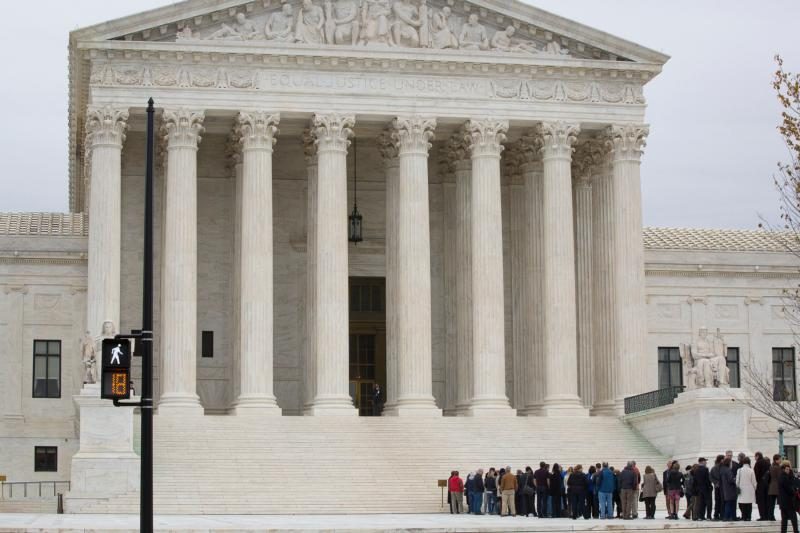
The US Supreme Court has said it will hear a challenge to two provisions of a Texas law regulating abortion clinics in the state. The 2013 state law requires the clinics to meet the same standards as ambulatory surgical centres when performing abortions and also requires abortion doctors to have admitting privileges at a hospital near an abortion clinic. It is the first abortion case the high court has taken in eight years. In 2007, the Supreme Court in a 5-4 decision upheld the federal ban on partial-birth abortion, which was signed into law in 2003. "The abortion industry doesn't like these laws because abortion clinics would be forced to spend money to meet basic health and safety standards," said Carol Tobias, president of National Right to Life. "For them, this isn't about 'protecting' the women they purport to help, it's about preserving their cash flow." The challenge to the law was brought by a coalition of abortion providers. The case is Whole Woman's Health v. Cole. On June 9, the 5th US Circuit Court of Appeals upheld the constitutionality of the law, and rejected pleas by abortion clinics to suspend its implementation while it is appealed. But on June 29, the US Supreme Court temporarily blocked Texas from enforcing new requirements on abortion clinics. The block will remain in place now until the high court rules sometime next year. No date was set on when the justices will hear oral arguments in the case. The rule on abortion doctors having admitting privileges already has gone into effect. Opponents of the law say its aim is to close abortion clinics and has created an "undue burden" on the right of women to have an abortion. An AP story said that more than half of Texas's 41 abortion clinics closed when the admitting privileges requirement went into effect. AP also said that 11 other states require abortion doctors who work at clinics have hospital admitting privileges. It quoted Nancy Northrup, president and CEO of the Centre for Reproductive Rights, as saying that Texas and other states have enacted what she termed "sham laws" to restrict abortion access, and claimed the Texas law doesn't "advance women's health" but "undermines it." National Right to Life in a news release said that under the 5th Circuit's ruling, every metropolitan area in Texas that currently has an abortion facility operating would still have that facility open. "If an abortionist closes up because he can't meet these most basic medical standards, that's a good thing for the mothers who would be targeted and the unborn children who would be killed," Tobias said in a statement. On June 30, the Texas Catholic Conference, the public policy arm of the Texas Catholic bishops, expressed disappointment with the Supreme Court's blocking of the clinic regulations. The bishops "grieve for the unborn children who will continue to die, and are concerned for the mothers who will subjected to substandard care, while the court delays until the fall to resolve this issue," a conference statement said. "While the Texas Catholic Conference opposes abortion, it equally values protecting and preserving the health of women, whose lives and dignity are just as precious as those destroyed by the act of abortion," the statement said.
11:19 AM
High court to hear challenge to Texas law regulating abortion clinics
The legal case will be the first on abortion that the high court has taken in eight years
Catholic News Service

3 min read



Already a subscriber? Sign in
5freearticles every month
Continue reading with a free account. No card needed.
- Five free articles every thirty days, on any device you sign in on
- The Catholic Herald newsletter, every morning
- Subscribe whenever you like for everything: every article and the magazine
Related articles
 Newsroom
Church leaders urge Drumcree dialogue: ‘Too much is at stake’
The Catholic and Church of Ireland Archbishops of Armagh have urged a renewed commitment to peace and reconciliation amid the Drumcree stand-off
Corrie Douglas-Young Newsroom
Thousands of Irish children to join global Rosary campaign
Corrie Douglas-Young Newsroom
TikTok priest urges young people to stand with persecuted Christians
Nathalie Raffray Newsroom
Baby born at 25 weeks reunites with neonatologist two years after leaving hospital
The Catholic Herald Newsroom
Joe Biden honoured by Planned Parenthood after defending abortion rights
Christine Rousselle
subscribe to the catholic herald today
Our best content is exclusively available to our subscribers. Subscribe today and gain instant access to expert analysis, in-depth articles, and thought-provoking insights—anytime, anywhere. Don’t miss out on the conversations that matter most.
Subscribe



