




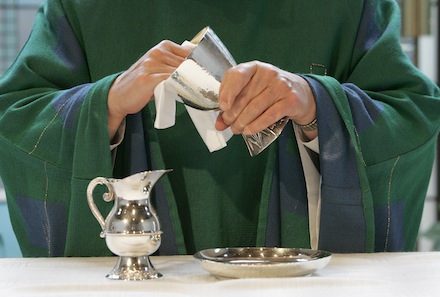
Something unexpected happened to me the other day. A minister of another Church rang me up and said that he had been given a Sacred Host by a member of his congregation, with the request that the said minister should pass it to a Catholic priest. Naturally, I said I would call round and collect the Sacred Host that very afternoon. I did so, recovered the Host, placed it in a pyx and heard the story. A young lady had been at a Catholic Mass and had gone up to Holy Communion, even though she was not a Catholic – she had gone up because she had been urged to go up by the people sitting around her. Once at the altar the priest had placed the Sacred Host in her hands. She, not being in communion with the Catholic Church, did not want to receive the Host, so carried it away with her, and then entrusted it to the minister of her own church, who then called me. Once I was at home, I disposed of the Host in the way that is prescribed by law. This incident raises all sorts of questions. First of all, such things can only happen when communion is given in the hand and the person receiving does not consume the Host at once. The Blessed Sacrament is supposed to be consumed at once, in sight of the altar; no one should carry it away, even if for only a few feet. How, though, can we stop them doing so? The only answer is that all, priest and congregation, must be vigilant and ensure that anyone attempting to carry away the Host is stopped. I realise that this may be difficult. I have heard stories of priests who have challenged people who were taking the Host away, and who have been abused for doing so. Another thing we could do is emphasise to all that there is a correct way to receive Holy Communion. Then of course there is the question of what to do when people present themselves for Holy Communion who seem unfamiliar with Catholic ritual. They ought not to be given Communion, but it can be hard to make this clear to them in the midst of the Communion procession. While on this subject, I think most priests will have had, at one time or another, a request to receive Holy Communion from someone who is not a member of the Catholic Church. Refusal, no matter how carefully explained, tends to cause great resentment. I imagine most priests dread such approaches from our separated brethren. I certainly do.
4:34 PM
How to receive Holy Communion
The Blessed Sacrament is supposed to be consumed at once
Fr Alexander Lucie-Smith

3 min read



Already a subscriber? Sign in
5freearticles every month
Continue reading with a free account. No card needed.
- Five free articles every thirty days, on any device you sign in on
- The Catholic Herald newsletter, every morning
- Subscribe whenever you like for everything: every article and the magazine
Related articles
 Newsroom
Church leaders urge Drumcree dialogue: ‘Too much is at stake’
The Catholic and Church of Ireland Archbishops of Armagh have urged a renewed commitment to peace and reconciliation amid the Drumcree stand-off
Corrie Douglas-Young Newsroom
Thousands of Irish children to join global Rosary campaign
Corrie Douglas-Young Newsroom
TikTok priest urges young people to stand with persecuted Christians
Nathalie Raffray Newsroom
Baby born at 25 weeks reunites with neonatologist two years after leaving hospital
The Catholic Herald Newsroom
Joe Biden honoured by Planned Parenthood after defending abortion rights
Christine Rousselle
subscribe to the catholic herald today
Our best content is exclusively available to our subscribers. Subscribe today and gain instant access to expert analysis, in-depth articles, and thought-provoking insights—anytime, anywhere. Don’t miss out on the conversations that matter most.
Subscribe



