



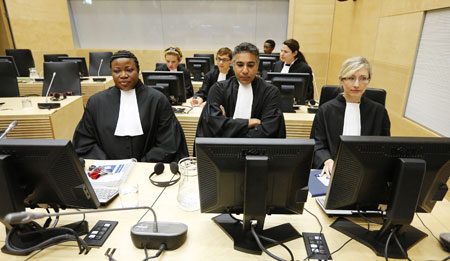
The unintended consequences of utopian schemes for the universal imposition of fairness and justice were highlighted, in very different circumstances, by two articles which appeared over the weekend. The first was a very interesting thinkpiece in the Spectator, by Douglas Murray. Its contention is summarised by the article’s title: “What has this era of ‘international justice’ done to deter genocide?” Murray’s case, which is one that has occurred to me repeatedly over the last year or so, is that the existence of the International Criminal Court, which was supposed when it was established 10 years ago to make the world a safer place, has in fact had the opposite effect: “As Syria now demonstrates,” argues Murray, “far from deterring brutal dictators, the prospect of ending up like Slobodan Milosevic or Charles Taylor has persuaded some of the worst dictators that they only have one choice: to fight it out to the end. The Assads are only the latest family to prove this point. Before them it was the Gaddafis. As the Libyan regime began to crumble, there were numerous attempts to get members of the family out. Yet even neighbouring Algeria was unwilling to give Gaddafi himself exile, and in the days and weeks before his fall, planes with family members on board were turned away from several countries. We will never know how many people needlessly died in those weeks as the Gaddafis looked for exits from the burning building. It was certainly a building which they had set alight, but it was the international community who had locked the doors (my italics).” Exactly so. Murray points to the example of Tunisia, whose dictator saw the writing on the wall in good time and fled to Saudi Arabia, which sensibly gave him asylum. Libya was a much worse tyranny than Tunisia — whose two dictators (I worked there in the days of Habib Bourguiba) were by the standards of monsters like Gaddafi and Idi Amin (who also took refuge in Saudi Arabia) fairly mild — though Syria is now about as bad as it gets. And as far as Syria is concerned, the fact is that because the international community has made it clear that for Bashar al-Assad there is to be no refuge, the killing will go on. Everyone is now saying, hopefully, that the Assad regime is in its final days. I strongly suspect that it is not, and that Assad will now dig himself in for the duration, and that we will have the worst of all possible outcomes: a bloody civil war which will go on for many years, with Assad or without him. The idea that there might be a “diplomatic solution”, brokered by the saintly Kofi Annan, was always a nonsense; by the time it was proposed, it occurred to me that, as in the case of Macbeth, there could be no compromise, no way back, because already too much blood had been shed; I even went to my Shakespeare and found the quotation; interestingly, Douglas Murray quotes the same passage in his convincing piece, which I recommend in its entirety:
3:52 PM
International justice, whether in the Hague or in Strasbourg, has done nothing either to deter genocide or defend human rights
The existence of the International Criminal Court has probably led to tens of thousands of deaths. As for human rights…
William Oddie

7 min read



Already a subscriber? Sign in
5freearticles every month
Continue reading with a free account. No card needed.
- Five free articles every thirty days, on any device you sign in on
- The Catholic Herald newsletter, every morning
- Subscribe whenever you like for everything: every article and the magazine
Related articles
 Newsroom
Church leaders urge Drumcree dialogue: ‘Too much is at stake’
The Catholic and Church of Ireland Archbishops of Armagh have urged a renewed commitment to peace and reconciliation amid the Drumcree stand-off
Corrie Douglas-Young Newsroom
Thousands of Irish children to join global Rosary campaign
Corrie Douglas-Young Newsroom
TikTok priest urges young people to stand with persecuted Christians
Nathalie Raffray Newsroom
Baby born at 25 weeks reunites with neonatologist two years after leaving hospital
The Catholic Herald Newsroom
Joe Biden honoured by Planned Parenthood after defending abortion rights
Christine Rousselle
subscribe to the catholic herald today
Our best content is exclusively available to our subscribers. Subscribe today and gain instant access to expert analysis, in-depth articles, and thought-provoking insights—anytime, anywhere. Don’t miss out on the conversations that matter most.
Subscribe



