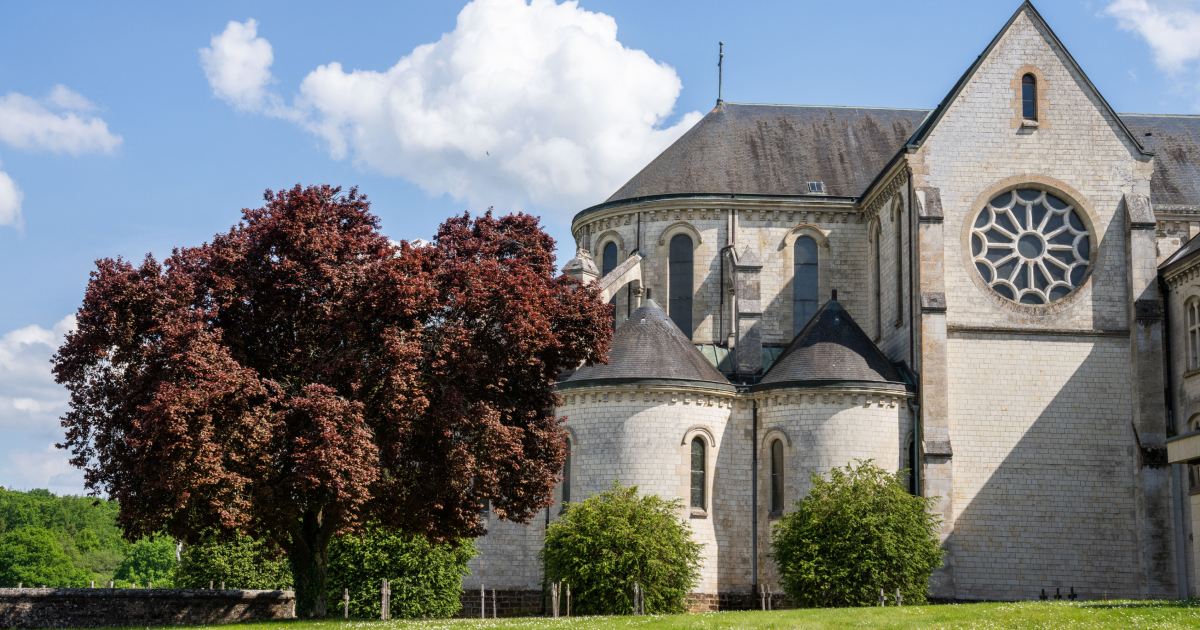


The recent announcement of the possible, if not likely, closure of the Abbey of La Trappe in Normandy in 2028 has sent shock waves around the monastic world and far beyond. For this is not just any monastery: it is the mother house of the Trappist Order – the very place from which the 17th-century reform of Cistercian observance spread, giving rise to the Cistercians of the Strict Observance, or ‘Trappists’. How is this possible? How can the abbey known for so long as ‘La Grande Trappe’, boasting of its utter fidelity to the Rule of St Benedict, simply close – at least in respect of being a Trappist community, whatever other purposes may be found for the historic buildings?
The facts enumerated in the abbot’s announcement speak for themselves: vocations have dried up and the cost of maintaining the site is disproportionate. It is not clear how many are in the community at present, or their average age, but since the shocking announcement earlier in March it cannot have helped that two more of their monks have died.
Of course, La Trappe is not alone in its plight. The Trappists have closed the Abbey of Achelse Kluis in Flanders (2011), Our Lady of Melleray in Brittany (2016), Our Lady of the Snows in the Ardèche (2022), the Trappe of Oelenberg in Alsace (2024), three of their five abbeys in Ireland since 2025, the Trappe of Zundert in Holland, as well as Notre-Dame du Port-du-Salut near Laval in France (2025), and the Abbey of Bellefontaine near Nantes, which will be taken over by the Benedictine monks of Le Barroux, who celebrate the traditional liturgy, later this year.
The decline of the Trappists seems to be both widespread and rapid, at least in Europe, but they are not alone. Many once-great Benedictine and Cistercian houses have abandoned their numerous ornate choir stalls and historic churches and retreated to cosy, smaller rooms to recite what parts of the Divine Office they can still manage. Not even the two monasteries of Subiaco – the very place of the foundation of the Benedictine order – can boast more than 16 or so not-so-young monks between them. The great Italian Abbey of Parma now houses only six or seven. The list could go on – and it is by no means safely confined to Europe. Many monastic houses in the Western new world face similar crises, if they have not already succumbed to them.
What has happened? Why is it that monasteries and monastic orders that have survived and bounced back from revolutions, expulsions and all manner of despotic persecutions now seem to be collapsing from within? The answer, I am afraid, is that they have not been able to withstand the aftermath of the most recent ecumenical council of the Church.
I hasten to underline the word ‘aftermath’, because there is no suggestion that Vatican II intended to undermine monasticism. Indeed, its Decree on the Adaptation and Renewal of Religious Life asserts exactly the opposite:
‘The monastic life, that venerable institution which in the course of a long history has won for itself notable renown in the Church and in human society, should be preserved with care and its authentic spirit permitted to shine forth ever more splendidly both in the East and the West. The principal duty of monks is to offer a service to the divine majesty at once humble and noble within the walls of the monastery, whether they dedicate themselves entirely to divine worship in the contemplative life or have legitimately undertaken some apostolate or work of Christian charity. Retaining, therefore, the characteristics of the way of life proper to them, they should revive their ancient traditions of service and so adapt them to the needs of today that monasteries will become institutions dedicated to the edification of the Christian people.’
However, the same decree cries out ‘update, adapt, update’ at almost every turn, and whilst following the Council’s admonitions monasteries rightly upgraded their heating provisions and allowed their brethren to wash more regularly and even began to respect the right of monastics to privacy in personal correspondence, etc., the injunction to update was too often understood as a command under obedience to change everything for the sake of changing everything. ‘We no longer do that,’ became the mantra, ‘because everything has changed now.’
But as sociologists and psychologists can tell us, the rapid changing of deeply rooted habits without sufficient reflection, reason or time easily destabilises institutions and individuals – a reality to which the rapid decline of many apostolic communities of priests, brothers and nuns bears tragic witness. Monastic communities, being perhaps more grounded in traditional observances, seemed to fare far better. But now even many of them seem to be on the brink. Why are even they succumbing now?
The answer is given, I think, in the Council’s decree in its recognition that ‘the principal duty of monks is to offer a service to the divine majesty at once humble and noble within the walls of the monastery… dedicating themselves entirely to divine worship in the contemplative life or [in some cases undertaking] some apostolate or work of Christian charity’. Any monastic in the Benedictine tradition, which includes Cistercians and Trappists, knows the fundamental precept ‘to put nothing before the Work of God’, that is, the singing of the Divine Office. St Benedict himself is very clear: ‘Those monks show themselves very slothful in their sacred service who in the course of the week sing less than the [150 psalms of the] psalter and the customary canticles: whereas we read that our holy fathers strenuously fulfilled in a single day what I pray we lukewarm monks may perform in a whole week.’ Whatever legitimate works monks may engage in, this has always been fundamental.
And yet, in their quest to ‘update’, this principle was all too often set aside. So too was the concern expressed in a 1966 letter to superiors of communities bound to sing the Divine Office in choir by the Pope who had brought Vatican II to its conclusion a year earlier. St Paul VI feared:
‘that choir from which is removed [the Latin] language of wondrous spiritual power, transcending the boundaries of the nations, and from which is removed this melody proceeding from the inmost sanctuary of the soul, where faith dwells and charity burns – We speak of Gregorian chant – such a choir will be like to a snuffed out candle, which gives light no more, no more attracts the eyes and minds of men.’
And he gave such communities – Benedictines, Cistercians and Trappists included – ‘the mandate of preserving the age-old solemnity, beauty and dignity of the choral office, in regard both to language, and to the chant’ (Sacrificium Laudis, August 15, 1966).
It is a fact, however, that this mandate was quickly set aside by many if not most monastic communities, far too many of which are indeed now ‘snuffed out’. That is to say that in their quest to adapt their ancient traditions their raison d’être was lost. They unintentionally undermined their very foundations.
For, whatever great service monastics have rendered in history – from the care for the sick, poor and homeless before ever social welfare systems existed, to their significant contributions to agriculture and scholarship in almost every domain, and even to the putting of the bubbles into the wine we now know as champagne – each and every monk concerned knew that he must put nothing before the Work of God and that he was obliged to the weekly chanting of the entire Psalter in the monastic choir. Disassembling this fundamental framework of monastic observance, and indeed radically rupturing the traditional liturgy of the Church as a whole, has proved, and continues to prove, to be a disaster of monumental proportions both inside and outside the cloister walls.
The abbot of La Trappe noted that vocations had long since ceased coming. That is not the experience of those monastic communities that maintain, or that have gone back to, the integral celebration of the traditional liturgy – the Divine Office, the Mass, the sacraments and so on. Certainly, rare is the young man or woman today who can disentangle themselves from the snares of a world in which self-will is sovereign, or indeed in so-called ‘traditional’ circles from the pick-and-choose selection of what they themselves judge to be ‘traditional’. Too often they arrive at the monastery in order to follow their own will and preferences. With such a Pelagian self-centredness God can often hardly get a word in, as it were, let alone call them to become the person He wishes them to be.
But some young people do respond generously to God’s call to the monastic life. When they do, they do not seek monasticism that has been neutered by attempts to renew and adapt it according to the zeitgeist of the 1960s and 1970s. They seek the conversion of their life according to the Rule of St Benedict lived at full strength, supported by the riches of the Church’s unedited liturgical tradition – adapted to modern circumstances, certainly, but not compromised by the modern world or contemporary ecclesiastical ideologies.
There are exceptions, of course, particularly where monasteries are heavily engaged in pastoral, missionary or educational work. Their apostolates attract a number of vocations. But in these instances, in reality, the life being lived is more akin to the life of apostolic canons than of monks. They do good work, to be sure, but their observance is some distance from the enclosed monasticism St Benedict lays down in his Rule.
Unfortunately, it seems inevitable that there will be more closures of monasteries, small and large. The statistics indicate that many formerly renowned communities are currently in such rapid decline that it may not be possible to prevent their demise.
But in God’s providence there are also new and vital green shoots of monastic observance springing up throughout the world. These are not the long-awaited ‘new springtime’ with which the reforms following Vatican II were marketed and sold, as it were. No, they are the new growth arising from the roots that have survived even after the landscape has been scorched by an unexpected disaster. They are small in size and number, but they are deeply rooted in the monastic tradition, and they will grow and bear fruit in due season. For this we can give thanks, even as we must currently mourn the passing of their great predecessors.
Dom Alcuin Reid is the Prior of the Monastère Saint-Benoît in Brignoles, France.