.png)


A largely quiet week in the Vatican affords time to look ahead at Leo’s upcoming Spanish voyage, while the leadership change in the Holy See’s communications department on Tuesday led the Roman discussion this week.
Leo XIV’s pontificate has in many ways been largely quiet, particularly when it comes to expected changes that he might have made concerning decisions inherited from Pope Francis. When it comes to his travels, though, the Pope has approached this aspect of his pontificate with great vigour, probably realising that this is the most energetic stage of his reign.
This morning the latest of such papal voyages began, as Leo will spend seven days in Spain, arriving back in Rome late on Friday night. The itinerary will see him move between Madrid, Barcelona, Gran Canaria and then Tenerife, encompassing a number of the customary meetings along the way: meeting with local clergy, civil authorities, the national episcopate and local communities of Catholics at the various stops en route.
One key highlight will be the Corpus Christi procession on Sunday, during which Leo will bear the monstrance throughout the procession, mirroring his inaugural Corpus Christi procession in Rome last year. In his absence, the Cardinal Vicar of Rome, Baldassare Reina, will preside over ceremonies in the Eternal City.
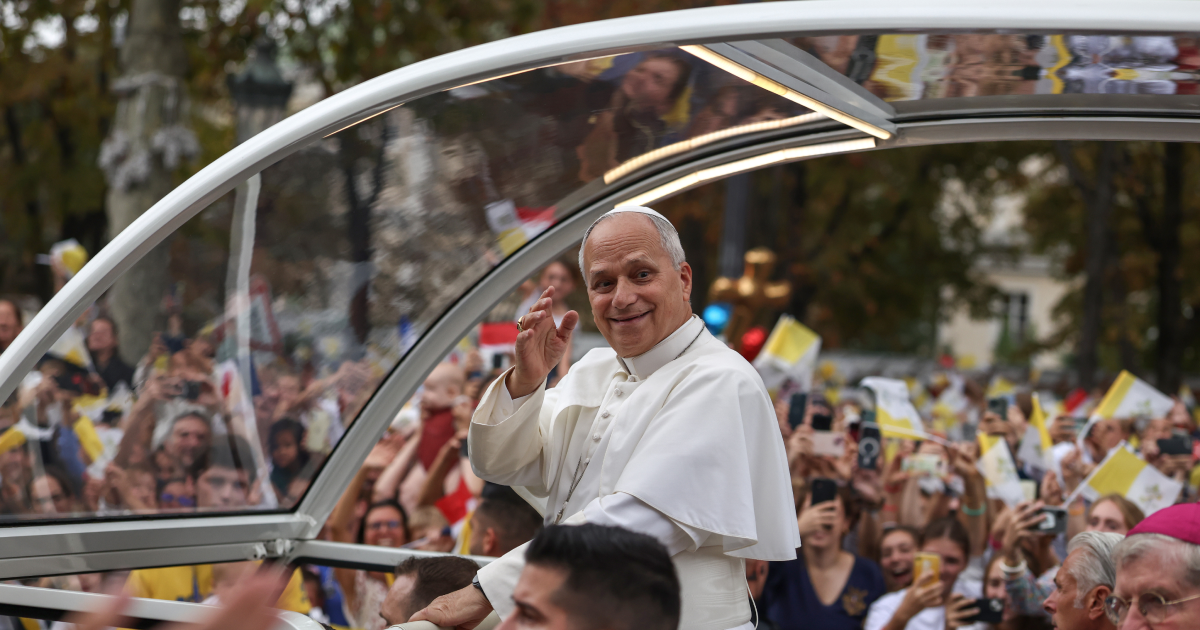
It is a visit that, like many papal trips, has been overshadowed by various controversies and debates. These will probably be forgotten during the visit itself, as media networks focus on images of a smiling Pope greeting cheering faithful, before being revisited after the fact to ascertain how the Pope responded to such issues.
One such element is the inclusion of a pro-LGBT group in the large mix of groups taking part in a mass audience with Leo on Sunday evening, at an event titled “building networks with the world of culture, art, economy and sport”. The group “Crismhom” has received an invitation to the event from Cardinal José Cobo Cano, the Cardinal Archbishop of Madrid. Much will be made of its invitation – by activists on the Left and Right – in an attempt to argue that its inclusion shows papal support for the group. The more nuanced reality, however, is that far from denoting papal approval of the group, it simply highlights the wildly liberal tendencies of Cardinal Cobo, which come as no surprise to any Vatican watcher.
The now infamous controversy over the listening centres as opposed to confessionals on offer for pilgrims during the Pope’s visit needs no introduction. After The Pillar broke news of the fact that “listening centres” would be on site during a prayer vigil with young people, rather than confessionals, international scrutiny swiftly proliferated. Following widespread criticism, the Archdiocese of Madrid asked parishes to arrange extra Confession availability during the vigil, and a separate initiative has been launched enabling pilgrims to locate confession spots for all of the Pope’s itinerary. Perhaps keen to avoid similar criticism, the Archdiocese of Barcelona ensured that confessionals would be in place for its own prayer vigil between the Pope and young people.
Likely encouraged into renewed activity, some Spanish bishops have used the days prior to Leo’s arrival as an opportunity to galvanise their parishioners into renewed practice of the Faith. Valencia’s Archbishop Enrique Benavent penned a letter lamenting the decline in Sunday Mass attendance as “one of the most worrying phenomena currently in the life of the Church”, while the president of the national bishops’ conference went even further.
Writing on June 1, Archbishop Luis Argüello laid out the restrictions on who is unable to present themselves for Holy Communion and in so doing appeared to reject the chief controversial theme of Amoris Laetitia. It is not possible to receive Communion (he wrote) “when a marital relationship has broken down and those who were part of that marriage are living in a new conjugal relationship”. Argüello would not have done so on the eve of a papal visit unless he was sure of his position being supported by Leo.
Herein lies another insight into how Leo wishes to govern when it comes to controversial elements inherited from Francis. The American Pope appears to allow bishops a certain autonomy, enough to enable them to whitewash the troublesome elements of Francis’s reign.
On this latter point, one element of Francis’s time which came to an abrupt end this week was the tenure of Paolo Ruffini as prefect of the Dicastery for Communication. In his place, Leo named Maria Montserrat Alvarado, hitherto chief operating officer and president of EWTN News.
Alvarado is not known as a hardline traditionalist, and already debate has emerged over her apparent downplaying of the need for Jews to convert to Catholicism. But from the simple fact that EWTN upholds traditional Catholic morality, her arrival at the Vatican is being viewed as a win for conservatives aggrieved at the style of Vatican communications under Francis.
Ruffini infamously defended the use of Fr Marko Rupnik’s art by the Dicastery, and the immensely well-funded Vatican office became adept at spin rather than news when it came to covering Francis’s pontificate. Alvarado will face a battle over internal culture in the Dicastery as an outsider, but also as one who will have to address issues such as Rupnik’s close colleague Nataša Govekar remaining director of the Dicastery’s theological-pastoral department.
Even aside from Alvarado’s personal views or style, the very fact of Leo naming EWTN’s president to lead Vatican communications, after Pope Francis famously attacked the same network as doing the “work of the devil”, sends an unmistakable message.
When it comes to messaging, the Vatican has also poured cold water on any hopes that liturgy would be formally discussed at the upcoming consistory. Leaked on Wednesday was the letter sent by the Cardinal Dean to the College of Cardinals, in which he outlined the precise agenda for June’s two-day consistory. Free interventions are once again limited; the encyclical is prioritised, as is synodality. One opportunity is available for cardinals to mention the liturgy as part of the first session on emerging needs of the Church, but no formal discussion is envisaged.
It is by no means unlikely, though, that Leo intends to address the liturgical question outside the consistory. While the consistory schedule does not include it, the individuals Leo has met in audience suggest that he is not blind to the need to respond to the liturgical crisis.