


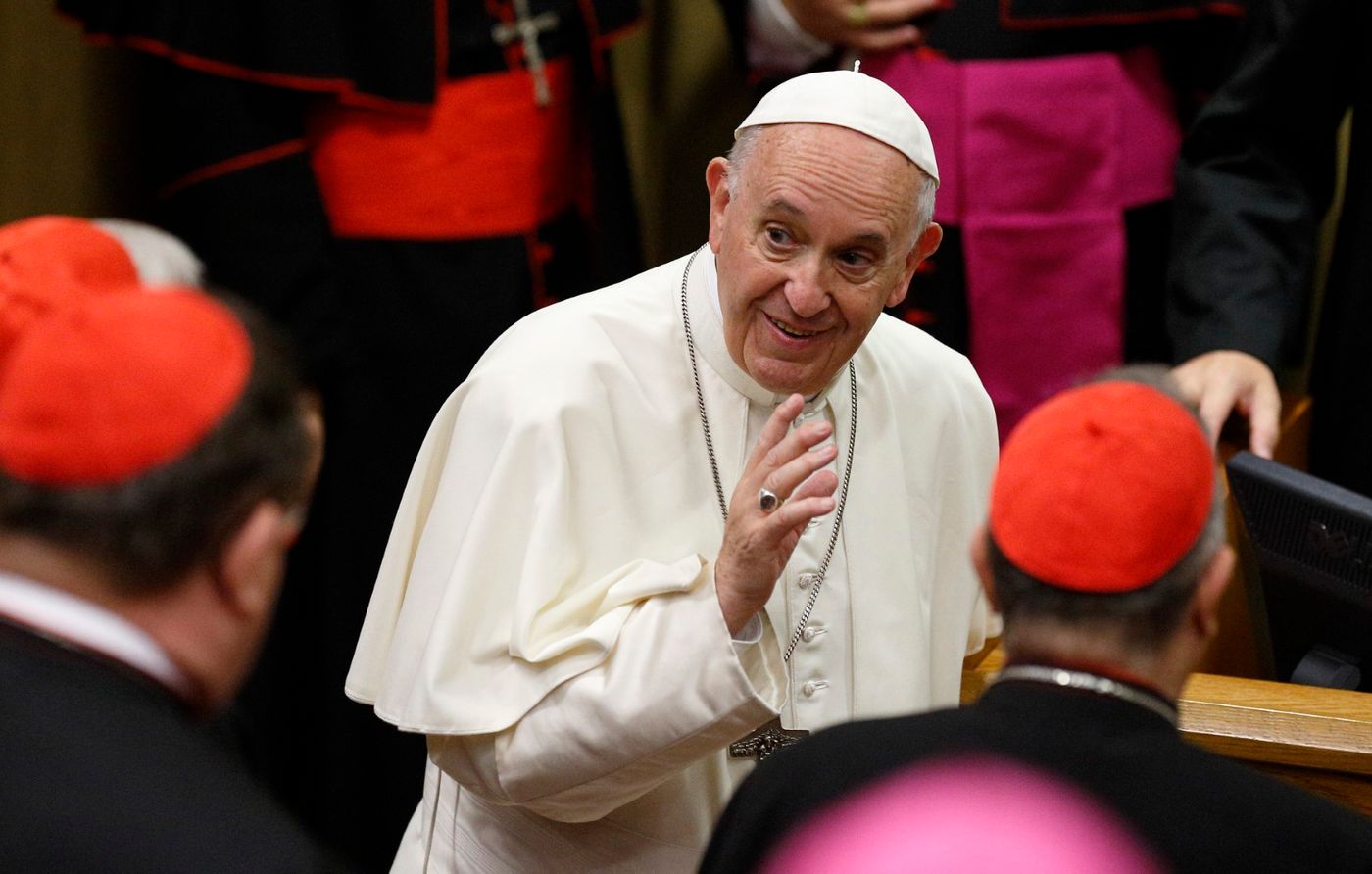
SOME REPONSES TO THE FIRST REPORTS OF THE SYNOD’S DISCUSSION GROUPS On October 9, the Vatican issued a report summarizing the Synod’s first round of small group discussions, which focused on Part One (paragraphs 1 to 72) of the Synod’s working document, the Instrumentum Laboris . As in past synods, bishop-delegates, Synod auditors, and invited observers divide into language-based discussion groups when the Synod is not meeting in general assembly. In Synod-2018 there are fourteen such groups, or Circoli Minori in Synod-speak: four for English speakers, three for French, one for German, two for Spanish, three for Italian, and one for Portuguese. (Once upon a time, there would be “circle” using Latin, but those days are no more.) The members of these groups share their thoughts on the Synod’s working document, one section at a time. Each small group has a president to moderate the discussion (although it is reported that some presidents are, shall we say, more active, sharing their thoughts on just about everyone else’s thoughts). A secretary takes notes and synthesizes them into a record of the group’s discussion. These reports then become raw material for the adjustment or revision of Synod’s final text, whatever form that might take. “Raw material” is exactly the right term for these reports. They are not polished discourses. They vary greatly in quality and focus. Asian and African English-speakers, for example, may have very different priorities from those in Europe or North America. That should be no surprise, but it can make for confused and tedious reading. Nonetheless, the reports do have value. Among other things, they hint at the Synod’s major fault lines. LETTERS FROM THE SYNOD shared the reports with a range of scholars and others for their overnight assessment. While quick and incomplete, their comments are interesting. From a Spanish Catholic journalist:The Spanish groups followed the IL closely and made a significant number of criticisms, but still worked with the text. There is nothing troubling in their comments but nothing inspiring, either. The perspective in both Spanish groups is quite Latin American: very little on issues related to sex, a lot on immigration, finding jobs, reaching the mass of youth, etc. In short, nothing unusual.From a U.S.-based theologian on the English language group reports:It seems to me that the most important thing to stress – really, to go to the wall for –is to minimize the damaging "LGBT/sexual identity" language, and then to get some positive affirmations in there about the importance of chastity.I think the chastity piece is strategically important because it is the antithesis of the pro-LGBT position….They have to talk about not seeming negative or finger-wagging, seeking openness. But the rejoinder is to talk about the tremendous suffering that young people are going through precisely because of sexual abuse, pornography exposure, emotional wounds, and broken hearts, from the lies and empty promises of the sexual revolution – and then offer chastity as a positive alternative.From a European-based religious:Some potentially problematic passages from various small groups:" are many other forms of family other than the nuclear family or the extended family. We had a debate in our small group about non-ideal groupings from the Christian perspective. Does leadership in the Church require bishops and priests to proclaim the Gospel truth by denying that these are families? Or does our leadership require us to accompany the young people in the reality in which they find themselves? Perhaps these are not contradictory realities: St John recounts that Jesus both accepted the woman caught in adultery and proposed something else. Is it possible for us to both accept and even honor the family unit that a young person finds herself in and to share the Gospel ideal to her? . . . ""It now seems necessary to approach the issue of sexuality more openly with young people and to discuss all the subjects related to it. The Church is called to update her teaching on these themes knowing that she is a servant of the mercy of God. In this sense, it might be useful to elaborate and propose to the particular Churches a document dealing with questions of affectivity and sexuality . . . ""From the riches of her teaching, including from her ‘treasure trove’ of social doctrine, the Church can offer reasons for living and hoping. She does this best with young people by avoiding a moralistic or polemical approach – as if we had all the ‘ready- made’ answers -- but instead accompanying young people in a climate of joy and adventure of discovery . . . ”"We must avoid telling young people ‘that should not be done’ but, rather, make them see the consequences of their actions, since an empathetic Church is the one that accompanies despite the errors, without imposing, prohibiting, or demanding. However, those same points are the least empathetic and there is a need to emphasize the importance of decisions and encourage them to take risks . . ."From a U.S.-based theologian, thoughts on the German group:Paragraph 2 is just obvious pandering to youth and a kind of youth-worship: “We hear the youth and look upon them with the ears and eyes of a younger Jesus.” Seriously?Paragraph 6 is setting the Synod up for a replay of Amoris Laetitia. After highlighting “joy” and “discernment” as the hallmark of this papacy in Paragraph 5, it emphasizes from the IL (and Amoris Laetitia): “Reality is more important than the Idea.” It goes on to interpret this to mean: “. . . we look with the loving eyes of the youth on the concrete person and concrete situation, and we learn to understand how God’s presence is illuminated there. For example, also there where that concrete reality does not yet correspond to the ideal Christian life.”First, this is pantheistic – where is truth found? In the concrete conditions of lived experience (natural), not in revelation (supernatural) – which seems to be, of course, the premise of the entire IL.Second, the German fathers are emphasizing a genealogical rather than a prescriptive approach – i.e, the Church is apparently not in the business of proposing things (teaching), but only in mining whatever is already there, embedded in the world. This is grounded in the complete collapse of nature and grace, i.e. theologically, naturalism; philosophically, Feuerbach.The most important element highlighted, in my view, is the German fathers’ discussion of anthropology. And because they have given so much attention to it, and because the Rhineland bishops have historically been so influential, I think the English-speaking bishops would do well to have a fully formulated response concerning anthropology. In their Paragraph 10, the Germans say that the Synod must consider the question of what it means to be human, to be a human person, what is actual freedom, where does one find one’s identity? And then they follow this up in their Paragraph 11 with the following (this is obviously a rough translation): “The question of embodiment and sexuality, the digital world, the inability to discern, the desire for the spiritual – phenomena which require a deeper anthropological investigation, if we desire to propose belief as a way to a successful human life. One Synod father suggested: If we don’t have a clear diagnosis of the human condition, than we don’t have a therapy for it. In any case, we are of the opinion that the meaning of the theme of sexuality for the youth, the mere description of the phenomenon and a few problems in sections 52-53 of the text , does not suffice. We beg for an anthropological deepening and orientation of these dimensions with an accent on the quality of human relationships.”Note, first, that here they are setting the anthropological stage for the LGBT argument – most likely by appealing to the “changing” human condition (think Bernard Häring) Second, note the theological fallacy – i.e., if we don’t understand the human condition, then we can’t address it. For which, the {Synod] Germans fathers will likely offer their assessment and their remedy. But of course the Church does have knowledge of the human condition (sin, virtue, vice, etc.) and therefore she does have the remedy (grace; Word and sacrament). Third, the “accent on the quality of relationships” sounds like a subjective substitution for the objective character of the relationship. i.e., same-sex relationships have the “quality” of love even if objectively they defect from the “ideal” of Christian love and we must “accompany” them.Lastly, notice that the Germans are angling for something more progressive than what is already in the IL.And finally, from a young American priest:An initial look at the English reports leaves me a bit underwhelmed. There is nothing particularly egregious in there, but there is nothing particularly good about them either. Just a collation of ideas with various degrees of merit and vacuous references to how much fun sports are (seriously).But Circle D, clearly the best of the English language groups, caught my attention in its debate between a “listening Church” and a “teaching Church.” A couple of distinctions are helpful here. First, just because a person is a member of the Church in a canonical/juridical sense does not mean that this person is in a state of habitual/sanctifying grace. A person can be a Christian in numero sed non merito, as Aquinas said, among others. Of course, Jesus ate with (“listened to”) sinners, but that was precisely to bring them to conversion. We cannot just assume that because a person has been baptized that all of his or her opinions about sexual ethics are equally valid.Second, there is an increasing tendency toward centralization at issue here. “Listening” takes place on the ground level. Any good bishop/priest/person with pastoral responsibilities will certainly listen to others and treat them with respect, even if the opinions they hold are not one’s own. That’s just good common sense and Christian kindness. But sincerely listening to someone is not a code for any other action. It’s just what it is. If people think that their pastors care about them, they will listen to what they have to say, even if they aren’t in total agreement. But for the Holy See to assume to itself the right to “listen” co-opts the good work of people on the ground every day in various ministry settings who already do this. The dynamic tension of helping people to live in an authentic Christian way cannot be resolved by Vatican fiat. The job of the Pope and the bishops is to teach faithfully and promote good initiatives from those who have internalized their teaching.These remarks are raw comments on raw material and should be judged accordingly. The Synod fathers have already pressed for more and earlier emphasis in the text on the person of Jesus Christ, the need for chastity and virtue education, and greater evangelical zeal. A great deal of discussion remains before the real shape of the Synod’s message becomes clear. The first round of Circuli Minori reports may be read in full here: http://press.vatican.va/content/salastampa/it/bollettino/pubblico/2018/10/09/0737/01558.html
5:00 AM
Letters from the Synod-2018: October 11
Reports and Commentary, from Rome and Elsewhere, on the XV Ordinary General Assembly of the Synod of Bishops
Xavier Rynne II

26 min read



Already a subscriber? Sign in
5freearticles every month
Continue reading with a free account. No card needed.
- Five free articles every thirty days, on any device you sign in on
- The Catholic Herald newsletter, every morning
- Subscribe whenever you like for everything: every article and the magazine




subscribe to the catholic herald today
Our best content is exclusively available to our subscribers. Subscribe today and gain instant access to expert analysis, in-depth articles, and thought-provoking insights—anytime, anywhere. Don’t miss out on the conversations that matter most.
Subscribe



