


DISQUISITIONS ...being thoughts on Synod 2015 from various observers
Questions of Process, Yet Again
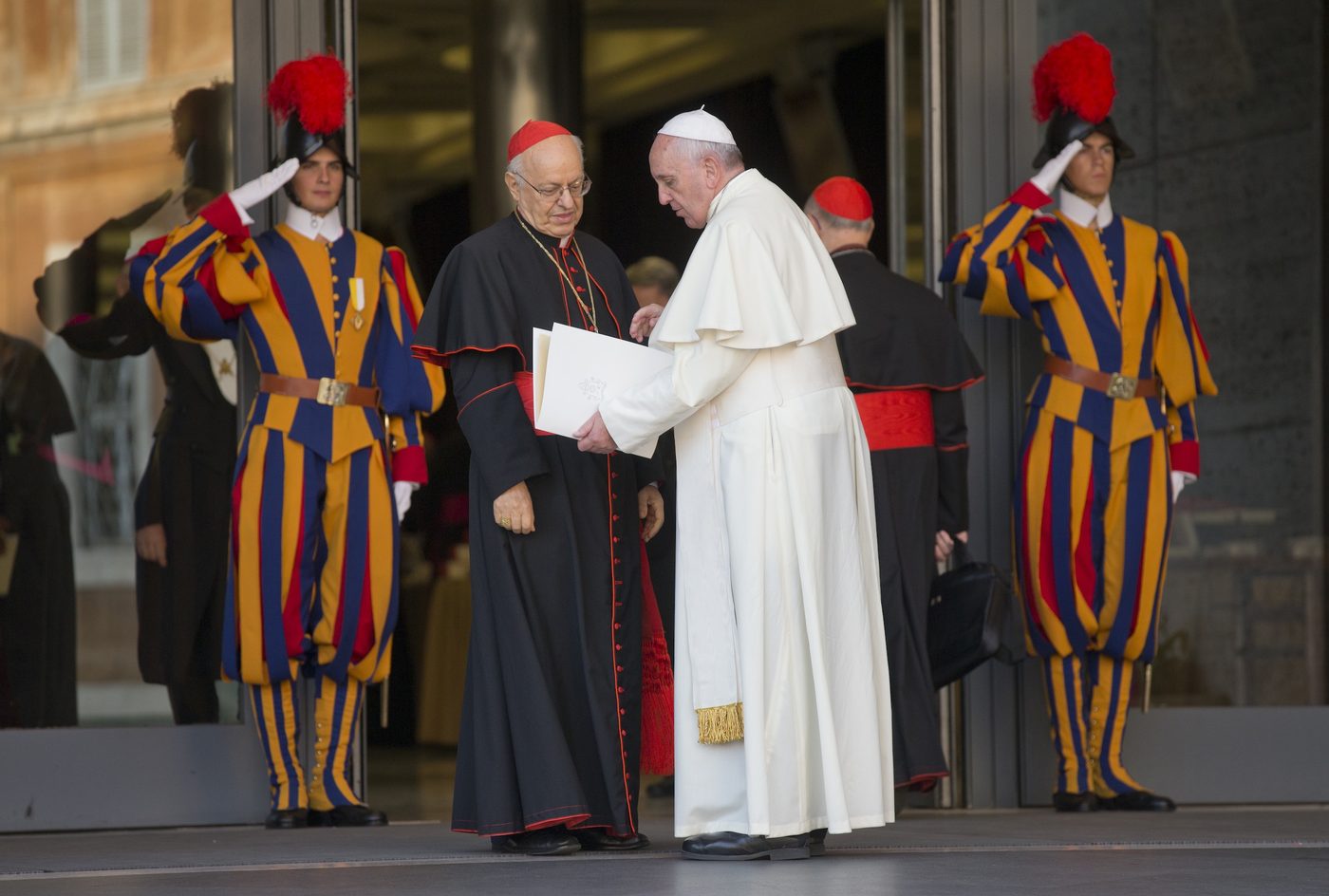
Robert Royal’s daily reports from Synod 2014, posted on The Catholic Thing (of which he is editor-in-chief), were required reading for anyone trying to understand the dynamics of that Synod amidst the reportorial and analytic fog: which fog, it now seems abundantly clear, was not always generated by the media. Letters from the Synod asked Dr Royal to reflect on that experience in light of Synod 2015, which he will also cover for The Catholic Thing, as well as contributing to this exercise in “theological journalism.” Robert Royal is president of the Washington-based Faith and Reason Institute and the author of numerous books, including The Catholic Martyrs of the Twentieth Century: A Comprehensive World History and the forthcoming study, A Deeper Vision: The Catholic Intellectual Tradition in the Twentieth Century. XR2 I went to Rome last October to observe what I expected would be external pressure and media spin on the Extraordinary Synod on the Family. As anyone who paid attention now knows, there turned out to be no need for external manipulation, because irregularities in internal procedures – what some have said amounted to “rigging” the process – led to the publication of an interim report that included highly controversial proposals on Holy Communion for the divorced and remarried, and passages that seemed to call for the Church to find value in same-sex relationships – perhaps even in homosexuality as such. That report was released publicly at noon on Monday of the second week of the Synod, the mid-point of the event, before even the bishops themselves had seen it. Over the next twenty-four hours, it precipitated a backlash and 180-degree turn that is still ricocheting around the world as we face another Synod in just a few days. Several synod fathers objected – vehemently – that the interim report wildly misrepresented their discussions. Cardinal Wilfrid Napier of South Africa in particular remarked that the Church found itself, as it often does lately, trying to catch up with mistaken notions transmitted via the media, a situation he described as almost “irredeemable.” But it ought to be said: this time it wasn’t the media that had misunderstood. The way the Vatican set up the Synod not only didn’t help. It helped create the problem. It was very difficult to assess how the Synod was going and how much the public briefings – not only the intermediate report – accurately reflected what was, and was not, happening. Because before the Synod even began, the Vatican decided that, unlike in past synods, there would be no daily summaries of what bishops had said during the sessions, which were all closed. (The opening session was televised and can be watched here, but that’s it.) That decision alone allowed the interim report to be written and publicised – by a small group, it appears – without any countervailing information. In theory, the closed process was supposed to give the participants space to be candid, without having to worry about how their statements would be reported. But in fact, many participants seemed nervous about just what this “openness” meant. The Pope harshly denounced Pharisaism and Jewish legalism, with its 613 points of law, in a homily at a Mass just prior to the Synod, which made it appear to more than a few observers that people who would defend traditional teachings on marriage would somehow ipso facto be considered pharisaical – hardly an inducement to candour at an event where the boss would be present. One also suspected at the time that the relatively closed process might have also been intended to “control the message.” In practice, this meant that reports had to rely on leaks by high-ranking Church officials to their various favoured journalists, which always accompany events in Rome, and which created a tough of war of claims and counterclaims – and little by way of fact or information to control them. In sum, the worst of both worlds. Something very similar seems to be in the works this time – perhaps even worse. In the upcoming Synod, there will be no interim report. Even the deliberations of the circuli minores, the small language groups that meet to refine the final report (and that played a major role in revising the disastrous interim report last time), will not be released publicly. And neither will the final report itself – or at least that’s what is being said, as the Synod is about to open. In the firestorm after last year’s interim report, Cardinal Lorenzo Baldisseri, who will again preside, announced that the language group reports would not be made public – which led to another uproar in which synod participants, notably both progressives and traditionalists, accused the committee running the event of manipulation. After a nod from Francis, the language reports – which called for hundreds of changes (modi) large and small – were released, and were quite eye-opening about the degree of dissatisfaction with both process and result. Presumably, as last time out, there will be daily briefings with cardinals and bishops chosen, no one knows quite how or why, to inform the press about developments. But in the digital age, all these restrictions and efforts to control the message seem hopelessly inadequate. Now that the press knows there will be large issues at stake, they’ll go into an aggressive mode, and in Rome they know how to do it. Leakers and counter-leakers and counter-counter-leakers will inevitably try to shape perceptions. In Washington, where I live, we have leaks too – a drop here, another there. In Rome, they use a fire hose. During the General Congregations that preceded the election of Pope Francis, whole speeches from those supposedly closed proceedings appeared verbatim, next day, in the Italian press. One cardinal told me, after, that he was astonished that the intervention by Cardinal Raymundo Damasceno Assis of Aparecida had somehow been transcribed and published, despite Vatican security efforts to keep everything private: “And what’s even more amazing, he spoke without a text. I was sitting next to him and he was just talking, without anything prepared in advance. Someone must have recorded him since there was no text to leak.” The Vatican has a reputation for poor PR. In a way, it’s almost refreshing in an age when everything is calculated, pre-packaged, pre-spun. But as the new Synod is about to open, it’s not clear that there is no calculation, packaging, spinning going on. It’s just that it seems weak and ineffective, and likely to confuse people yet again, about what the Church wishes to do about what everyone agrees is the urgent need to help the family.