



DISQUISITIONS ...being thoughts on Synod 2015 from various observers
Doubts About Devolution – I
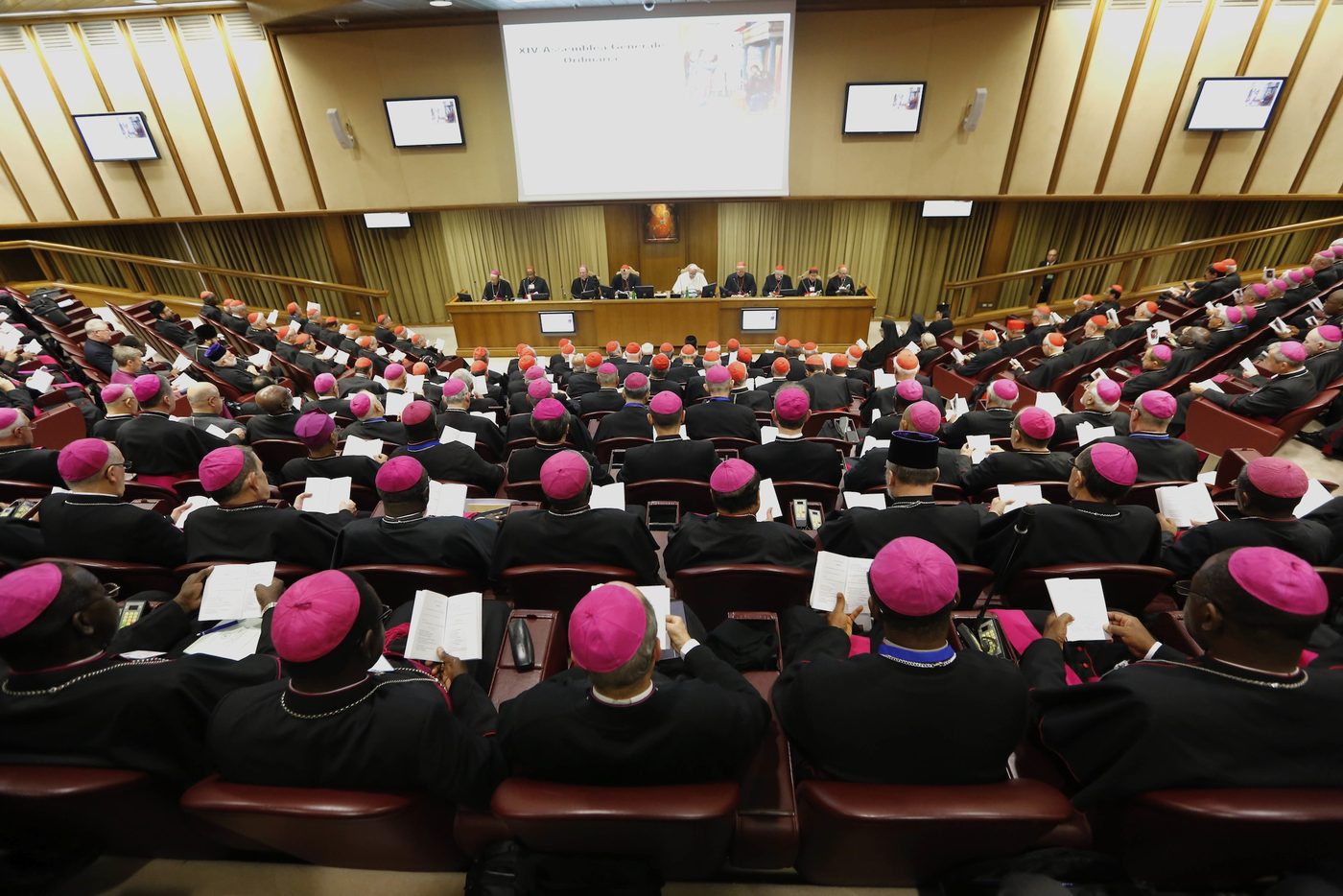
“But we have this treasure in earthen vessels, to show that the transcendent power belongs to God and not to us.” [2 Corinthians 4.7] It’s no insult to Synod-2015 to describe it as a contemporary example of what St Paul meant about the Church being an “earthen vessel” for the treasure that is friendship with Jesus Christ, Lord and Saviour. As numerous reporters and commentators have noted (some more accurately than others), there is a clash of theologies and pastoral sensibilities here at the Synod; procedures and process have been muddled; rumours and rumours-of-rumours abound, both inside the real Synod and in the media/blogosphere Synod. That’s all fairly obvious; it ought not scandalise anyone. Synod-2015 has not come close to the “knavish imbecility” that Hilaire Belloc thought rampant in the governance of Catholicism over time (as he also thought it a curious sign of the Church’s divine origins, given the Church’s endurance amidst human weakness and failure). But Synod-2015 is no perfect exercise in collegiality and synodality, any more than previous synods were, or any more than Vatican II was. The Church is always holy because the Church is the Body of Christ and shares in Christ’s all-holiness. But the notion of the real existing Church, if you will, as a perfected community in history is a dubious conceit redolent of the radical Reformation; it’s certainly not a Catholic idea, as the history of the papacy (among many other things) reminds us. Still, it’s worth pausing amidst the contentions and all-too-human characteristics of Synod-2015 to note with gratitude just how wonderful other aspects of Synod-2015 are. The Church is led by a pope from Argentina, who sits in the Synod as primus inter pares among his brother-bishops. The four “delegate-presidents” include a Frenchman, a Filipino, a Brazilian, and a South African. The General Rapporteur is a Hungarian canonist and cardinal. The Eastern Catholic Churches, Byzantine in liturgy and polity but in full communion with the Bishop of Rome, are well-represented in the Synod Aula. African bishops are among the most dynamic leaders of Synod-2015, a development that some would have thought a pious dream in the early 20th century. In brief, Synod-2015 is a remarkable display of the universality of the Catholic Church: a striking example of the catholicity of Catholicism. Universality or catholicity has long been regarded as one of the four “marks” or essential qualities of the Church, along with unity, holiness, and apostolicity. The Church affirms that conviction every Sunday and liturgical solemnity when, in the Nicene Creed, the people of the Church profess their belief in a Church that is “one, holy, catholic, and apostolic.” Yet of those four marks, “universality” has, for two millennia, been somewhat more of an abstraction than the others, simply because the missio ad gentes, the “mission to the nations” commanded by the Lord in the Great Commission of Matthew 28:19-20, had not really reached “the ends of the earth.” Now it has. And the reality of a true, existential catholicity is on full display at Synod-2015. The Catholic Church is more a truly “world Church” or “universal Church” today than it ever has been before. This is true in more than a geographic or ethnic sense, however. Whatever the occasional vulgarities of the blogosphere and Twitter-world, the Church is now engaging in a more truly catholic, which is to say “universal,” conversation than ever before. Some of the aspects that conversation may be alarming, but it’s a truly global conversation in which everyone who wishes to participate does so. Thus while the success of the missio ad gentes and the transportation revolution have driven the “existential universalisation” of the Church in ways you can see simply by looking at the Synod fathers, the IT revolution has done at last as much in making this a “world Church” in an unprecedented way. All of which raises an interesting question: At the precise moment when Catholicism is living its universality as never before, why are some proposing a return to pre-modern, or at least pre-20th century, forms of ecclesial life by urging a considerable devolution of authority within the Church to national or regional conferences of bishops? What is this New Gallicanism? To be sure, no one doubts that there are a lot of things that could be better done in the Catholic Church by local bishops or groups of local bishops than by Curial officials in Rome – and that “no one” includes sensible Curial officials. But a universal Church living its universality in unprecedented ways does not need a devolution of teaching authority to what are essentially coordinating structures for common activity in the apostolate: and that is what national or regional bishops’ conferences are, and according to John Paul II and Benedict XVI, all that they can be. Nor does a Church living its universality in a 24/7 world need a devolution of authority over pastoral practices that are intimately bound up with doctrinal unity, for divergence in such practices would severely compromise the unity of faith that is essential to the Church being itself. A look at the deliquescence of the Anglican Communion precisely because of such deconstruction-in-diversity ought to concentrate Catholic minds on this point – divergent practice on matters of serious theological and doctrinal consequence inevitably lead to the decomposition of unity-in-faith. Another thought occurs. While there is no sector of the world Church that does not have its issues with “Rome” and how things are done (or aren’t done) in Rome, “Rome” (meaning the central authority of the Church) is a crucial guarantor that problems often mismanaged for various reasons “at home” – the sexual abuse crisis in its pre-2002 phase comes to mind – are dealt with in a serious and effective way, which has been true of local churches since “Rome” got seriously involved in addressing the grave sins and crimes of the abuse crisis. Thus one wonders why those who celebrate a new and more assertive Roman role in disciplining malfeasant bishops when they fail to address the sexual abuse of the young are among those calling for a devolution of authority to national or regional bishops’ conferences. It does seem a bit inconsistent. There are other doubts about devolution, theological and historical in nature, that will be explored in this space in the days ahead. George Weigel, Distinguished Senior Fellow and William E Simon Chair in Catholic Studies, Ethics and Public Policy Center