


DISQUISITIONS ...being thoughts on Synod 2015 from various observers
St John Paul II on the Family: Then and Now
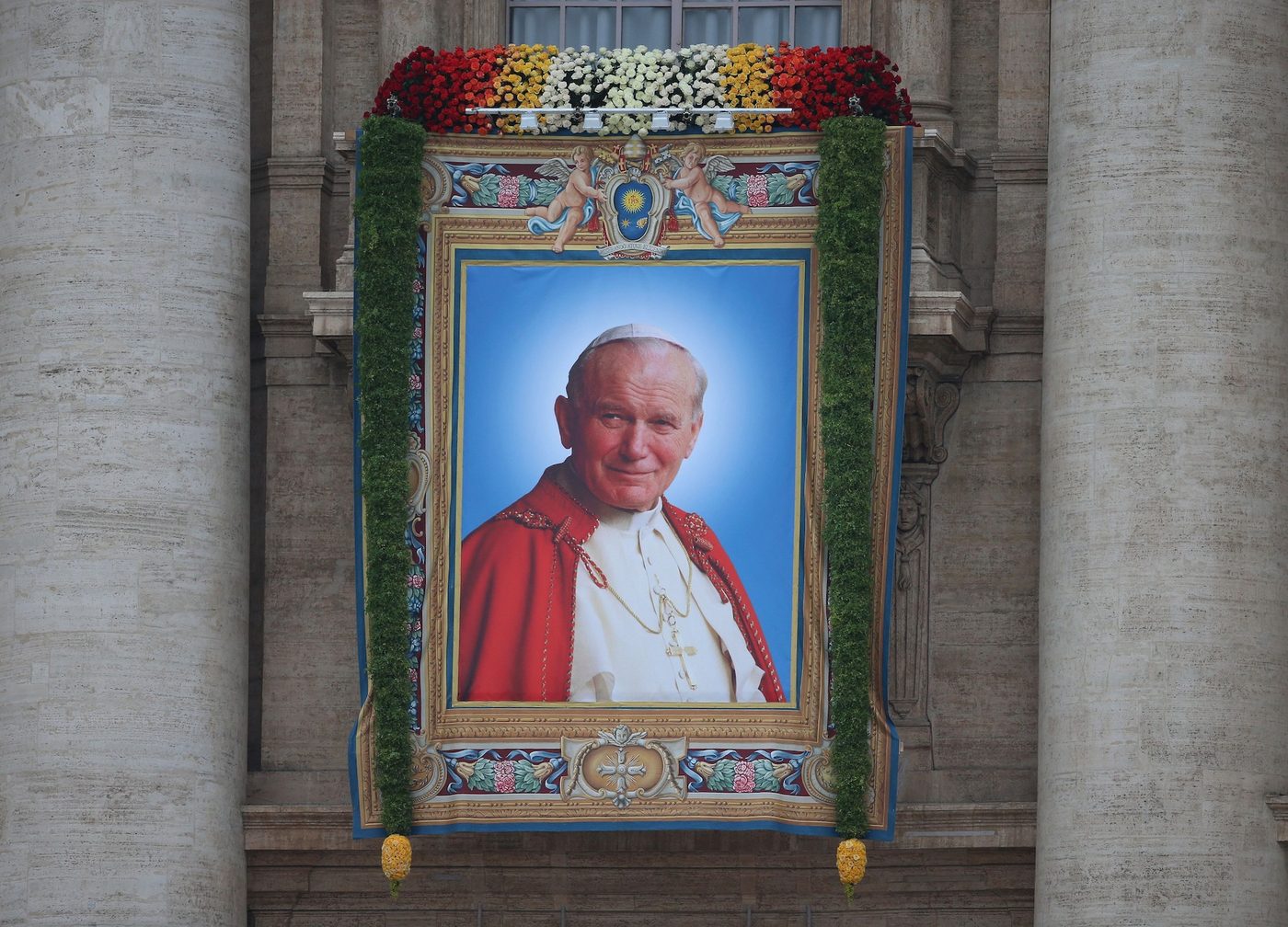
Today is the liturgical memorial of Pope St John Paul II, aptly described by Pope Francis during the canonisation homily last year as “the Pope of the Family.” Several aspects of John Paul’s experience of the family, teaching about the family and defence of the family seem worth a reflection on this special day of gratitude for his life and witness, as Synod-2015 begins its last 72 hours of work. Środowisko, World Youth Day, and the Theology of the Body When he was elected the 264th Bishop of Rome on October 16, 1978, Karol Józef Wojtyła brought to the Chair of Peter more direct, personal, pastoral experience of marriage and the family than any pope in a very long time. That experience was also the foundation of his philosophical and theological reflection on human love. The results of that striking interaction of experience and reflection would change the pattern of education-for-chastity and marriage preparation throughout the more alert parts of the world Church. It all began in March 1949, when Cardinal Adam Stefan Sapieha, the Archbishop of Kraków, sent young Fr Wojtyła to the parish of St Florian’s, just north of the city’s Old Town, to start a second centre of campus ministry in a city replete with students. Out of that assignment came the circle of lay friends that John Paul II would later call his Środowisko, an essentially untranslatable Polish word that connotes “milieu” or “environment.” These friends first met him and each other when he was a young priest and they were undergraduates. And in the cloying, claustrophobic atmosphere and dull greyness of Stalinist Poland, intelligent Catholic young adults found in Fr Wojtyła a man with a remarkable capacity for listening-and-challenging: a priest who created zones of freedom in which they could be themselves and come to a deeper appreciation of their Christian and human possibilities. Couples formed; marriages were celebrated; children arrived and were baptised; and the circle of Środowisko grew, even as the poorly dressed, pious and friendly young priest they knew became a university professor, an auxiliary bishop, the Archbishop of Kraków, a father of the Second Vatican Council, a cardinal and then the Bishop of Rome. The friendships stayed green, and the people of Środowisko remained among John Paul II’s closest friends for his entire life – and sat behind the assembled heads of state at his funeral Mass. But there was more to this than a network of longstanding acquaintances. As I said to my son, Stephen, when we attended the golden wedding anniversary celebration of a Środowisko couple in Kraków in 2014, “The people here are the beginning of World Youth Day.” A lot may have changed in the world between the first years of what became Środowisko and the mid-1980s. But John Paul II was convinced – against the counsel of a lot of bishops – that young people could still be challenged to lead lives of heroic virtue, and were indeed looking for just such a challenge. World Youth Days are now a regular part of the rhythm of global Catholic life. Yet for all the attention they rightly get, these remarkable festivals, which no one but John Paul II imagined possible thirty-some years ago, were not the only by-product of Karol Wojtyla’s pastoral ministry to young couples and young families. Among the other by-products were the book Love and Responsibility and the Wednesday general audience addresses that came to be known as the Theology of the Body – two staples of serious catechesis and marriage preparation work in the vital parts of the Church in the developed world. For Karol Wojtyła was a genuine intellectual who refined and deepened his experience – including his experience of counseling young souls and young couples – in rigorous thought that brought together the best of classic Catholic thinking with modern methods of philosophical and theological analysis. Ultimately, of course, John Paul II “refined” his experience in prayer. His prayer, however, was not detached from his thought; his prayer deepened and enriched his intellectual work. Synod-1980 and Familiaris Consortio This is the background against which to understand the second point for reflection on St John Paul II Day during Synod-2015: the Synod of 1980 and the apostolic exhortation, Familiaris Consortio, issued by John Paul II in November 1981. It is no secret that some bishops came to Synod-1980 with a dramatic agenda in mind: the repeal, or at least the de facto burial, of Paul VI’s 1968 encyclical, Humanae Vitae, on the morally appropriate ways to regulate fertility. John Paul II, for his part, thought that, while Paul VI’s teaching might have been better heard through a more personalistic presentation of its truths, Pope Paul had been absolutely right in his description of what a “contraceptive mentality” would do: it would congeal the instinct of generosity toward the future that is an absolute moral and cultural requirement for begetting children. And in doing so, it would lead to a further deterioration of marriage and the family. At the root of it all, John Paul II taught in Familiaris Consortio, was a false idea of freedom: freedom as willfulness. Such a notion inevitably led to the false idea of the family as an accidental aggregate of people who live together because it’s in their mutual interest to do so. In a thoroughly humanistic rebuttal to this desiccated notion of family life, John Paul II insisted that marriage can never be a mere contract, a utilitarian convenience, because human beings are made “through love” and “for love,” such that love is “the fundamental and innate vocation of every human being”: a vocation that is at the heart of marriage and the family. Understood in those terms – and, for Christians, through the redemptive truth about self-sacrificial love confirmed by the Cross and Resurrection – the duties, obligations, and sacrifices of married life and family life come to be seen, not as restrictive, but as liberating. Marriage and family life become agents of liberation from the prison of selfishness, releasing us into the far more humane experience of self-giving. Thus the family, for Catholics, is the “domestic Church” – one specific, grace-energised way to live the Christian vocation to love, and to love in communion with others. And the community of the family – familiaris consortio – is one of the primary antidotes that the Catholic Church offers to what Wojtyła had long ago identified as the great threat to the human future: the “pulverisation” of the human person, the reduction of men and women to the playthings of impersonal historical or economic forces; the degradation of the human by the rigid application of a criterion of utility, rather than dignity. The 1994 Cairo World Conference on Population and Development The third “moment” in the life and work of John Paul II that bears reflection as the Church marks his feast day during Synod-2015 takes us back over two decades, to the decennial UN conference on population and its relationship to development, held in 1994 in Cairo. That conference was intended by the population-controllers at the UN Fund for Population Activities and their Clinton Administration allies in Washington as the occasion to ratify abortion on demand as a fundamental human right, to be understood on a par with religious freedom and free speech. The further object of the exercise was to wrap the sexual revolution – in which abortion was understood as an essential component of “liberation” – in the mantle of international agreement and, eventually, international law. The juggernaut behind this agenda had rolled, largely unimpeded, through several years preparatory conferences, and seemed set to steamroll its way through the culminating Fourth World Conference on Population and Development at Cairo. Then John Paul II stepped in. After sending a letter to the UN Secretary General and every head of state in the world, questioning what was planned for Cairo, the pope led a personal campaign of resistance to the population controllers’ agenda throughout the summer of 1994, in a series of general audience and Angelus addresses that sought to rally world opinion to the defence of women and the unborn, the defence of marriage and the defence of the family as the fundamental unit of society. I describe the results of this unprecedented papal intervention in global population politics, and the skullduggeries that went on before and during the Cairo Conference, in Witness to Hope; suffice it to say here that the worst of the population controllers’ agenda was defeated and the conference final report stated that “in no case should abortion be promoted as a method of family planning.” Abortion on demand was not recognised as a fundamental human right, while the rights and responsibilities of parents toward their teenage children – which the population controllers wanted to abrogate in the name of sexual “liberation” – were reaffirmed. Public moral argument, it seemed, still had a place in the affairs of nations. Then and Now It’s not difficult to see parallels in all this to the concerns of Pope Francis and Synod-2015. Spiritually and intellectually serious young Catholics in late-Stalinist Poland were young people “on the peripheries” of a totalitarian society determined to remake human beings in the image of New Soviet Man. Yet, under the tutelage (“pastoral accompaniment”) of an inspirational priest who was also their friend, those young men and women and their families became the seedbed from which grew the best of contemporary Catholic catechesis on chastity and the most effective of contemporary Catholic marriage-preparation programmes. In the early 1980s, the number of walking wounded, stumbling across the battlefield of a modern culture cratered by the impact of the sexual revolution and its dissolution of fundamental human relationships and bonds, was accelerating. Familiaris Consortio proposed a “field hospital” for those walking wounded in the Catholic family, and in a distinctive Catholic feminism that declined to turn women and their unique gifts into simulacra of men. Then there is the danger that Pope Francis has described as the “ideological colonisation” of the world by population controllers and their allies in governmental and international development agencies. John Paul II’s dramatic efforts to change the course of the Cairo World Conference on Population and Development suggest that the Catholic Church has the conceptual resources to resist that imposition of decadence in the name of “development” – if its leaders have the nerve to stand against the Zeitgeist and be shepherds who defend the flock against predators seen and unseen. All of which suggests that there are striking parallels between the holy man whose feast we celebrate today, and the successor whom he called out of a kind of exile into a more capacious role in his local Church – and ultimately to the leading role in the world Church. George Weigel, Distinguished Senior Fellow and William E Simon Chair in Catholic Studies, Ethics and Public Policy Center