

August 16, 2026

NFP and IVF: two visions of human love

Michael J Robinson
More
Related
Min read
share

IVF is not an easy subject to talk about – And that’s hardly surprising. Behind every conversation about fertility treatment there’s a story. A husband and wife longing for a child. Months becoming years. Hope followed by disappointment. Prayers that seem to go unanswered.

Infertility isn’t simply a medical problem to be fixed. For many couples, it’s a profound sorrow. Any conversation about IVF that does not begin by acknowledging that suffering has begun in the wrong place.

The Catholic Church certainly does not dismiss it. She encourages research into infertility, supports treatments that genuinely restore or assist fertility while respecting the dignity of marriage, and asks us to accompany couples carrying this particular cross with compassion, friendship and hope.
But compassion does not mean we stop asking difficult questions. And we’ve been asking the wrong one.

The debate about IVF is usually framed around whether the Church is “for” or “against” it. But I wonder if that misses something much more interesting. What do IVF and its often-overlooked counterpart, Natural Family Planning, tell us about the way we understand love, marriage, children and, ultimately, the human person?

At first, comparing NFP and IVF seems rather odd. One belongs in marriage preparation courses, the other in fertility clinics. One is associated with couples trying to understand their fertility, the other with couples desperately hoping to overcome infertility. What could they possibly have in common?

Quite a lot, as it happens. Both begin with the same reality: human fertility. But they respond to it in very different ways. Natural Family Planning starts with a simple idea. Fertility isn’t a problem to be solved. It’s a gift to be understood. It asks husbands and wives to work with the natural rhythms of the body rather than suppress or bypass them. That requires communication, patience, generosity and, yes, self-control.

That’s why NFP has never been, nor should be considered, “Catholic birth control”. At its best, it reflects something much bigger. It’s a vision of marriage in which husband and wife learn to receive one another completely, including their shared fertility.

There is something else about NFP that is easily missed. It does not promise complete control. A couple can understand their fertility, make responsible decisions and have serious reasons for seeking or postponing pregnancy. But ultimately, they are working with something they did not create and cannot completely command.

But perhaps that’s part of the point. We have developed a strange habit of assuming that if something is difficult, there must be something wrong with it. Yet most things worth believing in, and certainly most things worth fighting for, ask something of us. Marriage does. Parenthood does. Faith does. Why should the responsible exercise of our fertility be any different?

Christian love has never meant the fulfilment of every desire as soon as we experience it. Sometimes love means waiting. Sometimes it means self-denial. Sometimes it means putting the good of another person before what I happen to want in that particular moment.

That might sound restrictive to modern ears. Christianity has another word for it: freedom. Not freedom from every limit, but the freedom that comes from learning to master ourselves rather than demanding mastery over everything around us.

Paul VI did not pretend in Humanae Vitae that this would always be easy. He acknowledged that periodic abstinence requires self-discipline and perseverance. Yet he also believed that those demands could foster thoughtfulness, responsibility and a deeper consideration between husband and wife.

So NFP is not simply a technique for managing fertility. It asks us to adopt a particular posture towards our bodies, our spouse and ultimately towards life itself. We receive rather than seize. We cooperate rather than command. IVF starts somewhere different.

And we need to be careful here because the motivation behind IVF is so often deeply moving. Couples do not pursue it because they reject children. They pursue it precisely because they desperately want one. That longing is good. The desire to become a mother or father is deeply human. But a good desire does not automatically make every means of fulfilling it good.

The Church’s concern has never been that a child conceived through IVF is somehow less precious. Quite the opposite. Every child, however he or she was conceived, possesses exactly the same human dignity and is made in the image of God.

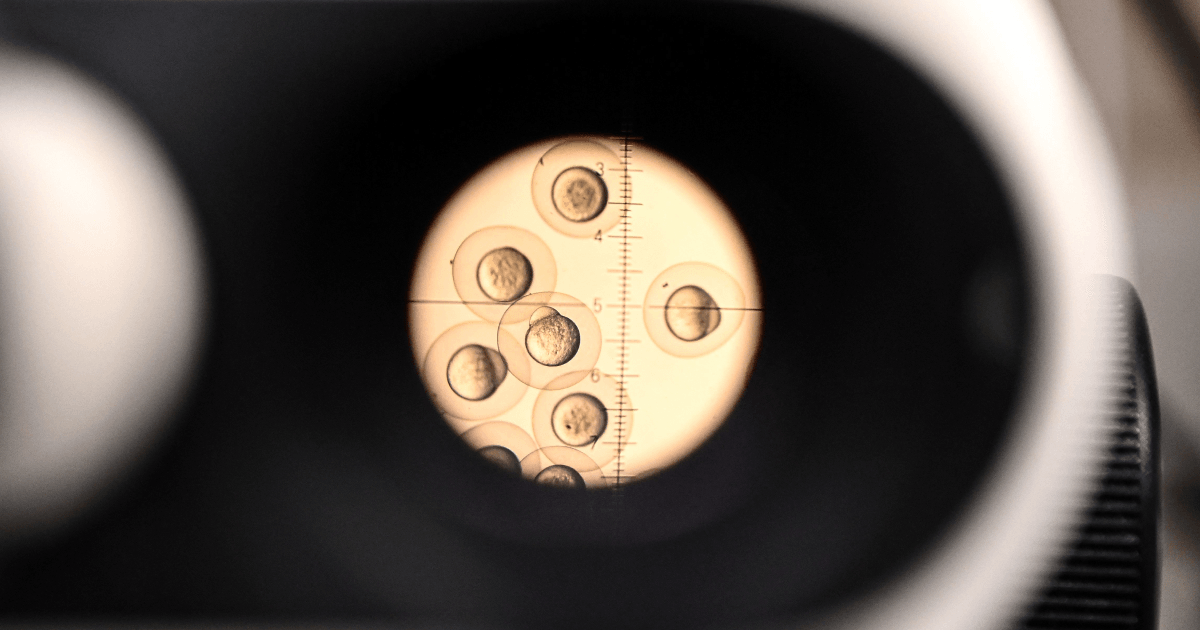
So the question isn’t about the child. It’s about the means by which that child comes into being. IVF moves conception from the marital embrace into a clinical process. Human embryos are created outside the body, often with more embryos created than will ultimately be transferred. Some may be frozen, some screened and some may never be implanted.

That takes us to the heart of the issue. The debate about IVF isn’t really about whether technology is good or bad. It’s about something much deeper: are children ultimately gifts to be received or outcomes to be achieved?

Technology, of course, can be a wonderful servant. Modern medicine has saved countless lives and relieved suffering on a scale previous generations could scarcely have imagined. Christians should celebrate that.

But technology doesn’t just change what we can do. Over time, it can change the way we think. Once reproduction becomes a technical process, technical questions naturally follow. Which embryos have the greatest chance of successful implantation? Should they be genetically screened? How long should frozen embryos remain in storage? What happens to those who are never implanted?

These aren’t hypothetical questions. They’re the inevitable questions of a system in which the beginning of human life has entered a laboratory setting.

There’s another connection here that I think we sometimes miss. Contraception and IVF are usually presented as moral opposites. In one obvious sense, they are. Contraception separates sex from children. IVF separates children from sex. The motivations are completely different. One seeks to prevent conception, while the other often comes from the heartbreak of being unable to conceive. But underneath both sits a surprisingly similar idea: that fertility is something we should increasingly be able to manage and control.

And that is why I do not think the Church’s teaching on IVF can really be separated from Humanae Vitae. When Pope Paul VI reaffirmed the Church’s teaching on contraception in 1968, plenty of people thought he simply didn’t understand the modern world. But his deeper concern wasn’t just about contraception. It was about what might happen to our understanding of sex, marriage and human life once fertility became something over which we expected ever greater control.

Nearly sixty years later, perhaps we should give that warning another hearing. This is where things become slightly uncomfortable for those of us in the pro-life movement. We’re very good at talking about the unborn child in the womb. We’re much less comfortable talking about the unborn child in the laboratory.

Why? Partly, I suspect, because this is so personal. Almost every parish has families touched by infertility. Many Catholics have children or grandchildren conceived through IVF. This needs saying clearly: those children are no less precious, no less worthy of celebration and no less loved by God than anyone else. But surely that cannot be the end of the conversation.

If we really believe that a new human life begins at conception, then should we not care just as much about the embryo in a fertility clinic as the embryo in the womb? It’s an uncomfortable question, but an important one. This is not an accusation. It is an invitation to consistency. The pro-life movement has always been at its strongest when it has defended human dignity without exception. An embryo in a laboratory freezer does not become less human simply because we cannot see him or her.

Perhaps Catholics have a blind spot here too. We’re often confident explaining why the Church opposes abortion. Some Catholics can explain her teaching on contraception. But ask about IVF and the conversation can become much less certain. Maybe that’s partly because we have presented the Church’s teaching in the wrong way. Christian morality isn’t supposed to be a collection of arbitrary prohibitions. The Church’s teaching on abortion, contraception, IVF and the dignity of marriage belongs to a coherent vision of what the human person is.

At the centre of that vision is an idea our culture increasingly struggles with: not everything we deeply desire can become something to which we are entitled. And perhaps that’s where NFP suddenly looks rather more radical than we give it credit for. In a culture obsessed with efficiency, it asks for patience. When we’re told that freedom means removing every limitation, it asks for self-control. And in a world increasingly convinced that every human problem must have a technological solution, it reminds us that some things are received rather than made. That’s a profoundly counter-cultural idea.

The Catholic vision isn’t anti-science. Nor is it indifferent to the anguish of the couple who longs for a child and cannot conceive. It simply asks us not to lose sight of something fundamental in our desire to overcome that suffering. A child is never simply the answer to our longing. He or she is a person in their own right. A gift before being the fulfilment of anyone else’s hopes, and someone whose dignity exists from the very first moment of life.

Perhaps, then, the question we should ask about advances in reproductive medicine isn’t simply: “Can we do this?” We should also ask: “What does doing this teach us about how we see one another?” Do we receive human life as something given to us, or do we increasingly regard it as something we can produce, select and control? That’s the question sitting beneath much of the debate about IVF. And perhaps it’s also the question Natural Family Planning has been quietly answering all along.

Michael J Robinson is the executive director of SPUC, the world’s oldest pro-life NGO and the UK’s largest.

Continue reading with a free account

Create a free account to read up to five articles each month
Create free account

You have # free articles remaining this month.

Subscribe to get unlimited access.
Sign up

subscribe to the catholic herald today

Our best content is exclusively available to our subscribers. Subscribe today and gain instant access to expert analysis, in-depth articles, and thought-provoking insights—anytime, anywhere. Don’t miss out on the conversations that matter most.
Subscribe