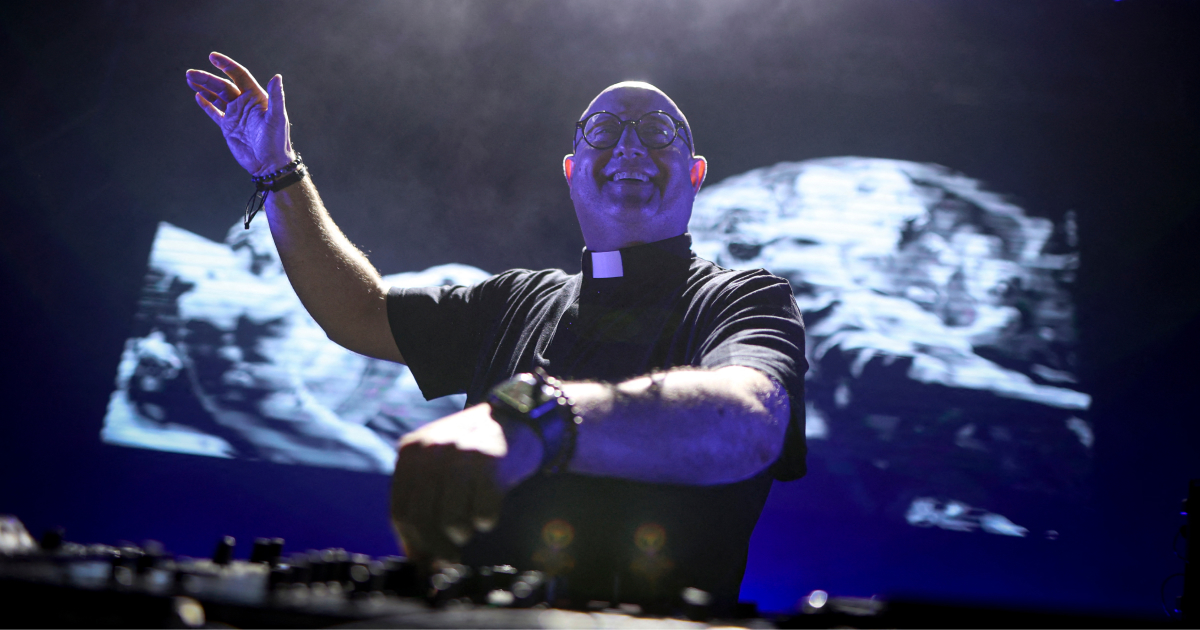


The priest, Guilherme Peixoto, widely known as Padre Guilherme, performed at the AHM nightclub in the Lebanese capital after a summary affairs judge dismissed a complaint lodged by a group that included clergy, who argued that the concert undermined Church values and misrepresented Christian ritual.
Earlier that Saturday, Padre Guilherme presided over the Eucharist at the University of the Holy Spirit of Kaslik, north of Beirut, concelebrating with a Lebanese priest before a large congregation of students and families. Speaking before the liturgy, he defended his musical work as part of his ministry, saying: “The Psalm asks us to praise the Lord with all instruments, so now you have this new instrument that is electronic music.”
That evening, he took to the stage at AHM nightclub before an audience estimated at around 2,000 people. The performance followed the rejection, one day earlier, of a legal complaint lodged by a group that included clergy, which sought to block the event on moral grounds. The petition argued that a priest performing as a DJ in a nightclub undermined Church values and misrepresented Christian ritual. A summary affairs judge dismissed the request, allowing the concert to proceed.
Organisers had announced in advance that no religious symbols would be displayed during the show and that Padre Guilherme would not appear in clerical dress. In contrast to the white robe he wore while celebrating Mass in Kaslik, he arrived on stage in normal clothes, a condition agreed following the complaints. The set lasted around two and a half hours and consisted largely of electronic dance music with heavy bass, punctuated by brief musical interludes. Visuals projected behind him included images of white doves and photographs of Pope John Paul II. At one point, he dedicated a track to Lebanon and waved a Lebanese flag, drawing cheers from the crowd.
Born in Guimarães in northern Portugal in 1974, Padre Guilherme was ordained in 1999 and serves in the Archdiocese of Braga. Alongside parish ministry, he has worked as a chaplain to the Portuguese armed forces, including deployments to Kosovo and Afghanistan. It was during a mission in Afghanistan in 2010, while organising social events for soldiers, that he first began DJing.
After returning to Portugal, he undertook professional training and began hosting club nights to raise funds for parish projects. During the Covid-19 pandemic, he started streaming weekly DJ sets online, combining electronic music with religious and folk elements, which brought him international attention. In 2023, he appeared at World Youth Day in Lisbon, performing outdoors shortly before a papal liturgy, an appearance that went viral online. He has since played at venues and festivals across Europe and Latin America.
The controversy surrounding Fr Guilherme Peixoto is not only due to generational differences. For many conservatives, it concerns the limits of missionary adaptation and the meaning of priestly representation in public life. It also raises questions about how far the Church can go in adopting the language and spaces of contemporary culture without losing clarity about who the priest is and what he signifies.
The priesthood is not merely a private individual with a set of hobbies, but a man configured sacramentally to Christ and publicly entrusted with a distinct ecclesial office. Catholicism has never been puritanical about personal pleasure or creativity, nor suspicious of culture as such. Yet it has always insisted that a priest’s public conduct, appearance, and associations carry symbolic weight, shaping how the faithful understand the Church herself. The Beirut DJ performance forces Catholics to ask not whether priests may engage the world, but how, and at what point engagement risks becoming confusion.
Padre Guilherme has been careful, and in some respects commendably clear, about the limits of his musical activity. Speaking to Irish broadcaster RTÉ, he stated: “It’s not music to play in church, it’s not music for Mass. It’s music to bring the Church outside the church.” That distinction is theologically consistent with Catholic teaching. The Church has always distinguished between sacred music ordered to the liturgy and other forms of cultural expression that may accompany Christian life more broadly. Missionaries have long adapted local customs, art forms, and music to communicate the Gospel beyond explicitly ecclesial settings.
There is also no reason to deny that priests, like lay people, remain human beings with talents, interests, and creative outlets. Catholic tradition has never required secular priests to abandon personality or culture, nor to live as hermits cut off from ordinary life. In that sense, an instinctive recoil from a priest engaging contemporary music would itself be misplaced.
The difficulty arises not from the fact of musical engagement, but from the particular cultural world into which that engagement is inserted. Nightclub culture is not morally neutral. It is shaped by assumptions about sexuality, intoxication, anonymity, and spectacle that sit uneasily with the Church’s understanding of the human person and the ordered pursuit of joy. Even when particular events are restrained or well managed, the symbolic world of the nightclub and DJ culture remains bound to a vision of degeneracy that is fundamentally at odds with the priestly vocation.
This is why clerical discipline historically placed such emphasis on visible distinction. Prior to the 1983 Code of Canon Law, priests were strictly obliged to wear ecclesiastical dress in public and were explicitly forbidden from adopting lay attire or participating in forms of secular life judged incompatible with clerical dignity. The cassock marked the priest as set apart for sacred service. Decrees from the post-Tridentine period through to the early twentieth century enforced this obligation with real penalties, out of concern for clarity and scandal.
In Lebanon, the organisers of Padre Guilherme’s performance insisted that he appear without clerical dress and that religious symbols be removed from the venue. Whatever readers may think of the prudence of that decision, its symbolic meaning is striking. The priest was permitted to perform only on condition that he cease, visually at least, to appear as a priest. That inversion should trouble Catholics more than the music itself. It suggests an implicit recognition that priestly identity is incompatible with the space he is entering, and must therefore be concealed.
Church history suggests the opposite. Christianity has spread not by mimicking every cultural form, but by offering a distinct and sometimes challenging alternative. When the boundaries between sacred and profane are blurred, it is rarely the world that is evangelised; more often, it is the faithful who are confused.
None of this denies Padre Guilherme’s sincerity or missionary intention, nor does it require a retreat into clerical isolation. It does, however, require renewed seriousness about the nature of the priesthood and the environments in which that nature can still be read. Evangelisation depends not only on going out, but on being recognisable when one arrives.