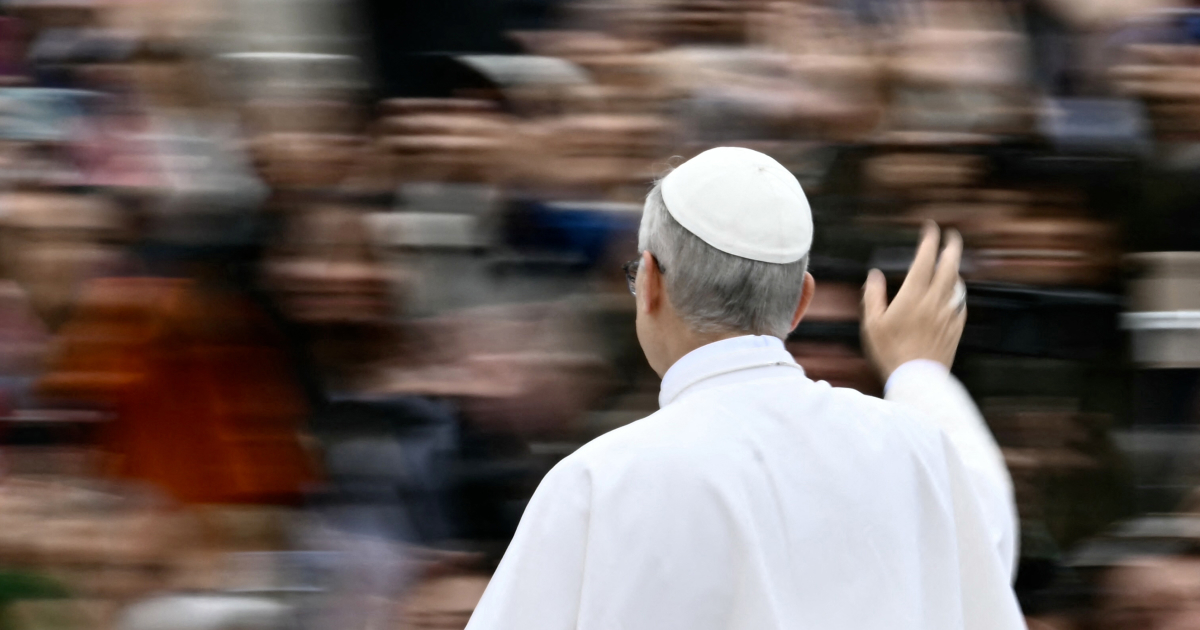


The nine months since the unexpected elevation of Cardinal Robert Prevost to the papacy as Pope Leo XIV have given the Church and the wider world an opportunity to understand a little better this unassuming Augustinian – the first American to occupy the ancient throne of Peter. As a bishop in rural Peru, Prevost tended to his flock unobtrusively, away from the glare of the press or commentariat. When he emerged on the balcony of St Peter’s Basilica to give his first blessing as supreme pontiff, the prognosticators had precious little to go on. By now, Leo’s words and his moments of silence, his actions and deliberate restraint, give clues as to the man, his leadership and the tone of his papacy.
In governing the Church, Leo’s reign so far has been in marked contrast to that of his immediate predecessor. Where Francis was ever ready to shoot from the hip and deliver an offhand comment to an eager and waiting press corps, the new pontiff exudes a measured calm. Improvisations are precious few, with Leo giving a sense that his words are weighed rather than scattered. While he did speak with reporters on the flights to and from his official visit to Turkey and Lebanon, Leo has generally retreated from the paparazzi papacy of Francis.
There have been hiccoughs along the way. Last September, Leo was caught off guard when confronted by a reporter about Cardinal Cupich’s plan to give a lifetime achievement award to the vehemently pro-abortion Senator Dick Durbin of the Pope’s home state of Illinois, based on the politician’s work on immigration reform. Leo clearly had no knowledge of the award, admitting he was “not terribly familiar with the particular case” and continuing to express the view that dealing with life issues in politics can be incredibly complex. After some days, a resolution to the crisis was found by which Senator Durbin decided he would not accept the award, but Cupich’s initial decision and the reporter’s question clearly left the Pope embarrassed.
Both Leo and his predecessor are marked by informality – but in very different ways. Francis’s informality seemed edged with intent and purpose, whereas Leo’s seems natural and unaffected. This allows Leo to achieve a reassertion of papal reserve without coming across as cold or distant, while leaving some Vatican watchers struggling to decode him. The Argentine pope gave his pontificate the full force of his personality, while his American successor has leant further into prioritising the institutional authority of his office over his own individuality in his public dealings.
A more consequential shift may lie less in the personality of the pontiff than in the internal psychological climate of the Church in response to it. Speaking to clergy on the front lines of parish life, one repeatedly encounters a word that would have been used far more sparingly a year ago: relief. The volatility of the Francis years sometimes caused confusion for the faithful and consternation for many priests left to pick up the pieces when off-the-cuff remarks to journalists were singled out for heightened attention.
Far worse was the printing of things he did not say at all. Pope Francis insisted on granting multiple interviews to the now deceased journalist Eugenio Scalfari, an atheist veteran of the Italian press and one of the co-founders of the leftist daily La Repubblica. After the first of these interviews was published, the Vatican press office was forced to concede there were errors in the journalist’s record of the encounter. Scalfari admitted he neither took notes during the interview nor tape recorded it. It is difficult to interpret Francis’s decision to grant multiple further (presumably unrecorded) interviews to Scalfari – including one in which the reporter claimed Pope Francis had doubted the existence of hell – as anything less than extreme carelessness.
The sense of relief attested to by clergy is not born of ideological triumph but of the easing of volatility. Leo’s first few months have coincided with what might be termed a decompression phase – a lowering of institutional blood pressure after a decade lived at rhetorical and administrative intensity. The subtleties of tone have played a large part in this recalibration.
Francis often spoke of priesthood in corrective terms with a negative, scolding aura – warning against careerism, clericalism, rigidity or spiritual worldliness. The critiques were not without foundation, but their cumulative effect on many faithful priests was wearying. Leo has adopted a markedly different register, as attested in his February 2026 letter to the clergy of Madrid in which he compared the priesthood to the cathedral of the Spanish capital.
“By contemplating its façade,” His Holiness wrote, “we already learn something essential. It is the first thing one sees, and yet it does not say everything: it points, it suggests, it invites. In the same way, the priest does not live to put himself on display, but neither does he live to hide. His life is called to be visible, coherent and recognisable, even when it is not always understood. The façade does not exist for its own sake: it leads inside. In the same way, the priest is never an end in himself. His entire life is called to refer to God and to accompany the passage towards the Mystery, without usurping its place.”
The Pope developed his theme further, describing the various architectural features of the cathedral and how they align with the nature of the priesthood and the life of the Church. When he speaks of priests, Leo tends to do so aspirationally rather than admonishingly – presenting the beauty of the vocation without being naive about its dangers.
This rebalancing of tone matters because the priesthood is already an exposed vocation. Clergy live publicly sacrificial lives in cultures that are at best indifferent and at worst openly hostile to their role. Where priests feel themselves rhetorically mistrusted by their own ecclesiastical leadership, morale erodes quickly. One priest I spoke to described the phenomenon as similar to failures in marriage: contempt, rather than open conflict, is the surest sign of breakdown. Even occasional papal remarks that seemed to caricature priestly motivations had disproportionate psychological effect in our well-connected age. Leo’s language, by contrast, has restored a presumption of goodwill and the priesthood as something to cherish and celebrate.
This is not to suggest that Leo is uninterested in reform or blind to clerical transgressions, but he appears to believe that priestly renewal begins with confidence rather than chastisement. In this sense he is less a diagnostic preacher than a formative one. He does not possess the deep theological virtuosity of Benedict XVI, but he exhibits a reflective depth that commands attention.
Large parts of the Church continue to face the challenge of stubbornly low numbers when it comes to attracting and fostering vocations to the priesthood. Western Europe and North America continue to experience contraction, while parts of Africa and Asia display resilience or growth. Previous pontificates produced discernible morale effects – a modest “Benedict bounce” in certain dioceses followed by a more complex “Francis effect”, energising missionary discourse but sometimes unsettling traditional seminary pipelines. It is far too early to identify a “Leo effect”, but vocations directors and seminary rectors will be watching closely. It takes time to form and foster a vocation to the priesthood. Understandably, vocational confidence tends to lag behind pontifical tone by several years, and during Francis’s pontificate, orders often had greater success than dioceses in recruiting young men.
Parallel to the cooling of clerical anxiety has been a reduction in the factional temperature within the Church. Over the past decade, papal allegiance acted as a proxy for ecclesial identity. Catholics spoke, only half jokingly, of “Francis Catholics” and their opponents. Leo is defining his pontificate neither as the perpetuation of his immediate predecessor’s nor as a repudiation of it. Acting as the calm “centrist dad” of pontiffs denies both Francis’s admirers and detractors the polarity that undermines the health and unity of the Body of Christ.
Nowhere is this more evident than in the handling of liturgical tensions. The question of the Extraordinary Form, so incendiary in recent years, has not vanished, but neither has it dominated Leo’s early governance. There has been no theatrical revisiting of restrictions, nor any appetite for juridical escalation. The temperature has simply been allowed to fall. Several bishops have interpreted this not as indifference but as an invitation to a more pastoral – rather than ideological – management of the question.
The Society of St Pius X remains the most deeply charged unresolved file. Francis’s reign beheld both progress and setbacks in the move to remove the Society’s awkward and irregular status. That irregularity has not been resolved, and their continued objections to the post-conciliar liturgy complicate any settlement. Leo’s instincts appear conciliatory – he is by temperament a bridge builder – but the prospect of further illicit episcopal consecrations by the SSPX is a serious challenge to the new pontificate. How he proceeds here will offer one of the clearest windows into his conflict-resolution model: whether unity is pursued through incremental concession, juridical clarity, unguarded generosity or patient stalemate.
The choice of Erik Varden – the Trappist monk and Bishop of Trondheim – to lead this year’s Lenten retreats for the Roman Curia is among the more revealing indications to date of Pope Leo’s liturgical disposition. A native Norwegian, Varden was received into the Church while still a teenager studying at Cambridge, where he remained to complete a doctorate in theology before entering the English Trappist abbey of Mount Saint Bernard in Leicestershire in 2002.
The polymathic monk went on to teach Syriac, monastic history and Christian anthropology at the Anselmianum in Rome, as well as studying music under the late Gregorian chant expert Mary Berry. In 2015, he was elected abbot of Mount Saint Bernard, but was called back to his native land in 2019 to serve as bishop of the territorial prelature of Trondheim. In that role, as well as in his monastic career, Varden has proved a friendly advocate for the faithful attached to the traditional rites of the Church’s liturgy.
Varden is no triumphalist reactionary. He moves with ease in ecumenical circles and last year gave a Lenten reflection on suffering at the invitation of the Anglican St Paul’s Cathedral in London. His brother bishops across Scandinavia testify likewise to his collegiality, having elected Varden president of the Nordic Bishops’ Conference. That a figure so openly sympathetic to traditionalists has been chosen to preach reflections to the Vatican’s highest-ranking clerics is therefore significant – while also characteristic of the reigning pontiff’s gentler, more diplomatic mode of governance.
If Leo’s rhetorical posture is far from combative, it would still be a mistake to confuse tonal moderation with doctrinal elasticity. Those close to him describe a man disinclined to culture-war theatrics yet entirely prepared to defend doctrinal boundaries when pressed.
In interpreting Vatican II, Leo has adopted a hermeneutic closely aligned with Benedict XVI’s thesis of continuity. He cites the Bavarian pope more frequently than Francis did in conciliar contexts, evoking development rather than rupture. These quotations and the thinking behind them have the potential to develop into a catechetical initiative aimed at recovering Vatican II from both reactionary dismissal and progressive overextension, reanchoring the Council within the Church’s longer doctrinal arc.
Germany remains the most structurally sensitive potential field of battle. The proposals of the German “Synodal Way” – touching governance, sexuality and sacramental theology – pose not merely disciplinary but ecclesiological questions. Previous suggestions put forward by the process – and greenlit by some bishops – include allowing divorced and remarried Catholics, as well as Protestants married to Catholics, to receive the Eucharist; blessing non-traditional “unions” that fall short of the validity of marriage; and even reopening the question of admitting women to ordained ministry.
To be fair to Pope Francis, his reactions to these proposals varied from clearly dismissing them to firm and outright opposition. Papal leadership does not seem to have produced any further clarity of thinking on the part of liberal laity involved in the German synodal process and the bishops who support them. Even though Archbishop Woelki of Berlin proclaimed that, for him, the Synodal Way is “over”, the final assembly of the project voted to establish a new permanent conference of laity and bishops to cement the process into the organisational structure of the Church in Germany. This proposal awaits Vatican endorsement or disapproval.
Leo has already shown a willingness to speak with unusual directness when doctrinal integrity is perceived to be at stake. During remarks on a return flight from the eastern Mediterranean, he spoke of the need to make sure the Synodal Way “does not … break away from what needs to be considered as the pathway of the universal Church” – language more upfront than his usual register. It signalled that while he prefers de-escalation, he will not preside over doctrinal fragmentation.
Administrative reform, particularly financial transparency, remains an expectation attached to Leo’s American background. The reputation for managerial rigour that often – but far from universally – accompanies American ecclesiastical leadership has not yet translated into headline reforms. Financial governance appears to sit in the queue behind other priorities, and previous champions of transparency like the late Cardinal Pell were left with their fingers seriously burned by those with something to hide.
Another challenge likely to arise during the next years of Leo’s papacy is the question of institutional Catholic identity. From his time in Peru, Pope Leo will know the case of the Pontifical Catholic University of Peru in Lima. In the 2010s, the 20,000-student institution was placed under visitation for failing to implement Pope St John Paul II’s 1991 exhortation Ex Corde Ecclesiae. It was stripped of its pontifical and Catholic status for four years, until 2016, and the underlying disputes remain only partially resolved.
In the Netherlands, Radboud University – founded in the 1920s as the first Dutch Catholic university since the Reformation – has likewise faced scrutiny over its Catholic identity. In 2020, the Dutch bishops clashed with the university over board appointments they judged insufficiently Catholic, fearing the erosion of an institution they had long sponsored. When dialogue failed, the bishops removed its Catholic status, though an appeal to Rome saw the designation restored in 2022.
In both Peru and the Netherlands, formal settlements have masked unresolved tensions, exposing how fragile Catholic designation becomes when doctrinal accountability weakens. If these or other cases come up, Leo’s Vatican will face a familiar dilemma: enforce identity and risk rupture, or tolerate drift and risk dilution. Failing a test case arising, institutions may be left to retain Catholic nomenclature while continuing to hollow out their substance.
Schools face a related, more practical crisis: the shortage of Catholic teachers and leadership capable of transmitting the Faith with conviction. Leo has framed education chiefly in anthropological rather than ideological terms, reaffirming in an apostolic letter last year that the family is the primary locus of formation. The many schools and other instructional institutions under the Church’s umbrella nonetheless remain widely respected but are intended as partners to parents in raising the next generation of Catholics. The horizon is crowded with potential flashpoints across continents: religious liberty litigation, educational autonomy, bioethical regulation and political disputes over sex and gender.
In the Roman Curia, Leo has largely retained the personnel he inherited from Francis. Having himself served as prefect of the Dicastery for Bishops, he appointed Archbishop Filippo Iannone – a canon lawyer and seasoned Vatican jurist – as his successor, signalling a willingness to rely on capable insiders.
He has also continued Francis’s practice of elevating women in religious life to senior curial roles, appointing Sister Tiziana Merletti as secretary of the Dicastery for Institutes of Consecrated Life, working alongside Prefect Sister Simona Brambilla.
Most major offices remain in the hands of Francis appointees: Cardinal Parolin at the Secretariat of State; Cardinal Fernández at the Dicastery for the Doctrine of the Faith; Cardinal Roche at Divine Worship; and Cardinal Czerny at Integral Human Development. Alongside them sits Matteo Bruni, the English-born lay head of the Vatican press office – a native English speaker whose presence offers practical advantages for an American pope.
Under Praedicate Evangelium, curial heads submit their resignations when they reach the age of 75. Czerny is nearing 80 and Roche reached the threshold last year, while Parolin and Fernández are younger. Leo’s handling of these roles – likely after the summer recess at Castel Gandolfo – will offer an early indication of his governing instincts.
The Secretariat of State remains the Curia’s powerhouse. Parolin is supported by deputy Edgar Peña Parra and foreign minister Archbishop Paul Gallagher. Parolin helped architect the Vatican’s 2018 accord with Beijing on episcopal appointments, an opaque agreement due for renewal in 2028. Leo’s own China posture is still difficult to read, though the early enactment of one diocesan restructuring in China planned during Francis’s pontificate suggests continuity for the moment.
Recent mid-level appointments within the Secretariat – reportedly made without the backing of Peña Parra or Gallagher – have fuelled speculation about future changes. Their eventual successors will help shape the direction of the Vatican’s most powerful department.
On a diplomatic and international level, the Pope’s travel plans will carry weight. A visit to Argentina would act as a gesture of pastoral continuity towards Francis’s homeland and perhaps a subtle act of reconciliation with constituencies there who felt overlooked by the late pope. Conversely, an early visit to the United States has been ruled out, perhaps to avoid stealing the thunder during celebrations of the 250th anniversary of the Declaration of Independence but also lest the papacy be seen to tilt geopolitically towards its incumbent’s native land.
Taken together, these strands suggest that Leo’s first year has been far from revolutionary – or reactionary – in content, but things are moving slowly and quietly. There have been no sweeping doctrinal reversals, no dramatic institutional purges, no manifesto encyclicals redefining the Church’s direction. Instead, there has been a change in mood and timbre: authority exercised quietly and conflict cooled rather than inflamed.
It might be tempting, particularly for commentators habituated to a period of papal dynamism, to mistake this for inertia. The history of the papacy, however, suggests that stabilisation phases often precede structural reform. Before a pontiff can move decisively, he must render the Church governable. Leo appears to understand this instinctively. He has slowed the tempo not necessarily because he lacks a vision, but because he recognises that pace itself had become destabilising.
The coming years will test whether this “slow papacy” can translate atmosphere into architecture of the Church’s life. Curial retirements and the choice of their successors will reveal his personnel instincts. The handling of the SSPX will demonstrate his model of conflict resolution. German synodality will almost certainly test his doctrinal red lines.
After a decade in which the Church often felt as though it lived in a state of tension, Leo has reintroduced rhythm, reserve and a little space for reflection. Whether that calm proves merely transitory or the foundation for something more substantial will determine how history ultimately judges his pontificate.