February 23, 2026

Lent at full strength

Dom Alcuin Reid
More
Related
Min read
share

Around Ash Wednesday we often hear that this year the parish (or even the diocese) is going to run a special Lent programme of Bible study or discussion or of learning about this or that type of spirituality or prayer. Such programmes often involve guest speakers, glossy brochures, extra meetings each week, etc. They cost a great deal of money, take up a great deal of time and involve a great deal of talk. And then they end, hopefully having brought about some good. Everyone is happy that something has been “done” for Lent and the people are content that they made an effort.

A Lent programme is essential. But whilst discussions, guest speakers and even glossy brochures could perhaps be of assistance, they themselves are not essential. Nor is the substantial dent in the budget. No, what is essential to making a good Lent is that we follow the Church’s own Lent programme. But what is that, we rightly ask?

The Church’s Lent programme is that which is set out in her Sacred Liturgy. That is to say that we must draw ever more deeply and fruitfully from the source and summit of our Christian life and mission – the Sacred Liturgy (the Mass, the Sacraments, the Divine Office and the other liturgical rites). It is already there in place waiting for us – we do not need to invent it. All we need to do is to drink ever more deeply of its riches.

Indeed, we must pray the Lenten liturgy this year, and every year God grants to us on this earth, with greater fervour, devotion and spiritual and apostolic fruitfulness. To put it another way, if you have a missal you have your Lent programme already in your hands. There is little need for much else (except for discovering the Divine Office, of course, which is something clergy could well arrange in Lent). Just open your missal and dive in more deeply. We can do the same with the riches of the breviary. All that we will find there, developed and handed on in centuries of tradition, is more than enough for a lifetime of Lents.

In Lent, however, as in no other season, the reform of the liturgy following the Second Vatican Council denuded the Sacred Liturgy, from the pre-Lenten season of Septuagesima to the clear and rich content of the proper prayers of the Mass (the collects, super oblatas and postcommunions). Their theology was considered too negative, with too much talk of penance and fasting, for the supposed needs of modern man some six or so decades ago. The reformed liturgical rites are, therefore, intentionally more supposedly “positive” in their outlook, something perhaps epitomised in the new formula for the imposition of ashes added as an option in the usus recentior: “Repent and believe in the Gospel,” which sits alongside (but usually in fact replaces) the traditional formula: “Remember, man, that thou art dust and unto dust thou shalt return.”

There is nothing intrinsically wrong with the injunction “Repent and believe in the Gospel.” Indeed, the prayers created for or placed anew in the modern missal are not of themselves erroneous or heretical. But they are much, much weaker. Compared to what preceded them, they could be described as “Lent-lite.” There was an intentional effort on the part of the reformers to make Lent seemingly more positive in its focus and less seemingly negative in the new liturgical texts: the ascetical disciplines are downplayed radically.

I would suggest that in the Church and world of today we do not need “Lent-lite.” We need it at full strength. We need to be confronted by the ascetical demands of the Christian faith and embrace the prayer, the fasting and the almsgiving to which the Church traditionally calls us through her Sacred Liturgy in this holy season of grace. Lent means penance. Lent should hurt. Lent should cost. Lent should cut. The tough demands of Lent should bring about some real and further conversion in my Christian life and vocation. This Lent should see me make real progress in overcoming vice, even if there will still be work to be done in future Lents.

And there is no better “resource” for this battle for ascetical progress, there is no better programme of action, than that laid down by the Church in her tradition in her unedited missal and breviary. Thanks be to Almighty God and to His providential instrument Pope Benedict XVI, these treasures have been rediscovered by many Catholics. That a Stalinist programme of shutting down this rediscovery in the last pontificate speaks for itself. It is not of God.

Lent has proper Mass texts for each day: different antiphons, prayers, readings and so on. These texts have, in most cases, been associated with the days upon which they are used for centuries – indeed many from the very earliest of times. These riches of our tradition give us more than enough each day – even, perhaps, too much – to be getting on with. They give us something new that we can savour each day for our nourishment and for guidance in our ascetical practices.

Participation in Mass as often as possible during Lent is fundamental and it is a sublime grace. But we must pray the Mass: preparation for it by pre-tasting its Gospel and other texts; by participating in the rites and chants and prayers and actions of the Mass with mind and heart and body whilst it is being celebrated; and by pondering – indeed contemplating – its riches afterwards as we engage in our daily work and other duties.

The daily Gospel of each day of Lent is fundamental. So too, I would suggest, is the collect of the Mass of each day. We can use it for private prayer not only at Mass but throughout the day – memorising it even. It will take seconds to pray, perhaps, but it will serve succinctly to recall to us that it is Lent, to teach us about its observance in mind, body and soul, and help us to remain awake to its call to ascetical disciplines.

We can go further, of course: the other proper prayers of the Mass, the Introit and Gradual in particular, are very rich indeed. But we need to be both prudent and realistic. If I can absorb more, that is good. But it is more important that my heart, mind and soul are nourished and formed on something than that I risk spiritual indigestion by trying to take in too much too quickly. Please God we shall be given other Lents in which we can digest more.

If we do faithfully follow the daily Lenten liturgy we shall very quickly be confronted by the Ember days – the particularly intense days of prayer and fasting in the Church’s year which occur four times each year and in Lent in the first full week of the season. These days were abolished in the post-conciliar liturgical reform, sadly, but there is no reason that we cannot observe them as a particular act of piety: there are, after all, many reasons to pray and fast and do penance more – in the Church, the world and in our own battle against temptation and sin.

We should note that the liturgical texts, including the extra Scripture readings, of the Ember days (in the older missal) are of very ancient origin. And their prayers call us unashamedly to fasting and abstinence.

We should also be clear that the Ember days are “days.” That is, in the Church’s year this coming Wednesday, Friday and Saturday are different – they have a particular importance in the Lenten season. What we do on these days should, in so far as possible, be utterly penitential. Our meals or collations should reflect their call to prayer and fasting – not just on Friday, but on Wednesday and Saturday as well. It would be incongruous for any Catholic seeking to live according to the Church’s liturgical tradition to be feasting on Ember Friday, or on Wednesday, or on Saturday (before Vespers). Liturgically, these days should not be occluded without “first class” reasons, as it were.

That is all to say that there needs to be a profound harmony between how we pray and how we live. Living the liturgy changes us. It demands sacrifices of us. It gives us occasion for evangelical witness to the secular world which simply does not comprehend why we would and should decline an invitation “because it is an Ember day.” As Catholics we certainly know how to feast on feasts. But the Church, through her Sacred Liturgy developed in tradition, reminds us that we must also know how to fast during a fast. And such are the Ember days, if not indeed all days of Lent.

Lent is a time to make more space for prayer and many good people will carve out of a busy schedule some time of a morning or an evening for just that. There are many devotional and spiritual practices approved by the Church and we are free to adopt those we judge to be appropriate. The pious person who devoutly prays the simplest of devotional prayers may be many times more holy than the priest or religious who is nevertheless unwilling to create the space in which Almighty God can speak to him or her.

And yet the Sacred Liturgy enjoys an objectivity and a priority over all other spiritual practices or devotions, however good or cherished they may be in themselves. Meditation may mediate God’s will. The rosary and Stations of the Cross without doubt assist people in entering into the mysteries of our salvation. But in praying the Sacred Liturgy we enter into the objective work of Christ in our world: we plug into the greatest source of grace that is available to us in this life.

The Sacred Liturgy is far more than the offering of Holy Mass. In the context of “extra” Lenten prayer one turns naturally to the praying of the Divine Office. If a parish wants a Lenten programme it could celebrate Lauds and Vespers publicly each day. It could help to form and prepare people to pray parts of the Divine Office privately, or in families or other groups. For in doing so we are praying the prayer of the Church, of Christ Himself, which is far greater and far more objectively efficacious than any private devotion or meditation.

As we know, to pray the Divine Office does take some preparation and formation. But the effort involved in learning its ways is a wonderful investment – it is an investment in Christ.

We sometimes hear calls to read the Bible more or to engage in what is called “spiritual reading” in Lent – and there is nothing fundamentally wrong with these exhortations. Indeed, our mother the Church has provided us with precisely these two things in the Divine Office, in the office of Matins (or its modern replacement, “The Office of Readings”). Now, Matins is not for the faint-hearted. It is a long and sometimes complex office, traditionally prayed in the early hours of the morning. Few lay people working in the world will be able to pray it integrally.

Catholics read the Bible in the Sacred Liturgy, in the selections of Sacred Scripture made in the Church’s tradition for a given feast or season. That is to say that if I wish to read the Bible more, the best way I can do that is in harmony with the Sacred Liturgy. Today I should be reading and pondering those passages that are read today at Mass or at Matins. I can read more, of course, but surely these must be my starting point.

Additionally, Matins contains the additional treasury of the homilies and discourses of the great Fathers and doctors of the Church. If one wants some spiritual reading for Lent other than Sacred Scripture, here it is. It surprises me how quickly some rush to buy the latest spiritual paperback – no matter how good it may be – when they have never encountered the Fathers of the Church in the selections of their writings given to us in the Sacred Liturgy for the very feasts and seasons we celebrate.

There is, then, more than enough to be getting on with in terms of reading the Bible and spiritual reading in the Sacred Liturgy itself. Frankly, there is too much in a way: we can perhaps do a little more each year. If we do so we shall most certainly be on a safe path to the riches of our Faith and tradition that will not fail to reward us.

Of course, the Sacred Liturgy includes the celebration of the sacraments. And Lent, as we know, is the season for the celebration of the Sacrament of Penance. It is the time to make a “good” or “integral” confession.

Please God we are in the habit of going to confession regularly. We should be. But Lent is an appropriate time for me to step back and to assess how well, how fruitfully I celebrate this part of the Church’s liturgy. Do I prepare appropriately? Do I participate in it fully – in the sense of truly opening my heart and soul to my confessor, and through his work to the grace Almighty God so wishes to give to me precisely in the areas where I need it the most? Do I ponder its celebration afterwards, considering carefully the spiritual advice I have been given, plumbing the depths of the beautiful prayers of the rite – most particularly the prayer of absolution? Or am I someone who is only too happy to mutter my sins as briefly as possible, hoping that the priest will not pick up on the big ones and glad to escape with a routine penance without much spiritual advice?

That approach might well be sufficient to obtain valid absolution, but it is hardly an optimal praying of the sacred and intimate rite of the Sacrament of Penance. Lent is the time to go to confession, certainly, but it is the time to ensure that I am going to confession well, optimally, not minimalistically. It is time to review the beautiful prayers of this rite, and to allow them to nourish and form me more fully both in my celebration of this sacrament and in my understanding of the depths of God’s mercy.

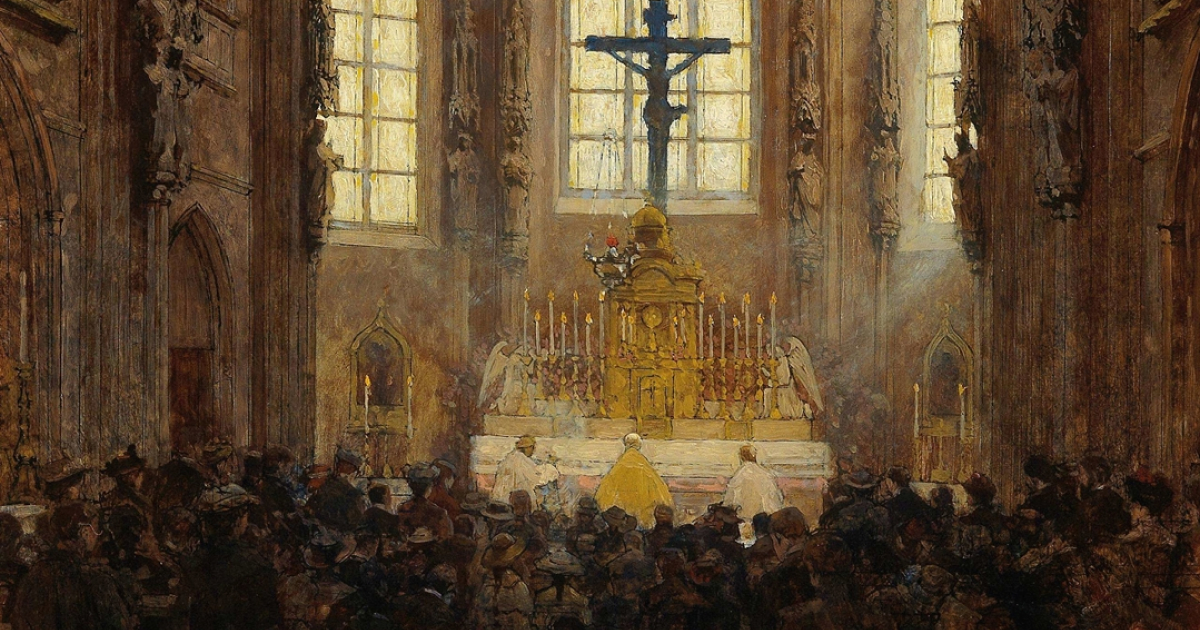
In the last two weeks before Easter, called “Passiontide,” the last week of which is of course Holy Week (or in the Christian East “great week”), the Sacred Liturgy gradually becomes more sombre, more intense, as Passiontide progresses. The rite of Mass is slightly abbreviated, crucifixes, statues and images are veiled as a form of visual fasting, as it were.

As ever, and ever more so, the texts of the Sacred Liturgy in Passiontide deserve our prayerful attention. If we arrive in Passiontide without having done much in Lent, then let the sobriety of these days be a reminder to us to do at least something more in terms of prayer, fasting and acts of charity. And let them serve as notice that Holy Week and the Paschal Triduum are imminent.

How many Catholics have never participated in the solemn rites of Holy Week? Indeed, how many assiduously avoid them – making sure they avoid such lengthy rites and find a “quick” Mass on Palm Sunday and Easter Sunday, with perhaps a look in some time during the latter half of the week at the altar of repose, or on Good Friday?

If the Sacred Liturgy is the optimal and objective source of grace in this world, and if the greatest liturgical rites of the year are ignored or even avoided by many of our brothers and sisters in the Faith, something is wrong. Severely wrong.

We cannot go into each of these rites in detail here. Let it suffice to say that because these rites are unique and demanding they will require more preparation. And, as I become more familiar with them year after year, so I will be able increasingly to draw from their great treasures. Fruitful participation requires some familiarity, and I should not be surprised if this is difficult at first. Perseverance in this participation is the key that will unlock the door to their riches and allow me fruitfully to ponder and draw from all that they contain. One who perseveres thus cannot think of Holy Week without the intimacy of participation in its solemn rites. Such a person prays the Sacred Liturgy: such a person has been shaped and formed by its power into that person Christ has called him or her to be.

On Ash Wednesday we were starkly reminded with the ashes imposed on us that we are nothing more than dust. Most often we ponder this reality in respect of our mortality. But the opposite is also true. For we read in the Book of Genesis that “The LORD God formed man of dust from the ground and breathed into his nostrils the breath of life; and man became a living being” (Gen 2:7).

Yes, we are truly dust. But through the power of Almighty God dust can have life breathed into it. Mere dust can become the apex of God’s creation – it can become a new creature that is the very “image” of God Himself (Gen 1:27). During this Lent Almighty God wishes to recreate us, to breathe life anew into the dust we are, into the sin-stained dust we have become.

In these privileged and holy days of Lent, then, let us attend His re-creative breath with all our energy, so that we may be able to celebrate the Sacred Liturgy of these days of Lent, and in particular the venerable and ancient rites of Holy Week, with even greater fervour and fruitfulness this year. When the light of Easter morning shines upon us may it illumine all that, through our humble penance and prayer, God’s grace has been able to do in us throughout this Lent, unto His glory and for the salvation of our souls and the souls of others.
Around Ash Wednesday we often hear that this year the parish (or even the diocese) is going to run a special Lent programme of Bible study or discussion or of learning about this or that type of spirituality or prayer. Such programmes often involve guest speakers, glossy brochures, extra meetings each week, etc. They cost a great deal of money, take up a great deal of time and involve a great deal of talk. And then they end, hopefully having brought about some good. Everyone is happy that something has been “done” for Lent and the people are content that they made an effort.

A Lent programme is essential. But whilst discussions, guest speakers and even glossy brochures could perhaps be of assistance, they themselves are not essential. Nor is the substantial dent in the budget. No, what is essential to making a good Lent is that we follow the Church’s own Lent programme. But what is that, we rightly ask?

The Church’s Lent programme is that which is set out in her Sacred Liturgy. That is to say that we must draw ever more deeply and fruitfully from the source and summit of our Christian life and mission – the Sacred Liturgy (the Mass, the Sacraments, the Divine Office and the other liturgical rites). It is already there in place waiting for us – we do not need to invent it. All we need to do is to drink ever more deeply of its riches.

Indeed, we must pray the Lenten liturgy this year, and every year God grants to us on this earth, with greater fervour, devotion and spiritual and apostolic fruitfulness. To put it another way, if you have a missal you have your Lent programme already in your hands. There is little need for much else (except for discovering the Divine Office, of course, which is something clergy could well arrange in Lent). Just open your missal and dive in more deeply. We can do the same with the riches of the breviary. All that we will find there, developed and handed on in centuries of tradition, is more than enough for a lifetime of Lents.

In Lent, however, as in no other season, the reform of the liturgy following the Second Vatican Council denuded the Sacred Liturgy, from the pre-Lenten season of Septuagesima to the clear and rich content of the proper prayers of the Mass (the collects, super oblatas and postcommunions). Their theology was considered too negative, with too much talk of penance and fasting, for the supposed needs of modern man some six or so decades ago. The reformed liturgical rites are, therefore, intentionally more supposedly “positive” in their outlook, something perhaps epitomised in the new formula for the imposition of ashes added as an option in the usus recentior: “Repent and believe in the Gospel,” which sits alongside (but usually in fact replaces) the traditional formula: “Remember, man, that thou art dust and unto dust thou shalt return.”

There is nothing intrinsically wrong with the injunction “Repent and believe in the Gospel.” Indeed, the prayers created for or placed anew in the modern missal are not of themselves erroneous or heretical. But they are much, much weaker. Compared to what preceded them, they could be described as “Lent-lite.” There was an intentional effort on the part of the reformers to make Lent seemingly more positive in its focus and less seemingly negative in the new liturgical texts: the ascetical disciplines are downplayed radically.

I would suggest that in the Church and world of today we do not need “Lent-lite.” We need it at full strength. We need to be confronted by the ascetical demands of the Christian faith and embrace the prayer, the fasting and the almsgiving to which the Church traditionally calls us through her Sacred Liturgy in this holy season of grace. Lent means penance. Lent should hurt. Lent should cost. Lent should cut. The tough demands of Lent should bring about some real and further conversion in my Christian life and vocation. This Lent should see me make real progress in overcoming vice, even if there will still be work to be done in future Lents.

And there is no better “resource” for this battle for ascetical progress, there is no better programme of action, than that laid down by the Church in her tradition in her unedited missal and breviary. Thanks be to Almighty God and to His providential instrument Pope Benedict XVI, these treasures have been rediscovered by many Catholics. That a Stalinist programme of shutting down this rediscovery in the last pontificate speaks for itself. It is not of God.

Lent has proper Mass texts for each day: different antiphons, prayers, readings and so on. These texts have, in most cases, been associated with the days upon which they are used for centuries – indeed many from the very earliest of times. These riches of our tradition give us more than enough each day – even, perhaps, too much – to be getting on with. They give us something new that we can savour each day for our nourishment and for guidance in our ascetical practices.

Participation in Mass as often as possible during Lent is fundamental and it is a sublime grace. But we must pray the Mass: preparation for it by pre-tasting its Gospel and other texts; by participating in the rites and chants and prayers and actions of the Mass with mind and heart and body whilst it is being celebrated; and by pondering – indeed contemplating – its riches afterwards as we engage in our daily work and other duties.

The daily Gospel of each day of Lent is fundamental. So too, I would suggest, is the collect of the Mass of each day. We can use it for private prayer not only at Mass but throughout the day – memorising it even. It will take seconds to pray, perhaps, but it will serve succinctly to recall to us that it is Lent, to teach us about its observance in mind, body and soul, and help us to remain awake to its call to ascetical disciplines.

We can go further, of course: the other proper prayers of the Mass, the Introit and Gradual in particular, are very rich indeed. But we need to be both prudent and realistic. If I can absorb more, that is good. But it is more important that my heart, mind and soul are nourished and formed on something than that I risk spiritual indigestion by trying to take in too much too quickly. Please God we shall be given other Lents in which we can digest more.

If we do faithfully follow the daily Lenten liturgy we shall very quickly be confronted by the Ember days – the particularly intense days of prayer and fasting in the Church’s year which occur four times each year and in Lent in the first full week of the season. These days were abolished in the post-conciliar liturgical reform, sadly, but there is no reason that we cannot observe them as a particular act of piety: there are, after all, many reasons to pray and fast and do penance more – in the Church, the world and in our own battle against temptation and sin.

We should note that the liturgical texts, including the extra Scripture readings, of the Ember days (in the older missal) are of very ancient origin. And their prayers call us unashamedly to fasting and abstinence.

We should also be clear that the Ember days are “days.” That is, in the Church’s year this coming Wednesday, Friday and Saturday are different – they have a particular importance in the Lenten season. What we do on these days should, in so far as possible, be utterly penitential. Our meals or collations should reflect their call to prayer and fasting – not just on Friday, but on Wednesday and Saturday as well. It would be incongruous for any Catholic seeking to live according to the Church’s liturgical tradition to be feasting on Ember Friday, or on Wednesday, or on Saturday (before Vespers). Liturgically, these days should not be occluded without “first class” reasons, as it were.

That is all to say that there needs to be a profound harmony between how we pray and how we live. Living the liturgy changes us. It demands sacrifices of us. It gives us occasion for evangelical witness to the secular world which simply does not comprehend why we would and should decline an invitation “because it is an Ember day.” As Catholics we certainly know how to feast on feasts. But the Church, through her Sacred Liturgy developed in tradition, reminds us that we must also know how to fast during a fast. And such are the Ember days, if not indeed all days of Lent.

Lent is a time to make more space for prayer and many good people will carve out of a busy schedule some time of a morning or an evening for just that. There are many devotional and spiritual practices approved by the Church and we are free to adopt those we judge to be appropriate. The pious person who devoutly prays the simplest of devotional prayers may be many times more holy than the priest or religious who is nevertheless unwilling to create the space in which Almighty God can speak to him or her.

And yet the Sacred Liturgy enjoys an objectivity and a priority over all other spiritual practices or devotions, however good or cherished they may be in themselves. Meditation may mediate God’s will. The rosary and Stations of the Cross without doubt assist people in entering into the mysteries of our salvation. But in praying the Sacred Liturgy we enter into the objective work of Christ in our world: we plug into the greatest source of grace that is available to us in this life.

The Sacred Liturgy is far more than the offering of Holy Mass. In the context of “extra” Lenten prayer one turns naturally to the praying of the Divine Office. If a parish wants a Lenten programme it could celebrate Lauds and Vespers publicly each day. It could help to form and prepare people to pray parts of the Divine Office privately, or in families or other groups. For in doing so we are praying the prayer of the Church, of Christ Himself, which is far greater and far more objectively efficacious than any private devotion or meditation.

As we know, to pray the Divine Office does take some preparation and formation. But the effort involved in learning its ways is a wonderful investment – it is an investment in Christ.

We sometimes hear calls to read the Bible more or to engage in what is called “spiritual reading” in Lent – and there is nothing fundamentally wrong with these exhortations. Indeed, our mother the Church has provided us with precisely these two things in the Divine Office, in the office of Matins (or its modern replacement, “The Office of Readings”). Now, Matins is not for the faint-hearted. It is a long and sometimes complex office, traditionally prayed in the early hours of the morning. Few lay people working in the world will be able to pray it integrally.

Catholics read the Bible in the Sacred Liturgy, in the selections of Sacred Scripture made in the Church’s tradition for a given feast or season. That is to say that if I wish to read the Bible more, the best way I can do that is in harmony with the Sacred Liturgy. Today I should be reading and pondering those passages that are read today at Mass or at Matins. I can read more, of course, but surely these must be my starting point.

Additionally, Matins contains the additional treasury of the homilies and discourses of the great Fathers and doctors of the Church. If one wants some spiritual reading for Lent other than Sacred Scripture, here it is. It surprises me how quickly some rush to buy the latest spiritual paperback – no matter how good it may be – when they have never encountered the Fathers of the Church in the selections of their writings given to us in the Sacred Liturgy for the very feasts and seasons we celebrate.

There is, then, more than enough to be getting on with in terms of reading the Bible and spiritual reading in the Sacred Liturgy itself. Frankly, there is too much in a way: we can perhaps do a little more each year. If we do so we shall most certainly be on a safe path to the riches of our Faith and tradition that will not fail to reward us.

Of course, the Sacred Liturgy includes the celebration of the sacraments. And Lent, as we know, is the season for the celebration of the Sacrament of Penance. It is the time to make a “good” or “integral” confession.

Please God we are in the habit of going to confession regularly. We should be. But Lent is an appropriate time for me to step back and to assess how well, how fruitfully I celebrate this part of the Church’s liturgy. Do I prepare appropriately? Do I participate in it fully – in the sense of truly opening my heart and soul to my confessor, and through his work to the grace Almighty God so wishes to give to me precisely in the areas where I need it the most? Do I ponder its celebration afterwards, considering carefully the spiritual advice I have been given, plumbing the depths of the beautiful prayers of the rite – most particularly the prayer of absolution? Or am I someone who is only too happy to mutter my sins as briefly as possible, hoping that the priest will not pick up on the big ones and glad to escape with a routine penance without much spiritual advice?

That approach might well be sufficient to obtain valid absolution, but it is hardly an optimal praying of the sacred and intimate rite of the Sacrament of Penance. Lent is the time to go to confession, certainly, but it is the time to ensure that I am going to confession well, optimally, not minimalistically. It is time to review the beautiful prayers of this rite, and to allow them to nourish and form me more fully both in my celebration of this sacrament and in my understanding of the depths of God’s mercy.

In the last two weeks before Easter, called “Passiontide,” the last week of which is of course Holy Week (or in the Christian East “great week”), the Sacred Liturgy gradually becomes more sombre, more intense, as Passiontide progresses. The rite of Mass is slightly abbreviated, crucifixes, statues and images are veiled as a form of visual fasting, as it were.

As ever, and ever more so, the texts of the Sacred Liturgy in Passiontide deserve our prayerful attention. If we arrive in Passiontide without having done much in Lent, then let the sobriety of these days be a reminder to us to do at least something more in terms of prayer, fasting and acts of charity. And let them serve as notice that Holy Week and the Paschal Triduum are imminent.

How many Catholics have never participated in the solemn rites of Holy Week? Indeed, how many assiduously avoid them – making sure they avoid such lengthy rites and find a “quick” Mass on Palm Sunday and Easter Sunday, with perhaps a look in some time during the latter half of the week at the altar of repose, or on Good Friday?

If the Sacred Liturgy is the optimal and objective source of grace in this world, and if the greatest liturgical rites of the year are ignored or even avoided by many of our brothers and sisters in the Faith, something is wrong. Severely wrong.

We cannot go into each of these rites in detail here. Let it suffice to say that because these rites are unique and demanding they will require more preparation. And, as I become more familiar with them year after year, so I will be able increasingly to draw from their great treasures. Fruitful participation requires some familiarity, and I should not be surprised if this is difficult at first. Perseverance in this participation is the key that will unlock the door to their riches and allow me fruitfully to ponder and draw from all that they contain. One who perseveres thus cannot think of Holy Week without the intimacy of participation in its solemn rites. Such a person prays the Sacred Liturgy: such a person has been shaped and formed by its power into that person Christ has called him or her to be.

On Ash Wednesday we were starkly reminded with the ashes imposed on us that we are nothing more than dust. Most often we ponder this reality in respect of our mortality. But the opposite is also true. For we read in the Book of Genesis that “The LORD God formed man of dust from the ground and breathed into his nostrils the breath of life; and man became a living being” (Gen 2:7).

Yes, we are truly dust. But through the power of Almighty God dust can have life breathed into it. Mere dust can become the apex of God’s creation – it can become a new creature that is the very “image” of God Himself (Gen 1:27). During this Lent Almighty God wishes to recreate us, to breathe life anew into the dust we are, into the sin-stained dust we have become.

In these privileged and holy days of Lent, then, let us attend His re-creative breath with all our energy, so that we may be able to celebrate the Sacred Liturgy of these days of Lent, and in particular the venerable and ancient rites of Holy Week, with even greater fervour and fruitfulness this year. When the light of Easter morning shines upon us may it illumine all that, through our humble penance and prayer, God’s grace has been able to do in us throughout this Lent, unto His glory and for the salvation of our souls and the souls of others.
subscribe to
the catholic herald

Continue reading your article with a subscription.
Read 5 articles with our free plan.
Subscribe

subscribe to the catholic herald today

Our best content is exclusively available to our subscribers. Subscribe today and gain instant access to expert analysis, in-depth articles, and thought-provoking insights—anytime, anywhere. Don’t miss out on the conversations that matter most.
Subscribe