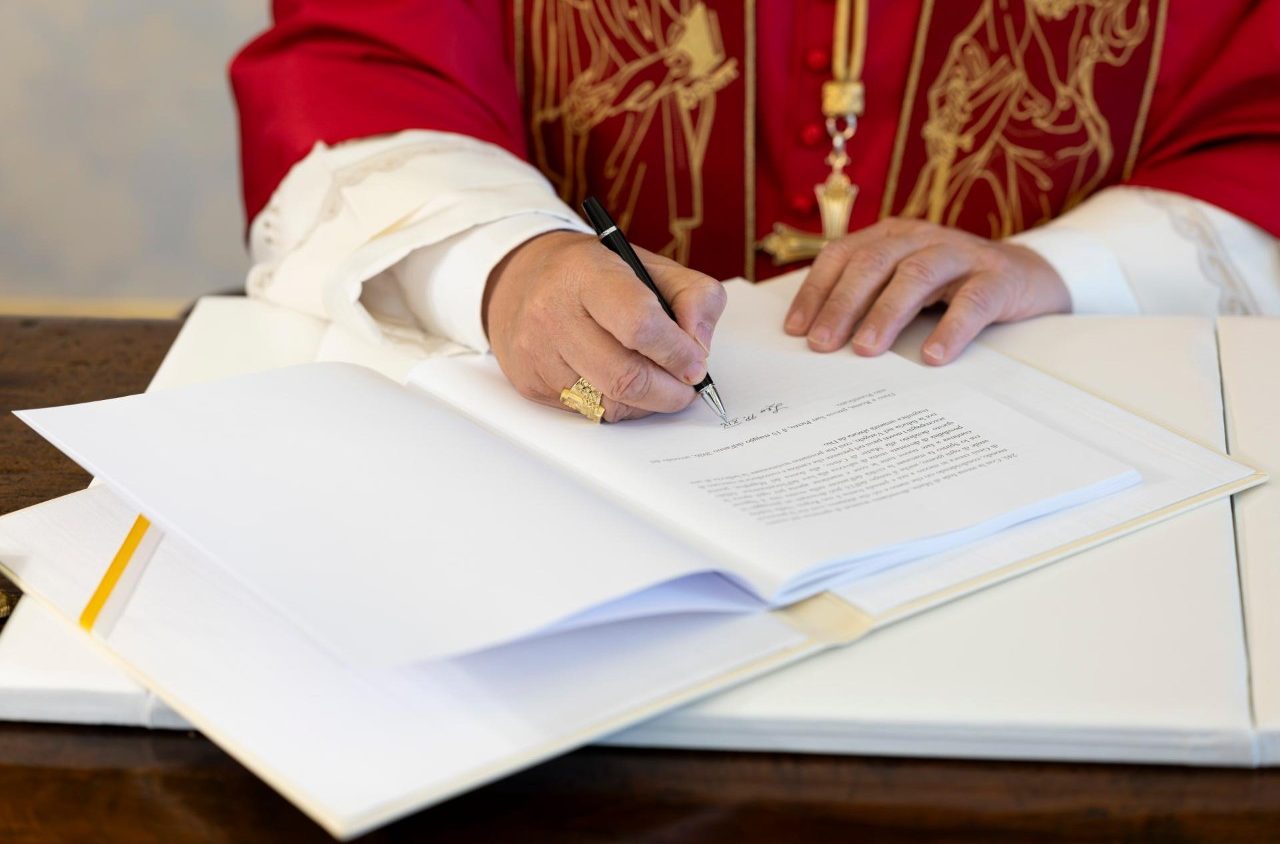



Pope Leo XIV’s encyclical, Magnifica Humanitas, is much more than a reflection on artificial intelligence. It is a meditation on the human good in our contemporary context, a resounding call for each of us to take seriously the task of “safeguarding the human person” in our time and place.
The fundamental theme of the encyclical is the necessity to take the time to think, to hazard those fundamental philosophical questions that require patience and earnest inquiry, questions that cannot be answered by Large Language Models, because they do not echo the past but help shape the future.

As a contemporary Socrates, Pope Leo begins by asking those fundamental questions of the human wayfarer: “Where are we going? Towards what goal do we wish to orient ourselves? What direction should we choose as a people and as a human community?” His concern is to avoid “a paradox of material progress and anthropological regression”.
The Pope refers to the present moment as a worksite and says we all must choose, individually and collectively, whether the work that we are undertaking will be a new Tower of Babel, which concentrates power in the hands of the few to the disenfranchisement of the many, or a new city wall, a new Jerusalem, which embraces the common benefit of all.
Indeed, Pope Leo repeatedly worries about the consolidation of power in the hands of a few global companies and individuals that largely seem beyond the reach of governmental regulation and personal responsibility. “A more moral AI is not enough if that morality is determined by a few. What is needed is a more active political involvement that is capable of slowing things down when everything is accelerating, and of protecting the opportunities for communities still to be able to participate and ask questions.”
Only in the abstract can technology be neutral; in the concrete, as a particular technology has been developed, it either promotes integral human development or does not. It shapes how we think and is therefore something that calls for real discernment. It is thus not only a question of how technology is used but above all how the technology is actually built.
“For this reason, ethical discernment cannot be limited to asking whether we are using a system for good or bad purposes; it must also examine how that system is designed and what vision of the human person and society is embedded in the data and models that guide it.”
As an example, he points out that parents cannot safeguard their children alone; they must have the cooperation of the state and the companies that develop technological products. The algorithmic power to optimise engagement must be deliberately limited to leave room for free choice and healthy personal development.
The Pope reminds us that our machines are not conscious. “So-called artificial intelligences do not undergo experiences, do not possess a body, do not feel joy or pain, do not mature through relationships and do not know from within what love, work, friendship or responsibility mean. Nor do they have a moral conscience, since they do not judge good and evil, grasp the ultimate meaning of situations, or bear responsibility for consequences.”
He notes that simulation is not the same as duplication. “They may imitate language, behaviour and analytical skills, or even simulate empathy and understanding, but they do not understand what they produce, for they lack the affective, relational and spiritual perspective through which human beings grow in wisdom.”
Like a portrait in an art museum, our machines look similar to us in their externals, but they nonetheless are not us in what counts. Therefore, they cannot help us in what is essential to the human enterprise: the pursuit of wisdom.
Answering such metaphysical questions about what artificial intelligence is and is not allows us to focus on the real ethical and anthropological concerns regarding AI and the integral human good.
Bringing to bear over a century of development, Pope Leo articulates the fundamental principles of Catholic social teaching. The fundamental idea is to foster participation in contrast to alienation.
In the first place, the goods of the earth and the works of human hands are for the benefit of the whole human family. “In a world where data, computational resources and regulatory influence remain in the hands of a few, to speak of the common good means exposing this new form of epistemic, economic and political asymmetry and naming the new monopolies of AI. To speak of the universal destination of goods means finding ways of ensuring universal access to both technologies and the education needed to use them.”
In the second place, the common good requires that each member and each community be able to exercise real causality and experience deeply the common concern of each member: “To speak of subsidiarity calls for protecting the ability of communities to make choices and corrections, rather than confining their role to mere oversight after the standards have been set elsewhere. To speak of solidarity obliges us to recognise the hidden, often exploited workers, who sustain algorithmic systems.”
In the third place, justice demands that we actively avoid doing harm rather than only redressing harm after it occurs. “To speak of justice requires questioning the global distribution of power that decides who in fact can train these models and who is merely subjected to them. Likewise, it means acknowledging that social justice is not only a goal to be safeguarded after technologies are deployed, but a condition that must shape their very design from the outset.”
Quoting Gandalf’s words in JRR Tolkien’s The Lord of the Rings, Pope Leo says it is the task of each one of us to do what we can to forge a better future for us all. We can do this in a variety of ways, but he recommends some concrete points of meditation.
One thing is to safeguard truth, which is necessary for political life. “Indifference to the truth leads, slowly but surely, to a descent into totalitarianism.” Truth, moreover, is necessary for realising the blessings of technology. “Fidelity to the truth requires integrating the possibilities offered by technology within a framework marked by wisdom, which is capable of safeguarding both the dignity of each person and the future of our common home.”
A focus on truth requires devoting new resources to education. All of us stand in dire need of help: “The pervasiveness of digital media fosters a culture of immediacy and hyper-stimulation, which gives rise to fatigue, boredom and apathy concerning the effort required for seeking the truth.” Instead of ploughing our fortunes into technology, we need to invest in people and their capacity for understanding. “Educating people about the use of AI, then, involves teaching them to decide when and for what purpose it ought not to be used.”
A central place for such education is fellowship. Pope Leo encourages us to prioritise focal practices that build genuine community. “The digital culture multiplies connections and offers new opportunities for interaction; yet, the human heart retains an irrevocable need for genuine closeness. I invite everyone to cherish places and times where physical presence remains crucial, such as shared meals, Christian community gatherings, time spent with the lonely and serving the poor.”
The success of such fellowship requires the means provided by work. With an eye to his predecessor, Pope Leo XIII, he calls for imagining a deployment of AI that does not eliminate jobs but promotes the dignity of workers as a constitutive good of business. He warns of the effect of unemployment on the family with dire consequences for the common good: “While technological successes are celebrated, the social fabric is progressively eroded, as if by a silent virus.” Work enables the fellowship of the table, a school in virtue.
Work is to be undertaken in a spirit of justice, which means that businesses must take into account the effects of their products on the human community: “When business models thrive on human weakness, the person is treated as a means rather than as an end; those who design or finance such systems bear a moral responsibility that cannot be ignored.” He therefore calls us to investigate the supply chain of AI development and execution: “If technology promises emancipation, yet produces new forms of global subordination, it stands in contradiction to the fundamental principle of human dignity.”
With particular concern, the Pope also denounces the increasing belligerence of nations in part fuelled by the development of technologies that lower the political costs of waging war. He decries the use of autonomous weapons systems, insisting that it is always necessary that human choice and moral deliberation be at work. Moreover, while acknowledging in principle the legitimacy of self-defence, he says that all too often “just war” theory is used to rationalise unjust and aggressive behaviour instead of relying on the more effective means of diplomacy and dialogue.
A strange but promising feature of the present moment is that those most intimately involved in AI development are those most keenly aware of the need for guidance to ensure that such development benefits rather than harms us.
The Pope’s fundamental message is that we are not powerless in the face of the logic of technology. The future is not predetermined, for we have the philosophical and ethical principles, clarified over centuries of refinement, to respond to the challenges and safeguard what matters.
Each of us is responsible, not just makers but also investors, not just investors but also users, and not just private entities but also public ones. The Church offers the world an integral vision of human development, one in keeping with our God-given dignity. Our task is to bring it to fruition, wary of what St Augustine calls the libido dominandi, the lust to dominate, and confident in the desirability of the good.
Just 12 months after his election, Pope Leo XIV has issued an encyclical devoted to defending human magnificence in the face of artificial distortions, and he has done so by continuing the legacy of his namesake, Pope Leo XIII. As the previous Leo articulated a humane response to the industrial revolution, so the present Leo articulates a human response to the AI revolution. In doing so, he gives cause for a realistic hope that this new technology can yet be shaped to better the human estate.
“With the heart of a shepherd and a father, I ask everyone to abandon the construction of yet another Tower of Babel and to join forces in building up the common good, so that humanity will never lose its beauty, and the world once again will come to recognise the human heart as the place where God desires to dwell.”
Chad Engelland, PhD, is professor of philosophy at the University of Dallas. He is the author of seven books, including Phenomenology, The Way of Philosophy, and The Way of Aquinas.


x02.jpg)