




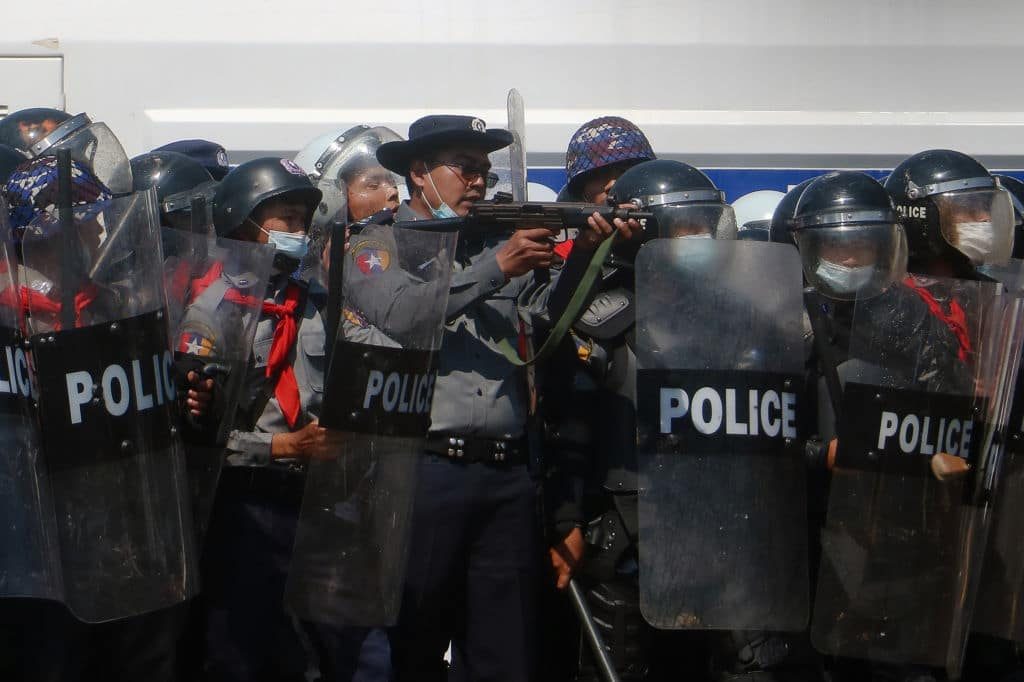
As an estimated 100,000 protesters demonstrated in Yangon and thousands more marched across the country on Wednesday, 40 police joined protesters in Kayah province. They waved banners expressing their support for the "civilians" of Myanmar. "Members of Myanmar police force (Kayah state) stand with civilians," one banner read. Protesting officers gave a three-fingered salute, a sign of resistance against the military. Others carryied posters reading: "We do not need military dictatorship". Approximately 20 other officers joined protesters across the country – in Pathein, Naypyidaw, Myeik, Magway and Mawlamyine. Recent reports from Myanmar indicate growing police violence. Water cannons were used to disperse the crowds on Monday but the police have since turned to tear gas, rubber bullets and live ammunition to deter protesters. Warning shots are said to have been fired at protests in Naypyidaw on Tuesday before police opened fire with rubber bullets. Human Rights Watch reported that police shot a woman in the back of the head and wounded a man in the chest in Naypyidaw. The woman, identified as Mya Thwe Thwe Khine, 20, was hit by a blast from a water cannon before turning away, when "a crack [was heard] and she slump[ed] to the ground." A doctor at the hospital in Myanmar's capital, where Khine is being treated, said: "she had a projectile lodged in her head and had lost significant brain function." Her wound is "consistent with that of live ammunition," he said, though the injured man Roe Way's chest wound was not. The military instigated the coup last week after Myanmar's Commander-in-Chief Min Aung Hlaing declared the country's 2020 elections fraudulent – a claim dismissed by Myanmar's electoral commission. The Tatmadaw, as it is also known, have instituted a 8 pm to 4 am curfew and banned gatherings of more than 5 people. It has been condemned for its use of force against protestors by the UN. “I call on the security forces to respect human rights and fundamental freedoms, including the right to peaceful assembly and freedom of expression”, said Ola Almgren, UN Resident Coordinator and Humanitarian Coordinator in Myanmar. Church leaders in the country have called for the release of Aung San Suu Kyi and other civilian leaders. Echoing Cardinal Archbishop of Yangon Charles Bo's statement last week, bishops said that dialogue is critical. “We need dialogue, which is the effective way to solve the problems and our differences,” said Bishop Alexander Pyone Cho of Pyay. “As a bishop, I emphasize faith in God who will help change the country,” he continued. Bishop Raymond Sumlut Gam of Banmaw called on Catholics to "trust God and deepen our faith as God can do everything.” “We hope that the country’s leaders will find the right solution through transparency,” Gam said.
12:21 PM
Police officers join protests as violence escalates in Myanmar
As an estimated 100,000 protesters demonstrated in Yangon and thousands more marched across the country on Wednesday, 40 police joined protesters in Kayah province.
Ferdie Rous

3 min read



Already a subscriber? Sign in
5freearticles every month
Continue reading with a free account. No card needed.
- Five free articles every thirty days, on any device you sign in on
- The Catholic Herald newsletter, every morning
- Subscribe whenever you like for everything: every article and the magazine
Related articles
 Newsroom
Church leaders urge Drumcree dialogue: ‘Too much is at stake’
The Catholic and Church of Ireland Archbishops of Armagh have urged a renewed commitment to peace and reconciliation amid the Drumcree stand-off
Corrie Douglas-Young Newsroom
Thousands of Irish children to join global Rosary campaign
Corrie Douglas-Young Newsroom
TikTok priest urges young people to stand with persecuted Christians
Nathalie Raffray Newsroom
Baby born at 25 weeks reunites with neonatologist two years after leaving hospital
The Catholic Herald Newsroom
Joe Biden honoured by Planned Parenthood after defending abortion rights
Christine Rousselle
subscribe to the catholic herald today
Our best content is exclusively available to our subscribers. Subscribe today and gain instant access to expert analysis, in-depth articles, and thought-provoking insights—anytime, anywhere. Don’t miss out on the conversations that matter most.
Subscribe



