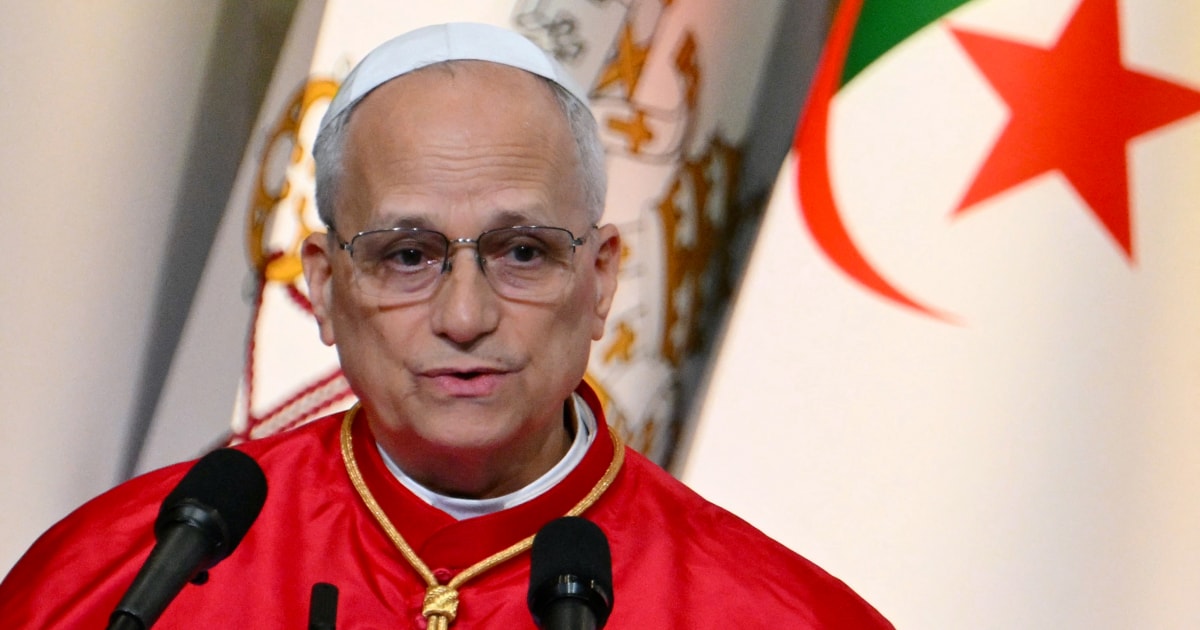
Pope Leo has begun his first Apostolic Journey to Africa with a full programme in Algeria, including diplomatic engagements, interreligious encounters and meetings with the country’s small Catholic community.
Upon arrival in the Algerian capital, Algiers, on Monday morning, he was formally welcomed by the country's president, Abdelmadjid Tebboune
His first public stop was at the Martyrs’ Monument, Maqam Echahid, which commemorates those killed in the Algerian War of Independence between 1954 and 1962. Addressing those present, the Pope said that “the future belongs to men and women of peace” and added that “true freedom is not merely inherited; it is chosen anew every day”.
From there he proceeded to the presidential palace for a courtesy visit with President Abdelmadjid Tebboune, before addressing civil authorities, members of the diplomatic corps and representatives of civil society at the Djamaa el Djazair Conference Centre.
Speaking to an audience of around 1,400, the Pope described himself as a “pilgrim of peace” and emphasised the shared dignity of all people, stating: “We are brothers and sisters, for we have the same Father in heaven.”
He praised Algeria’s traditions of hospitality and solidarity, noting in particular the social importance of almsgiving, which he said showed “a sense of justice regarding wealth”. He added: “Indeed, a religion without mercy and a society without solidarity are a scandal in God’s eyes.”
He urged those in positions of responsibility to pursue dialogue and mutual understanding, saying: “By respecting the dignity of everyone and allowing yourselves to be moved by the pain of others, instead of multiplying misunderstandings and conflicts, you can surely become protagonists of a new chapter in history.”
In the afternoon, the Pope visited the Great Mosque of Algiers, one of the largest mosques in the world, where he was received by its rector, Mohamed Mamoun Al Qasimi. After removing his shoes at the entrance, he spent time in silent reflection before a brief exchange.
During the visit, he said: “I thank you for these reflections and for these important words during this visit, from a place that represents the space that belongs to God, a divine and sacred space, where many people come to pray and to seek the presence of the Most High in their lives.”
Recalling his long-standing connection with the country through St Augustine of Hippo, he described Algeria as “the land of my spiritual father” and spoke of the search for truth and the dignity of the human person as shared concerns. “To seek God also means recognising the image of God in every man and woman,” he said, adding that such recognition calls for mutual respect and peaceful coexistence.
In the guest book of the mosque, the Pope wrote in French: “May the mercy of the Most High preserve the noble Algerian people and the entire human family in peace and freedom.”
Later in the day, the Pope travelled to the district of Bab El Oued to visit the Centre for Welcome and Friendship run by the Augustinian Missionary Sisters. The visit was private and focused on the memory of those Religious who were killed during the Algerian civil war of the 1990s. Two members of the community, Sister Esther Paniagua Alonso and Sister Caridad Álvarez Martín, were among those murdered in 1994.
Reflecting on their lives, the Pope said their witness expressed a central aspect of Augustinian spirituality, fidelity even to the point of martyrdom. He thanked the sisters for their continued presence and charitable work, noting the significance of their mission in a society marked by the memory of conflict.
The final public engagement of the day took place at the Basilica of Our Lady of Africa, where the Pope met members of the local Catholic community alongside representatives of other religious groups. Despite heavy rain and strong winds, large numbers gathered both inside and outside the basilica.
During the meeting, testimonies were offered by individuals of different faiths, including a Muslim woman and a Pentecostal student, who spoke of living side by side in mutual respect. In his address, the Pope referred to their experience as a sign of hope, saying that in a world “where division and wars sow pain and death among nations, in communities, and even within families”, their witness of unity was “a compelling sign”.
He concluded the day with a private meeting with the bishops of Algeria at the Apostolic Nunciature.
Reports also emerged during the visit of a security incident in Blida, approximately 45 kilometres from Algiers, where two suicide bombers reportedly attacked a police station. Early accounts indicated that the attackers died at the scene and that a police officer was injured. The incident did not affect the Pope’s programme.