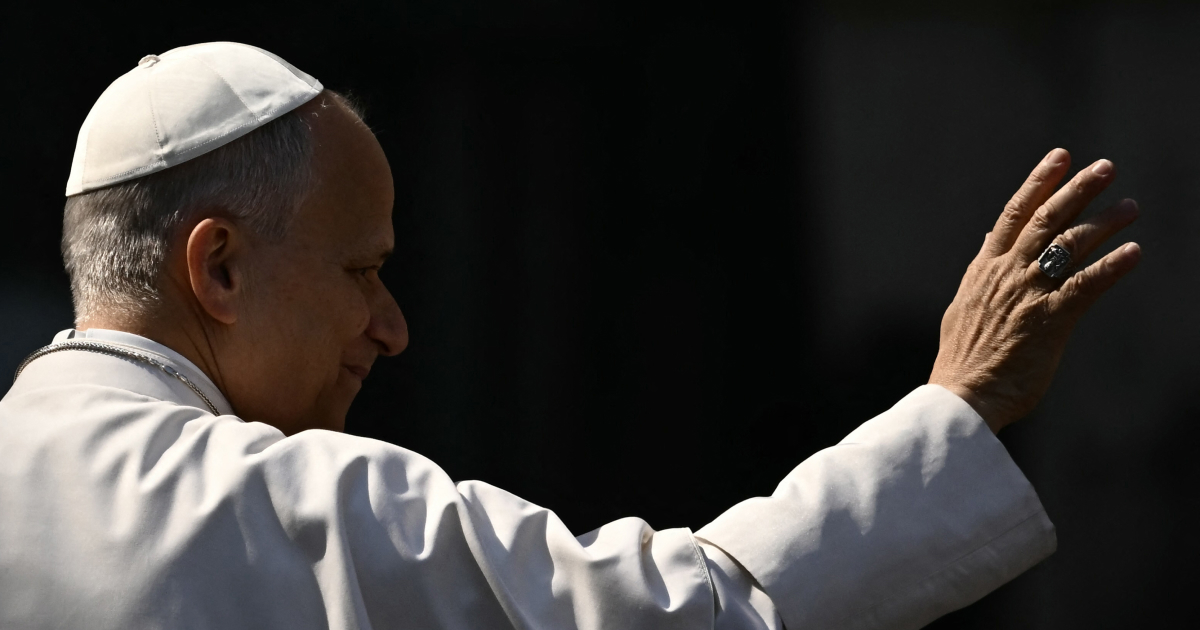


On 18 March, Cardinal Parolin addressed a plenary meeting of the French bishops by letter, delivering a message, or series of messages, from Pope Leo. The letter called on the bishops to defend Catholic schools and not to forget the care due to priests guilty of abuse, and it also addressed the question of the Traditional Mass:
‘Dear brothers, you intend to address the delicate subject of the Liturgy, to which the Holy Father pays particular attention, in the context of the growth of communities attached to the Vetus Ordo. It is concerning that a painful wound continues to persist within the Church regarding the celebration of the Mass, the very sacrament of unity. Healing it requires a renewed openness to one another, with deeper understanding of each other’s sensitivities – a perspective that can allow brothers, enriched by their diversity, to welcome one another in charity and in the unity of faith. May the Holy Spirit inspire you with practical solutions that generously include those sincerely attached to the Vetus Ordo, in harmony with the directives of the Second Vatican Council regarding the Liturgy.’
We have been rather starved of concrete indications of Pope Leo’s attitude towards the Traditional Mass (if he has settled on the term Vetus Ordo, that is fine by me) and this letter has stimulated much commentary.
The first thing to notice is the way in which Pope Leo has chosen to make his contribution to the French bishops’ discussion: in a letter not from him but from his Secretary of State. By doing this, he acts through formal channels, and is holding back from creating what could be seen as an official magisterial text.
On the other hand, he did not speak through France’s apostolic nuncio, Archbishop Migliore. The intervention of Cardinal Parolin, the most senior curial official, gives it greater weight, and the form of the intervention ensured that it would be public. This seems very carefully calibrated. Interestingly, Parolin is not known as a friend of the Vetus Ordo; an emollient message passed on by him seems particularly powerful, and there can be no doubt that the ideas in the letter come directly from the Holy Father.
The text is carefully worded. Pope Leo expresses the hope that the Holy Spirit will suggest ‘practical solutions’ to the bishops: he is not suggesting any himself. But he gives them an idea of what good solutions will look like.
First, they will be ‘practical’, as opposed to ideological or theological. The problem is not simply a practical problem, but the bishops should be approaching it with a view to a practical solution, a solution which is to ‘generously include’ those attached to the Vetus Ordo. This implies some kind of practical accommodation, which can only mean allowing more celebrations of the older liturgy.
This accommodation is for the sake of those ‘sincerely’ attached to the older Mass. ‘Sincere’ suggests a contrast with those whose attachment is instrumental: those who want to use the Vetus Ordo for some ulterior purpose. Their existence is not ruled out, and perhaps they can be blamed for the old policy, but clearly they are now less important than the great majority of people who attend it, who like it because they find it spiritually satisfying. If this is the case, after all, no further motive is necessary.
The importance of this kind of solution, and its appropriateness, is further clarified. It is important because the current situation represents a ‘painful wound’. Blame for this wound is not assigned to anyone; perhaps it is best to see it simply as the unfortunate outcome of history, including some very recent history. On a casual reading, the ‘wound’ metaphor might seem to refer to the division implied by the mere fact that there are two rival liturgical rites, but if Pope Leo is concerned about a practical solution to help those attached to the older form, this cannot be what he means. The wound that concerns the Holy Father is one that can be healed by ‘generous’ inclusion of those attached to the Vetus Ordo, suggesting that what he had in mind is their current deep unhappiness, in feeling excluded from the Church’s pastoral care. Pope Leo is calling for the bishops to understand the sensitivities of those attached to the Vetus Ordo, and, having come to that understanding, respond to this sensitivity by making provision for the celebration of this liturgy.
Some might suggest that those attached to the Vetus Ordo could have greater understanding of the other side in the debate, but of course this letter is not addressed to a gathering of traditionalists, but a gathering of bishops. As a matter of fact, as far as understanding goes, the situation is not symmetrical. The great majority of Catholics attached to the older Mass know the reformed Mass, and the people who attend it, extremely well, having lived for decades with the Novus Ordo, only discovering the Vetus Ordo as adults. It is the traditional milieu which is, unsurprisingly, a mystery to those people, priests and bishops, who have never much come across it.
The appropriateness of an accommodation for the Vetus Ordo is suggested by it emerging from ‘a perspective that can allow brothers, enriched by their diversity, to welcome one another in charity and in the unity of faith’. It is of the utmost significance that the Vetus Ordo can be described as part of ‘diversity’ in a positive sense. This means that Pope Leo understands it as having something to contribute to the Church – something to ‘enrich’ the whole – and as being able to do this in charity and unity of faith.
Those attached to the Vetus Ordo, like all Catholics, are called to a unity of faith, and this is a call traditionalists are happy to answer. What is crucial is that the older liturgy is not itself regarded as an obstacle to a unity of faith. This idea was the justification for the elimination of the ancient Mass put forward by Pope Francis in Traditionis custodes: that liturgical diversity undermines the unity of the Church. This argument was reiterated by Cardinal Arthur Roche at the last consistory, in the short paper he distributed to the cardinals.
This letter surely sounds the death knell of that argument. The problem remains, however, that Traditionis custodes is still the law of the Church, and seriously hinders bishops in France and elsewhere from applying the practical solutions Pope Leo now calls for. Bishops are unable to authorise celebrations of the Vetus Ordo in parish churches; they are unable to set up new personal parishes; and they are unable to permit priests ordained since Traditionis custodes to celebrate it. All of these things were explicitly designed to help eliminate the older liturgy, and to establish liturgical unity (in Pope Francis’s words) ‘throughout the Church of the Roman Rite’. If Pope Leo rejects the critique of liturgical diversity, and wants practical solutions to a different wound in the Church, one created by the marginalisation of Catholics attached to the Vetus Ordo, he needs to look again at these rules.