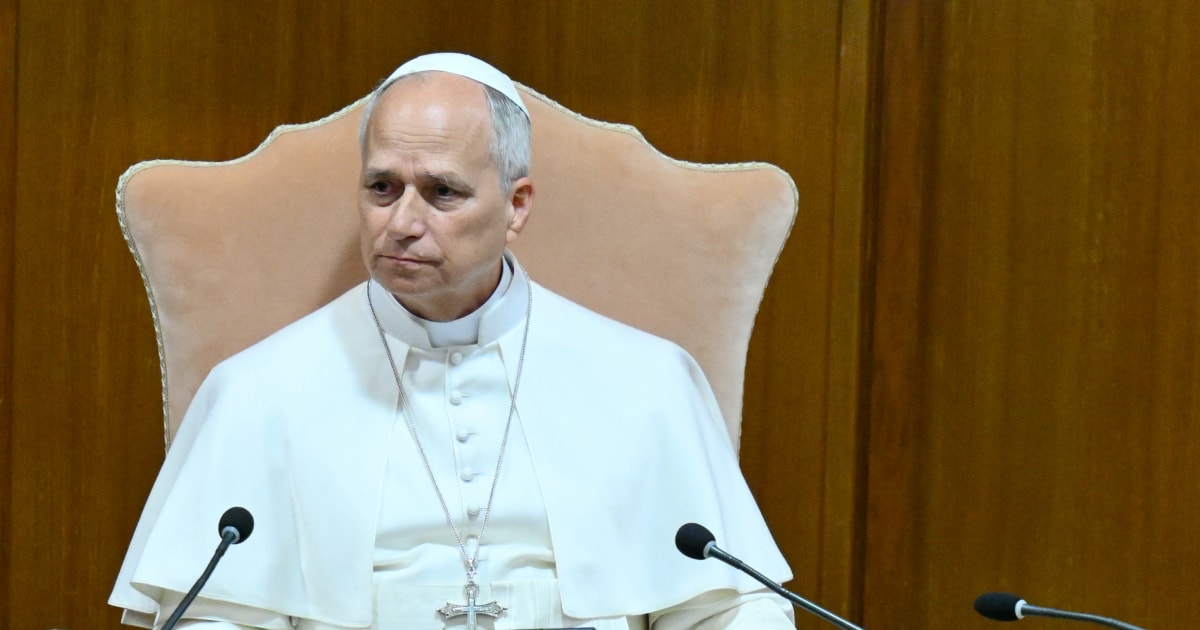




The Holy See selected May 22 for the release of Pope Leo XIV’s debut encyclical, Magnifica Humanitas, which addresses concerns over transhumanism, technological revolution and artificial intelligence.
At the presentation of the document in the Vatican Synod Hall, the Pope was joined by a number of speakers who helped explain the context surrounding its promulgation.
The date was significant, marking the 135th anniversary of Pope Leo XIII’s landmark encyclical addressing the plight of the poor and factory workers in a transforming industrial age.
Pope Leo was flanked by Cardinal Pietro Parolin, Cardinal Víctor Manuel Fernández and Cardinal Michael Czerny, alongside Prof Anna Rowlands, Anthropic co-founder Christopher Olah and Prof Leocadie Lushombo.
The presentation revealed some of the underlying geopolitical, developmental, ethical and anthropological problems that Leo and his guest speakers anticipated for the 21st century as AI and similar technologies become increasingly prevalent.
These included: the danger of power being concentrated in the hands of a small number of wealthy private transnational actors; the outsourcing of conscience and the pursuit of truth to machines; the domination of populations by increasingly uninhibited military and surveillance technologies; man’s quest to escape limits and achieve self-mastery alienating him from God and his fellow man; and the misuse of data, turning information about private lives into resources to be exploited.
After an introductory video depicting human technology’s mixed legacy of violence, beauty and mutual aid, Cardinal Fernández clarified that, contrary to reports, it remains significant that the subtitle of the document is “in the time of artificial intelligence”, not “on artificial intelligence”.
“Humanity is magnificent,” Cardinal Fernández said, despite the fact that “the text acknowledges the terrible capacity for evil that lies within us”.
Cardinal Fernández suggested that this fact, which technology has in the past amplified, reveals how “wounded we are”. Situating his critique in recent news, the cardinal condemned military strikes on innocent women and children that contravene “international law”.
He continued by warning that “even … in the third millennium” new technologies, if left unchecked, are capable of reducing people to slavery.
However, in line with the other panellists’ views, Cardinal Fernández said technology may also play a positive role. When it aids culture and beauty, he suggested, it can “make us proud to be human”. He cited such 20th-century examples as Picasso’s Guernica, Beethoven’s Ninth Symphony, the civil rights movement associated with Martin Luther King Jr and Nelson Mandela, and institutions such as the Red Cross, the United Nations and its Refugee Convention.
Cardinal Fernández then challenged “transhumanism” and “posthumanism” – “some forms of which go so far as to [propose] that humanity should be replaced”. The cardinal identified a quasi-religiosity behind this new intellectual movement, saying that it invites the subject to “think of a life of paradise”.
“Various forms of technology delight at first,” he cautioned, “yet shortly after, an emptiness returns.”
“As believers, we are certain that none of this will fill the void. [It] will not fill the infinite space in our hearts … Behind this idea of progress lies a false mysticism that is precisely the opposite of what Christians … call ‘new life’ … that takes us genuinely beyond ourselves into transcendence.”
Cardinal Fernández contrasted the Christian religion, which understands the path to this beatitude as “life lived in faith, hope and charity”, with its inverse mirror in the new ideology. Transhumanists replace faith in the love and power of the Father with faith in technology, hope with a “superficial hope for a new product that will relieve our boredom”, while “love … is forgotten – as we desire more while the other person disappears”.
Transhumanism, he said, seeks to overcome “every limit”. Cardinal Fernández indicated that the fruitfulness of the human experience of “limitation” must be explored.
“In truth, limitation is not always a flaw to be corrected, but a place where the human person matures and opens up to relationship,” he said, explaining that humans do not flourish despite limitations but often through them.
“It is precisely in being limited that there is room for compassion, concern for the needs of others … [and] for spiritual experience and the worship of God.”
Cardinal Fernández concluded his remarks by cautioning against technology enthusiasts who believe humanity can become “marvellous” by escaping pain and suffering, suggesting that to do so entirely may also require extinguishing love itself.
Prof Anna Rowlands then set out the explanatory context for the intentions of those involved in the production and consultation process behind Magnifica Humanitas. Prof Rowlands specialises in Catholic social teaching at Durham University and was selected by Pope Francis in 2023 to work with curial dicasteries in the Vatican.
From the outset, Prof Rowlands insisted that the encyclical letter is “not neutral”. She affirmed that it is a critique of a real danger of mechanistic utilitarianism in a world increasingly dominated by technology.
This impulse leads some, she said, to seek to “overcome our humanity – and become our own Gods”.
Humans, Prof Rowlands stated, are “more than tools of the state, market agents, or user tools of an algorithmic order”.
“The encyclical tradition also … exposes false idols. The popes have taught: we will not be saved by the market, nor by the nation, nor by the … state. Today, Pope Leo warns – we will not be saved by AI either,” she said.
Prof Rowlands argued that the encyclical reflects the belief that, while technology can and has contributed positively to the human story when it meets genuine human needs and helps people flourish, it must be approached “within the terms of the covenant between God and man”.
Prof Rowlands suggested to whom the encyclical is likely addressed when she echoed Pope Leo’s warning: “Powers of innovation, traditionally held in the hands of states, are today in the hands of a few wealthy individuals … whose cultures are concealed from common good scrutiny – and risk appearing as a new imperium.”
Prof Rowlands said the encyclical, drawing on the Church’s tradition of Aristotelian and Thomistic virtue ethics, which holds embodied and spiritual eudaimonia as the purpose of man’s existence, is an effort to re-identify what human excellence is.
She argued that this understanding is stronger than the mechanistic “might makes right” stance that transhumanism and a posthuman era may inaugurate, which pretends to be strength but masks impoverished relations and coercion.
Christopher Olah, the tech scientist and engineer who co-founded the AI company Anthropic, spoke next. Olah received a scholarship and sponsorship from the tech billionaire Peter Thiel, who is a vocal transhumanist, at an early age. He gave a balanced warning about technology’s capacity for good and ill.
Olah acknowledged that many in the industry are motivated by incentives that do not always lend themselves to questions about the common good or restraint, including “pride”, “ambition” and the desire to “remain commercially viable and to stay at the frontier of research”, racing competitors.
“That is why, if we want this technology to go well, it is enormously important to have people outside those incentives,” he said, welcoming the arrival of the encyclical. “People who care about things going well; who are willing to say hard things, and insist on safety; who are willing to be earnest, thoughtful critics.”
“That is what I see in Magnifica Humanitas,” he said.
Olah said there exists a genuine immediate risk that “AI will replace human labour at a very large scale”.
He recognised that his scope as a scientist was limited, and that how such radically transformative technologies interact with the world is rightly a question for philosophy, the humanities and the Church.
Léocadie Lushombo, associate professor at the Jesuit School of Theology of Santa Clara University, then clarified that Pope Leo “tells us not to forfeit wonder to AI”.
Her principal caution was that machines may displace and atrophy fundamental functions of the human soul, such as the pursuit of truth, “if we offload responsibility onto machines”.
This may happen, she warned, if humanity adopts the transhumanist ideology that prioritises “efficiency” over substantive human freedom. Lushombo said the pursuit of truth requires silence, reading and contemplation, including the verification of sources and dialogue with others through an interchange of perspectives.
Lushombo quoted Leo’s statement in the encyclical: “Even today, colonialism assumes new forms. It no longer dominates only bodies, but appropriates data, transforming personal lives into exploitable information.”
Cardinal Czerny offered a concise reflection on integral ecology and the responsibility of technological stewards, underscoring the need for ethical oversight that protects both creation and the vulnerable.
Significantly, Cardinal Czerny did not judge whether AI might be conscious, but left the question to future discernment and scrutiny.
Cardinal Parolin, Secretary of State, kept his remarks brief, focusing on the geopolitical implications and the Holy See’s call for international cooperation and restraint in the face of unchecked private power in AI development.
“The speeches we have just heard reflect a conviction that the technological future is not an already-written destiny but rather a space entrusted to our own … responsibility,” he said, indicating that the Church’s intervention does not insist purely on the safety of systems, but on a fundamental consideration of their teleology and final ends or purposes.
In his closing remarks, Pope Leo XIV offered a short but pointed synthesis. He thanked the panellists for illuminating the stakes and reiterated the encyclical’s core message: Magnifica Humanitas is an urgent call to orientate technology towards true human flourishing – one that honours limits, protects the dignity of every person and resists the concentration of god-like power in the hands of a new technological elite.
Pope Leo said AI is “dramatically changing how war is waged”, and repeated Cardinal Czerny’s concerns about conscience.
Situating his critique geopolitically, the Pope described his consultation with “very troubling voices [who] have also reached [him] about increasingly autonomous weapons systems practically beyond any human reach to govern them effectively”.
The Pope concluded the conference without mentioning any target of his critiques by name, leaving unidentified emerging technological empires of innovation that risk subordinating humanity to their own vision of progress.
Leo quoted St Paul: “‘Let us not sleep as others do,’ [he] admonished, “but let us keep awake” (1 Thess 5:6). Such vigilance is necessary today.”