


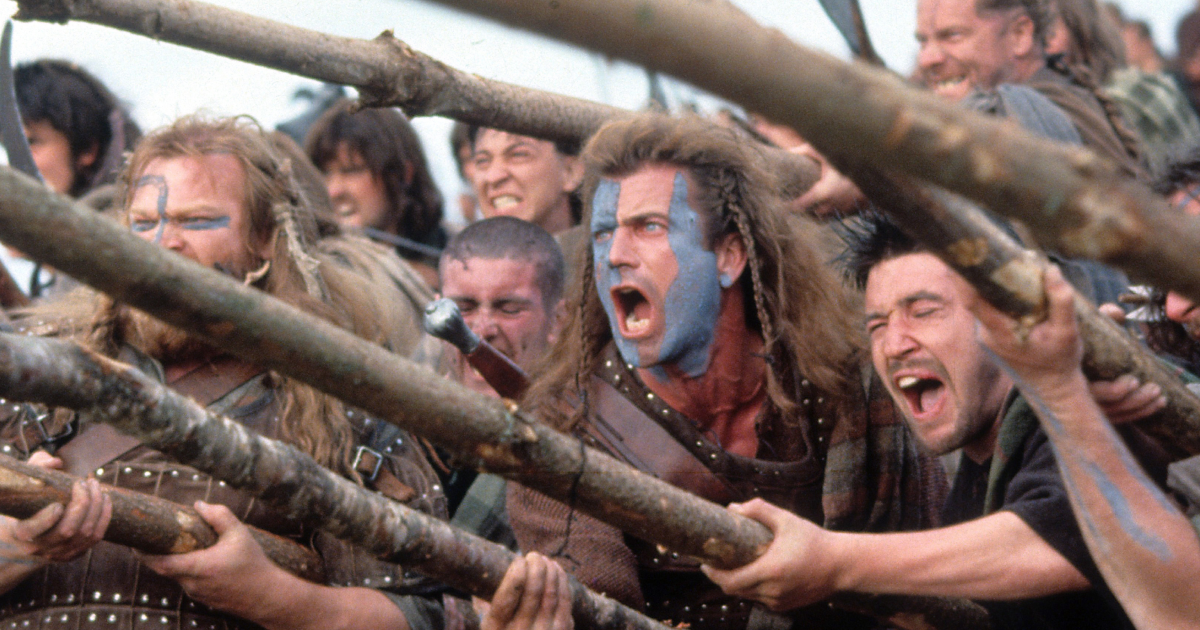


Sir William Wallace has managed in death to attract even more attention than he did in life. A pivotal figure in the Scottish psyche and a minor figure in the English, he has been nationally deified. Some think he should even be canonised.
There are, for better or worse, few pieces of writing about Wallace which do not begin with Braveheart. After all, many of those pieces would not exist without it. The film was a sensation for audiences globally. For Scots, it was a moment of relief when the world finally recognised just how important their country was.
In the years since, there has been a general consensus that whilst the film’s inaccuracies are deep-set and widespread, the conversation on the matter has been as gruelling and drawn out as Wallace’s own death.
The Scots did not wear kilts, Wallace was not a yokel and the eponymous Braveheart was King Robert the Bruce, not the protagonist. Past the many more anachronisms, however, it combines into an incredibly compelling piece of romantic cinema. One detail missing, less discussed, is the Faith, uncharacteristically absent for both the Middle Ages and Mel Gibson – bar a striking comparison to Wallace’s death and the Resurrection.
Calls for his canonisation came soon after the film’s release, but they were preceded by a number of medieval Scottish chroniclers keen to legitimise his actions and their own nation’s place in Christendom. It is reported that the Church had been preparing a case for canonisation soon after his death, but those attempts were floundered by papal turmoil.
In 2000, a number of Scottish Catholics and historians pointed to Wallace’s deep faith and drew parallels between his death and Joan of Arc’s. Wallace had, after all, remained loyal to Pope Boniface VIII, who in turn declared that Scotland belonged to the Holy See, not England.
The office of Cardinal Thomas Winning of Glasgow noted that he was aware of such sentiment, but that a popular devotion would need to exist before pushing a cause for canonisation. A spokesperson said that whilst it was “clear that Wallace is a widely admired Scot, it would be stretching things a little to suggest that most people were devotees of his sanctity." They advised against comparing his death to a martyrdom.
John McGill, a Catholic historian who wrote In Pursuit of William Wallace (1999), described him as a “warrior monk” of “great spirituality”. He found medieval accounts of English priests praying for him, with one having a vision of his soul entering heaven.
Reading of Wallace, one imagines the figure of an Old Testament king: capable of both great devotion and great acts of violence. In the 15th-century Scotichronicon, his victory at the Battle of Stirling Bridge (1297) was credited to the intervention of St Andrew and St Cuthbert. By the end of the battle, Wallace flayed the English captain and fashioned his skin into a sword belt.
Fresh from that victory, he transformed disorganised raids in northern England into an invasion. On November 7, he arrived in Hexham Abbey, all but abandoned bar three remaining canons. A party of Scots demanded they produce treasures, which the canons countered had already been looted by another band.
It was at this point that Wallace arrived and asked for Mass to be celebrated. In keeping with pious practice, he left the abbey after the elevation to remove his weapons.
Historian Andrew Fisher notes in his book William Wallace (1986) that “in his absence some Scots entered and removed holy articles without which the service could not continue”. “When Wallace learned of this, he ordered the capture and hanging of the thieves,” Fisher wrote.
His men were half-hearted in their attempt. Admitting the lack of feasibility (perhaps on account of a lack of his own authority) to the canons he issued them a letter of protection. The raiding continued, but St Cuthbert – who two months before had given him victory in Stirling – drew up a storm of snow and ice to deter the Scots from ravaging Durham, which was under his patronage.
An English chronicler noted that the “power of St Cuthbert was in no way diminished [and] the enemy’s plan to enter his land was foiled”. Cuthbert had scuppered them.
On Wallace, Fisher wrote: “The Church he supported in Scotland, its English representatives he treated less tolerantly. The crimes with which he would be charged by Edward’s justices in 1305 were not wholly fabrications; Wallace himself, at his trial, far from seeking to deny or excuse them, glorified in what he had done and regretted that he had not done more.”
The Church on either side of the River Tweed was as much of a national political vehicle as it was a religious one; Wallace’s own animosity towards the English Church must be understood in that context.
At his execution which followed the trial, Wallace was stripped, dragged naked on a hurdle, hanged until near death, cut down whilst still alive, likely emasculated, disembowelled (his entrails were burned before him), beheaded and quartered. His head was displayed on London Bridge with quarters sent to Newcastle, Berwick, Stirling and Perth.
Throughout his long campaign which earned him such a gruesome demise, he had carried a psalter which he asked to be brought to him at the scaffold. During the torturous execution, a priest held it open before him, and Wallace read from it as he died.
Amongst the generation of Scots who led the Wars of Independence, you would not be left wanting for candidates for canonisation. Bruce, despite the war with England, maintained a continued, intense devotion to St Thomas Becket.
Before the Battle of Bannockburn in 1314, he urged his men to go to Confession and hear Mass, before he invoked the aforementioned saints – Becket included – to win them their victory.
He admittedly did kill a rival in a church – a crime for which he was later absolved. Bruce carried the guilt of that murder all of his life, and intended to go on crusade as recompense. He died in 1329 before he could get the chance.
In his dying wish, he asked his friend Sir James Douglas to carve out his heart (the Braveheart) and take it on crusade instead. In Spain, he met with Castilian forces, and a cordial contingent of English crusaders, to engage the Moorish army.
Cut off from the other troops and realising his death was imminent, Douglas took Bruce’s heart and threw it ahead of him, so as to follow his king and friend one last time into battle. Some would call that a martyrdom.
Many nations would relish having national heroes who held their faith so central in their lives – and many do. Scotland, however, has been 500 years away from that faith, far from the “special daughter of Rome” it was once known as.
The Church has changed in its tastes as well. Hesitant to canonise, and much more hesitant to canonise warriors such as Wallace, a St William of Elderslie is as distant today as it was in 2000. But, as the Church recognised then, that possibility first requires a cult of devotion. If we wish to rebaptise Scotland we ought to emphasise its Catholic foundation. If you want to see both, you had better start praying.


