


SAINT OF THE WEEK: May 19 – Saint Dunstan
Early in 10th-century Wessex (tradition tells us), a gentleman named Heorstan was attending church on Candlemas Day with his wife Cynethryth, who was renowned for her holiness. Suddenly all the candles in the church were extinguished and only the candle held by the pregnant Cynethryth relit itself. This was taken to be a miraculous sign of the remarkable nature of the child, born some months later and christened Dunstan.
His parents sent the boy to Glastonbury Abbey for his education and Dunstan devoted himself to learning as many practical handiworks as took place within the abbey precincts, not neglecting his intellectual learning and – on the harp – musical skill.
Through the influence of his uncle, Archbishop Athelm of Canterbury, Dunstan entered the court of King Æthelstan. There his rapid rise provoked jealousy. Rivals accused him of practising magic because of the breadth of his learning and craftsmanship. Expelled from court, he was beaten, thrown into a cesspit and escaped with great difficulty, seeking refuge with Bishop Ælfheah of Winchester. After suffering a grave illness, he resolved to become a monk.
Returning to Glastonbury, Dunstan lived for a time as a hermit in a small cell beside St Mary’s Church, devoting himself to prayer and study. Later legend placed here the famous story of Dunstan’s encounter with the Devil, whom the saint seized with the hot tongs of his work as a smith, leading to the folk rhyme:
“St Dunstan, as the story goes,
Once pull’d the devil by the nose
With red-hot tongs, which made him roar,
That he was heard three miles or more”
Dunstan’s fortunes changed under King Edmund I, who made him an adviser and eventually appointed him abbot of Glastonbury. At Glastonbury, Dunstan rebuilt monastic life and his abbey became the centre of the English Benedictine revival.
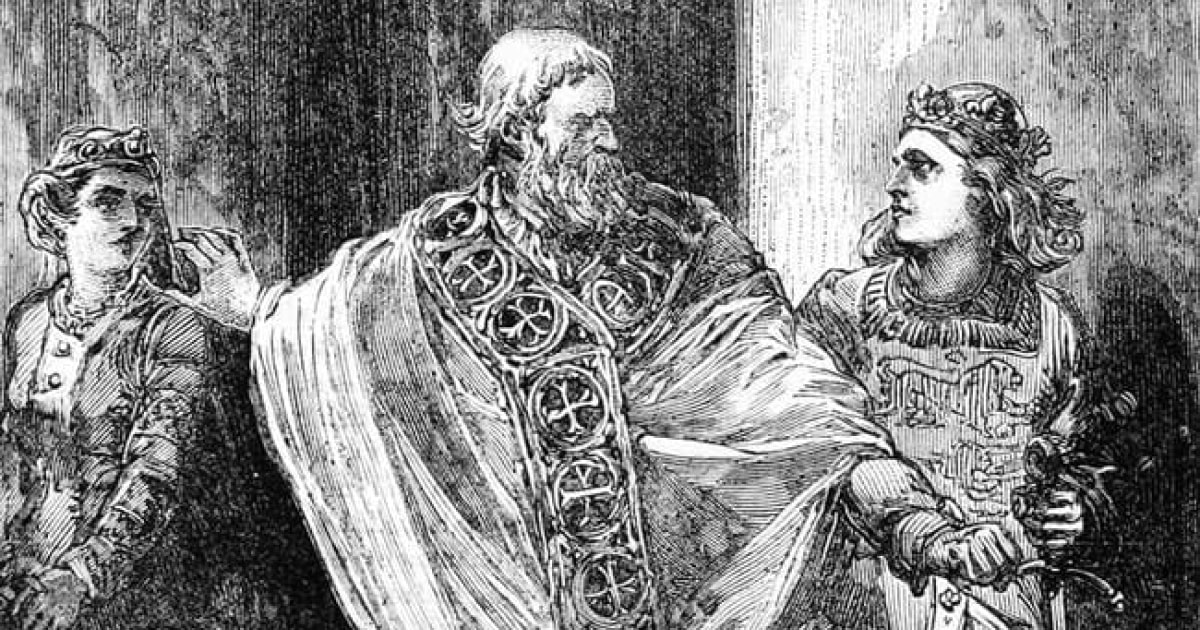
Under Kings Eadred and later Edgar the Peaceful, Abbot Dunstan became one of the leading figures in England, promoting ecclesiastical reform, royal authority, education and moral discipline. He was constantly offered a succession of bishoprics, all of which he refused until he was eventually persuaded to accept being made Bishop of Worcester, then Bishop of London and finally Archbishop of Canterbury in 960, receiving the pallium in Rome from Pope John XII.
Dunstan worked closely with fellow reformers such as St Æthelwold and St Oswald of Worcester. Together they restored monasteries, disciplined clergy, encouraged learning and strengthened both Church and kingdom. Medieval writers credited Dunstan’s statesmanship with bringing England an unusual period of peace and order.
After Edgar’s death, political conflict revived. Dunstan supported King Edward the Martyr against rival factions and later warned the young Æthelred the Unready of future calamities. In old age he retired largely to Canterbury, where he devoted himself to prayer, teaching, scholarship, church-building and craftsmanship, especially the making of bells and organs. Stories circulated of visions of angels singing to him.
Forewarned of his death by a vision, Dunstan died on May 19, 988, after preaching at Mass on Ascension Day. Buried at Canterbury Cathedral, he became one of the most beloved saints of medieval England until his shrine was destroyed at the Reformation.
Dunstan’s popularity amongst later generations of the faithful is attested to by the many churches dedicated to him. In the City of London, St Dunstan-in-the-West survives and is used both by the Church of England and a Romanian Orthodox community. St Dunstan-in-the-East was destroyed by a German firebomb and its ruins are left as a somewhat ethereal public garden. The church dedicated to him at Canterbury became the final resting place of the head of St Thomas More. A church in Stepney was originally dedicated to All Saints but, sitting in a manor Dunstan owned and improved, was rededicated to him following his death, as was the church in his birthplace of Baltonsborough.
In 1915, Sir Arthur Pearson founded a charity to look after soldiers and sailors who had gone blind during the ongoing Great War. He was lent a house in Regent’s Park known as St Dunstan’s Villa, owing to an association with the church of St Dunstan-in-the-West. From then until 2012, this charity was known as St Dunstan’s, and continues its work today as Blind Veterans UK. In the 1930s, the villa was rebuilt as Winfield House, which since 1955 has been the official residence of the American Ambassador to the United Kingdom.


.jpg)