


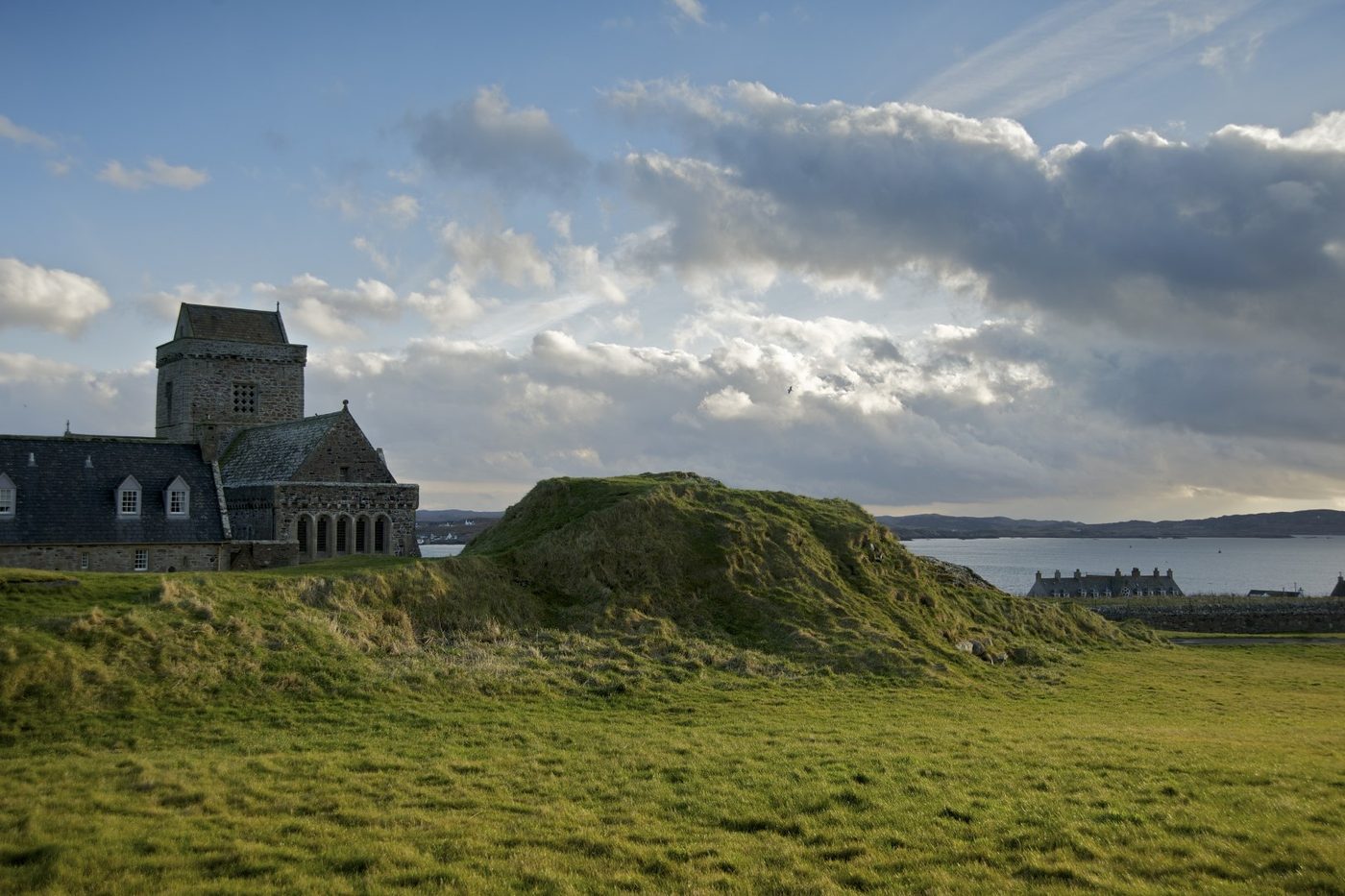
Fragments of a wooden hut found on the Scottish island of Iona have been confirmed as the 1,400-year-old remnants of the cell of St Columba. The Irish saint founded a monastery at Iona that became one of Europe’s leading centres of learning and served as the springboard for the evangelisation of Scotland. St Columba was renowned for his sanctity and his life was associated with many miracles. His guidance for monastic life was followed in Scotland, Ireland and Northumbria until it was superseded by the milder Rule of St Benedict. St Columba’s biographer Adomnán wrote that in his old age Columba slept on a bare slab of rock, ate barley and oat cakes, and drank only water. A team of archaeologists from the University of Glasgow tested a sample of hazel charcoal taken from the presumed site of St Columba’s cell. The charcoal had been kept in a matchbox in a garage in Cornwall for several decades. It had been found at Tòrr an Aba, the “mound of the abbot”, a rocky hillock traditionally thought to be the site of St Columba’s cell. The sample has now been carbon-dated as between AD 540 and AD 650. The hut appears to have burned down. It lay underneath beach pebbles and had been marked with a stone cross. The existing abbey on the island dates to the 12th century. It ceased functioning as a monastery after the Reformation but was revived by the ecumenical Iona Community in 1938. Professor Thomas Clancy, Celtic and Gaelic historian at the University of Glasgow, said: “The results of the radiocarbon dating are nothing short of exhilarating. The remains on top of Tòrr an Aba had been dismissed as from a much later date. Now we know they belonged to a structure which stood there in Columba’s lifetime.” Also exciting, he said, was that they possessed a manuscript of psalms called the Cathach that had probably been written by St Columba in the cell.
1:00 PM
Sixth-century cell of St Columba discovered
Staff writers

2 min read



Already a subscriber? Sign in
5freearticles every month
Continue reading with a free account. No card needed.
- Five free articles every thirty days, on any device you sign in on
- The Catholic Herald newsletter, every morning
- Subscribe whenever you like for everything: every article and the magazine
Related articles
 Newsroom
First parish named for Bl Fulton Sheen established in Illinois
Bishop Louis Tylka of Peoria announced the new Blessed Fulton Sheen Parish two days after Sheen became the first American-born bishop to be beatified
Christine Rousselle Newsroom
Injured priest tells Poles: ‘Do not blame Ukraine’ for convent attack
Corrie Douglas-Young Newsroom
Church leaders urge Drumcree dialogue: ‘Too much is at stake’
Corrie Douglas-Young Newsroom
Thousands of Irish children to join global Rosary campaign
Corrie Douglas-Young Newsroom
TikTok priest urges young people to stand with persecuted Christians
Nathalie Raffray
subscribe to the catholic herald today
Our best content is exclusively available to our subscribers. Subscribe today and gain instant access to expert analysis, in-depth articles, and thought-provoking insights—anytime, anywhere. Don’t miss out on the conversations that matter most.
Subscribe



