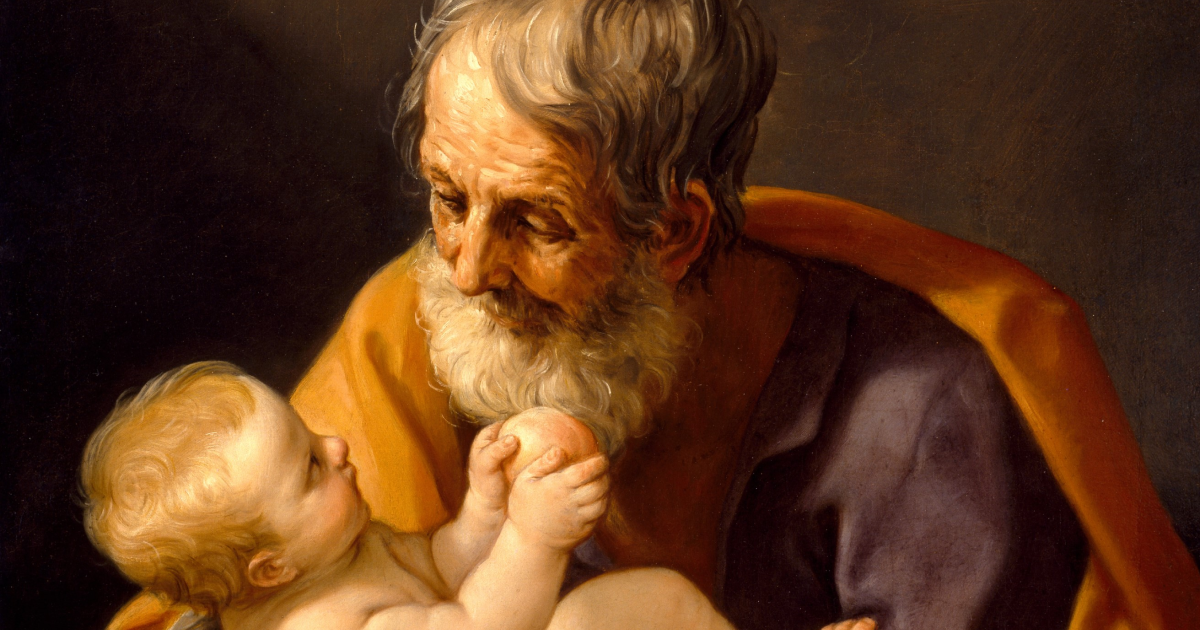


St Joseph is a rather peculiar figure. We know very little of him, and what we do know, we know mostly indirectly. He remains hidden from the main narrative in all the Gospels, and he never says as much as one word. Yet Matthew, in his terse infancy narrative at the very onset of his Gospel, cared to pass a comment on this humble man which should not be glossed over on account of its meaningful significance. St Matthew calls Joseph dikaios, a righteous man.
Anyone familiar with the New Testament would immediately intuit that this notion of righteousness is of no little importance. Indeed, Matthew employs it more than any of the other Gospel authors.
Dikaios, righteousness, translates into Greek the Hebrew sedaqa, which denotes a certain correct behaviour that is fitting for a pact between two people. In the Old Testament, against the backdrop of God’s covenant with his people, this notion becomes a theological factor. Sedaqa establishes a framework of correct behaviour in fidelity to the covenant between God and the Israelites. God is said to act righteously whenever he saves his people, according to his word, from external threats, while the people of Israel are said to act in righteousness when they keep and observe the Lord’s word and entrust themselves to Yahweh.
The first reading from the seventh chapter of Isaiah, on the fourth Sunday of Advent, is epitomical of this notion. The prophet goes to King Ahaz, encouraging him to put his trust in Yahweh rather than the Assyrian king. On the other hand, Isaiah promises him that God would also be faithful to his word and would save Israel from its menacing assailants. As a warrant of Ahaz’s obedience, Isaiah hands down the promise of a virgin who bears a son and whose name shall be Immanuel.
Essentially, then, according to this theological worldview, righteousness entails an act of salvation from God’s end and an act of obedience from the end of human beings. God is righteous when he acts faithfully to his covenant by saving his people, while human beings are said to act righteously when they faithfully obey God’s word.
The liturgy of the fourth Sunday of Advent sets the birth of Jesus Christ immediately against the framework of this covenantal dialectic of righteousness. It does so by means of St Matthew’s terse account, which acknowledges the birth of Jesus Christ as the long-awaited fulfilment of the prophet’s promise to Ahaz. Thus considered, Mary and Joseph are no mere literary devices but key figures representing different righteous responses by the parties in a covenant.
The Virgin Mary, on the one hand, becomes a token of the fulfilment of God’s promise made to Ahaz by Isaiah. Matthew states this in no uncertain terms. The child born of the Virgin Mary is the Emmanuel, the God among us, whom the prophet had promised long ago. In this drama of salvific economy, she stands as the perennial sign of God’s righteousness, that is to say, of his fidelity to the covenant by an act of salvation on behalf of his people.
On the other hand, if Matthew sees in Mary a sign of God’s righteousness and fidelity to his covenant, no less does he consider Joseph a sign of the human being’s righteous behaviour and fidelity to God’s covenant. Joseph is righteous (dikaios) because he is not remiss in his obedience to God’s word.
St Thomas Aquinas does not overlook this connection. In his commentary on St Matthew’s Gospel, he notes the obedience of Mary’s spouse (obedientia sponsi) and quotes St Paul’s words from Romans 5:19: “For as by the disobedience of one man many were made sinners, so by the one man’s obedience many will be made righteous.” Remigius of Auxerre, a Benedictine monk from the Carolingian period, also falls within this tradition. In one of his homilies he wrote, “Through the disobedience of Adam we were all lost, but through the obedience of the good Joseph we were all called once again to our pristine state.”
It is noteworthy how Joseph’s obedience is transposed into a Christological tenor. In his prompt answer of obedience, Joseph anticipates Christ’s human response to the Father. His obedience mysteriously reveals by what act we are to be saved. Matthew’s remark about Joseph’s righteousness, then, is no passing comment. Joseph is righteous because he somewhat antecedently reveals obedience as the correct human behaviour within the context of the new covenant with God, now established in Christ.
Divine and human righteousness, understood as fitting behaviour in a covenant, so wonderfully prefigured in Mary and Joseph, actually converge in Christ’s own mystical person. Jesus Christ becomes the locus where the righteousness of God and man intersect. In Christ, God shows himself righteous by coming down to save his people, while also, in Christ, humankind shows itself righteous by remaining steadfast and faithful to God through the perfect obedience of the incarnate Son.
God shows his righteousness by saving his people through a human offering of an act of perfect obedience in the incarnate Son. St Augustine, in his characteristically mystical way, comments on Psalm 142, saying, “You created me by your Word and recreated me by your Word. You created me with the Word remaining with you, but you recreated me with the Word becoming flesh for our sake.”
The one who performs an act of perfect obedience on earth is, in fact, the one who is eternally consubstantial with the Father. In a sense, Christ’s earthly obedience is the human expression of his divine personhood. The personal reality of this man, Jesus Christ, is a relation of eternal origin from the Father. In the incarnation, this Trinitarian personal relation achieves a temporal and human articulation when Jesus lives out his life wholly oriented to God in obedience.
God’s righteous behaviour was supremely revealed in Christ’s own human nature, but it was incipiently prefigured in the humble carpenter of Nazareth. In a sense, Joseph is the precursor of human righteousness as it later unfolds in Christ’s own life. By dint of an extraordinary gift of grace, he provides a perfect human response to God’s covenant, foreshadowing that salvific act by which humankind would eventually become righteous once again in the incarnate Lord. He shows himself wholly conformed to Christ before Christ was even born.
In this sense, Joseph becomes a major Advent figure alongside Isaiah, John the Baptist and Mary. Isaiah is the prophet who foretells the coming of the Messiah, while John the Baptist is the precursor who prepares the way and points him out when he eventually comes. Mary is the sign of God’s righteousness and fidelity to his covenantal people, while Joseph becomes the sign of human righteousness and fidelity to God, which is ultimately and supremely manifested in Christ’s own earthly life.