




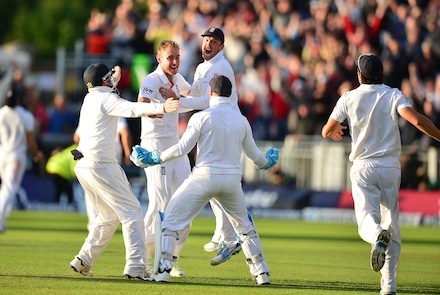
I had to reach my allotted span (indeed, pass it by a year or two: I’m now well into the years of labour and sorrow) before I discovered the great human drama that is test cricket (and above all, that is Ashes cricket). Not county cricket, or one day cricket or 20-20 cricket (smash bang wallop, as Sir Geoffrey Boycott contemptuously called it the other day), but test cricket, especially as explained to those of us whose technical knowledge and experience of cricket as a game is as limited as mine is, by that great triumph of modern programming (one of the few things worth possessing a DAB radio for; it’s the only way you will hear it) Test Match Special or TMS (blest vocables). The trick is to watch the cricket on Sky with the volume muted, and on your earphones listen to TMS, which will describe to you, with learning and humour, what it is that you are watching and instruct you in a great deal more besides. Test cricket, it now seems to me — as a mirror of the drama of human life; of its uncertainties; its failures; its triumphs; its moral quandaries; the way it can call forth exceptional achievements when they are needed, not for self-glorification, but for the common good, the needs of the team (Bell’s three centuries); the understanding a Test match slowly engenders that nothing can be achieved without imagination, courage and persistence and that we have always to be prepared for defeat and failure — Test cricket approaches the profundities otherwise attained only by great literature, even, at times, by religion itself. Its afficionados are seized by the dramatic nature of this endlessly complex and poetic game as much as a Wagner devotee in the throes of a full Ring cycle. Great cricket writing is full of poetry and passion. Consider the following lyrical, almost numinous, passage, by Jim White, in Wednesday’s Telegraph:
12:43 PM
Test match cricket approaches the profundities otherwise attained only by great literature, even by religion itself. Why does it happen so rarely?
Of course it doesn’t quite achieve what only a religious understanding can deliver: all the same, nearly all human life is there
William Oddie

7 min read



Already a subscriber? Sign in
5freearticles every month
Continue reading with a free account. No card needed.
- Five free articles every thirty days, on any device you sign in on
- The Catholic Herald newsletter, every morning
- Subscribe whenever you like for everything: every article and the magazine
Related articles
 Newsroom
Church leaders urge Drumcree dialogue: ‘Too much is at stake’
The Catholic and Church of Ireland Archbishops of Armagh have urged a renewed commitment to peace and reconciliation amid the Drumcree stand-off
Corrie Douglas-Young Newsroom
Thousands of Irish children to join global Rosary campaign
Corrie Douglas-Young Newsroom
TikTok priest urges young people to stand with persecuted Christians
Nathalie Raffray Newsroom
Baby born at 25 weeks reunites with neonatologist two years after leaving hospital
The Catholic Herald Newsroom
Joe Biden honoured by Planned Parenthood after defending abortion rights
Christine Rousselle
subscribe to the catholic herald today
Our best content is exclusively available to our subscribers. Subscribe today and gain instant access to expert analysis, in-depth articles, and thought-provoking insights—anytime, anywhere. Don’t miss out on the conversations that matter most.
Subscribe



