



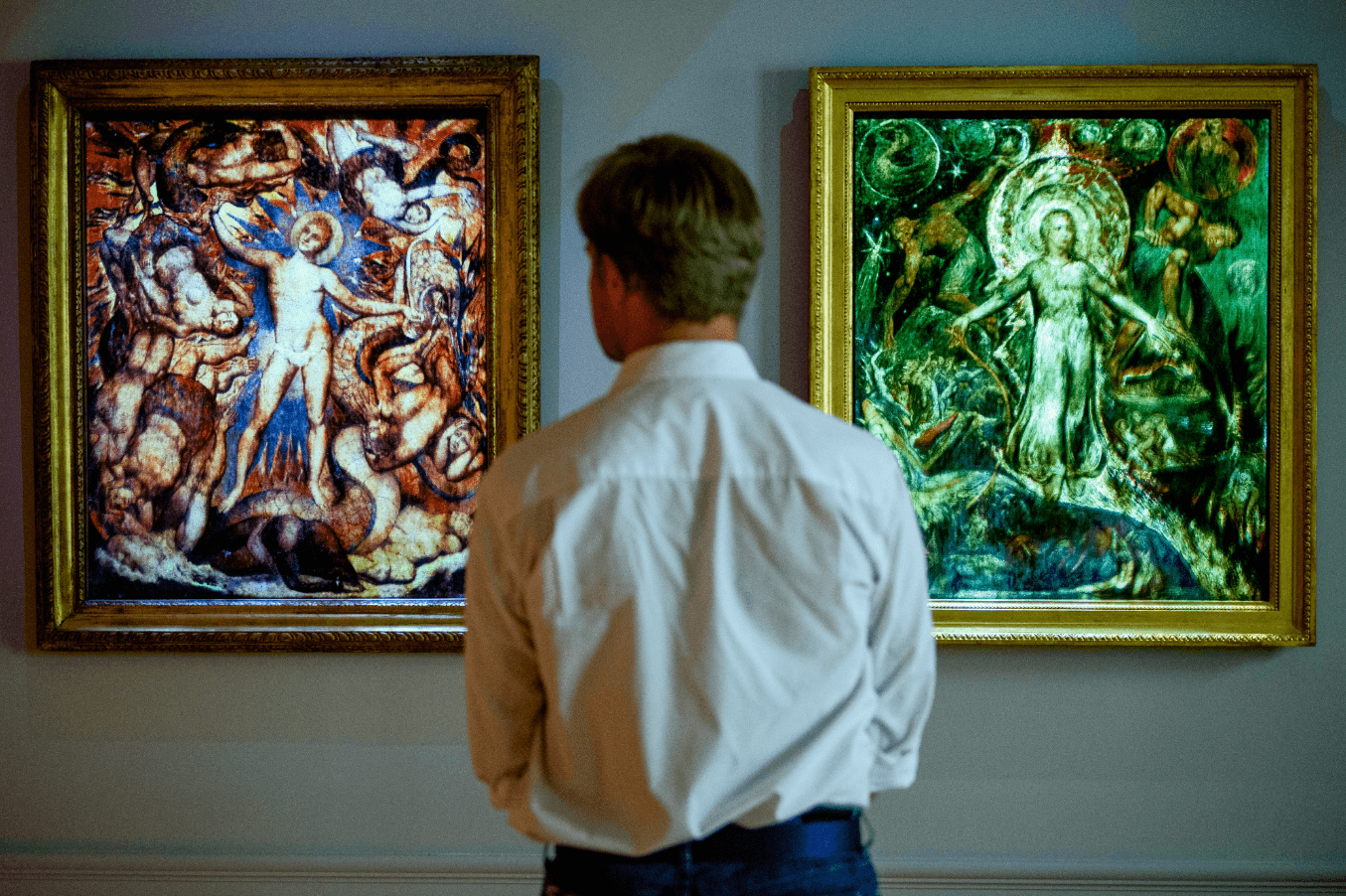
The best known of Blake’s works is that bit of his poem on Milton which we know as Jerusalem – the anthem of the Women’s Institute, the raucous bit of the Last Night of the Proms. And being familiar, it’s quite probable we don’t actually register the words: “And did those feet in ancient times / Walk upon England’s mountains green?” Right there you get something of the problem of Blake, that very London poet: the localism of his visions. Had Blake asked whether the Holy Lamb of God was on the pastures of Israel seen, no one would have turned a hair. But because he has the sheer effrontery to locate Christ in the dark Satanic Mills of Birmingham, he seems like a lunatic. The reason we are thinking about him now is of course the big new exhibition on Blake at Tate Britain, reviewed on p29. It shows more than 300 of his works, and usefully reminds us of his perfectly respectable upbringing in Broad Street. Soho, in his father’s hosiery shop, and his perfectly conventional artistic formation at the Royal Academy. Blake’s religion is of course touched on – you cannot actually engage with him without discussing it. There is an allusion to his frequent visions (his expression in one famous portrait is attributable to having just seen the Archangel Gabriel). But the exhibition lets his distinctive beliefs speak through his works. Yet there is no escaping the reality that, as the author Peter Ackroyd points out, William Blake was the last truly religious artist in Britain. He was a Swedenborgian. His mother, like Swedenborg (himself a visionary), was a member of the Moravian Church. Many of Blake’s ideas about sex as a route to the divine seemed to have come from just this source. It’s hard not to enjoy the recollection of one of his patrons who called on the Blakes in Kennington only to find them sitting naked in their garden. Blake chirruped hospitably: “Come in! It’s only Adam and Eve, you know.” We are told in Scripture that “your young men shall see visions, and your old men shall dream dreams” (Acts 2:17). Blake saw visions when he was only a little boy. He came home to tell his mother he had seen the prophet Ezekiel in Peckham sitting under a tree, and his mother smacked him. These vision were an aspect of his life which critics today prefer to gloss over, and would probably be glad to attribute to epilepsy or a neurological condition. But Blake had no inhibitions in discussing them. No sooner had his engraving master sent him to Westminster Abbey to draw the monuments than he saw Christ followed by a troupe of angels. GK Chesterton put it thus:
12:00 AM
The artist who saw the prophet Ezekiel in Peckham
the best known of blake’s works is that bit of his poem on milton which we know as jerusalem – the anthem of the women’s institute, the rauc...
Melanie McDonagh

5 min read



Already a subscriber? Sign in
5freearticles every month
Continue reading with a free account. No card needed.
- Five free articles every thirty days, on any device you sign in on
- The Catholic Herald newsletter, every morning
- Subscribe whenever you like for everything: every article and the magazine
Related articles
 Newsroom
Church leaders urge Drumcree dialogue: ‘Too much is at stake’
The Catholic and Church of Ireland Archbishops of Armagh have urged a renewed commitment to peace and reconciliation amid the Drumcree stand-off
Corrie Douglas-Young Newsroom
Thousands of Irish children to join global Rosary campaign
Corrie Douglas-Young Newsroom
TikTok priest urges young people to stand with persecuted Christians
Nathalie Raffray Newsroom
Baby born at 25 weeks reunites with neonatologist two years after leaving hospital
The Catholic Herald Newsroom
Joe Biden honoured by Planned Parenthood after defending abortion rights
Christine Rousselle
subscribe to the catholic herald today
Our best content is exclusively available to our subscribers. Subscribe today and gain instant access to expert analysis, in-depth articles, and thought-provoking insights—anytime, anywhere. Don’t miss out on the conversations that matter most.
Subscribe



