

By 2031, First Minister John Swinney aims to hold another Scottish independence referendum. The previous had been promised as a “once in a generation” vote. To be fair to Swinney, his party has waited long enough to fulfil that criterion.
He is joined in the endeavour by the leaders of Wales and Northern Ireland, all of whom have pro-independence governments. The three signed a memorandum of understanding: “Westminster’s time is coming to an end.”
“Scotland, Wales and Ireland have distinct histories, identities and political traditions. Each of our nations has the right to determine its own future, through democratic means and in accordance with the wishes of its people,” it read, calling for the British Government to “prepare for, plan and facilitate constitutional change in each jurisdiction”.
If the referenda do go ahead, the Church will, inevitably, play a role of varying influence in each. Ireland and Wales at the opposite ends of Church involvement and historical contention; Scotland between them. There is a perception amongst many non-Catholics in the UK that the Church in Scotland is primed towards Celtic separatism, deriving from how much it owes to the Irish diaspora.
Before the Irish famine, the Church set about a mission to re-evangelise Scotland, with the Jesuits aiming towards the gentry and clan chiefs and the priests of the Scots colleges and Franciscans towards the common people. That changed following the massive influx of Irish refugees, which demanded the Church turn its attention to serving the Catholics now on its doorstep.
But how Ireland, not forgetting other Catholic immigration into Scotland before the 21st century or the historically recusant population, shaped the Scottish Church was not uniform. Today, that character remains, and its views on Westminster vary almost as much as amongst every other Scot. Anecdotally speaking, whilst neither view is totally dominant, you are still more likely to find a unionist priest in the east than you would in the west.
The night before the 2014 referendum, Braveheart played on the television – for some, a much more appropriate Scottish classic than Trainspotting. Yes and Naw stickers littered the lampposts on the streets. Nationalists were beset by the optimism which characterised the early 2010s, unionists by the trepidation of a seemingly uphill battle that could redefine their national identity.
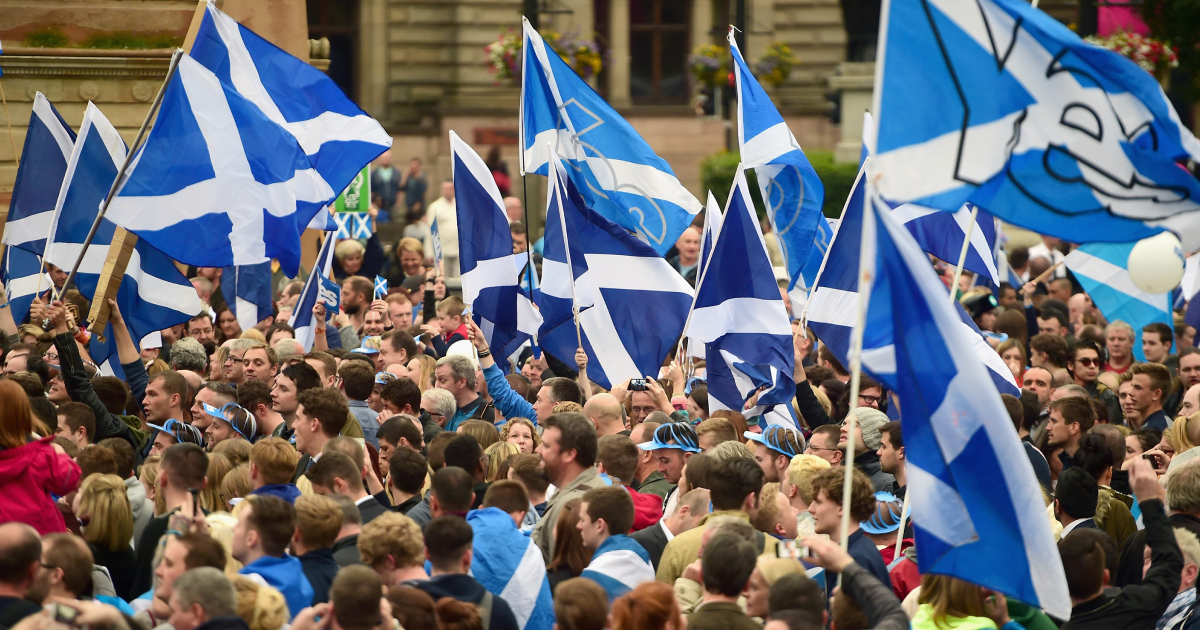
The early polling suggested a victory for independence. Glasgow, one of the four areas which voted in favour, saw George Square filled with crowds, with police fearing a clash between the two sides. As the No result was declared with 55 per cent of the vote, a lingering and defeated gloom of nationalists remained. As did the stickers for many weeks after.
It was not long before a Yes2 campaign for another referendum was spoken of – just slightly after a tongue-in-cheek push for a People’s Republic of Glasgow – but the energy which dominated Scotland from 2013 until that day has never been replicated.
A paper written by the Catholic sociologist Dr Paul Gilfillan surveyed working-class faithful in Fife ahead of the referendum. Prior to the campaigns, most of those surveyed opposed independence (and did not see any spiritual significance in it).
He found that “an older generation of Catholics at a crucial point in their national story did not see God as part of that story or at work in their history”.
“Reviewing my interview transcripts,” he wrote, “it is clear that Scotland’s history plays little or no part in my informants’ self-understanding as Catholics, and that they have no consciousness of belonging to a coherent or self-aware Scottish Catholicism, so that this generation’s Catholicism is not in any conscious relationship to the on-going constitutional ferment that has characterised Scotland since the nineteen-seventies.”
In 2013, he found that only a quarter favoured independence. A year later, all but a quarter were in favour. The place of Catholicism in that change, however, appeared starkly absent.
“My conclusion was that as a consequence of Scotland having been a stateless nation for so long, my informants were immersed in a thoroughly privatised, constitutionally subservient and a ‘well-behaved’ Catholicism that ‘knew its place’,” he wrote.
“Instead of any politicisation of religion or a religious based politicisation of the ‘social structure’ or ‘the nation,’ for instance, my informants can be fairly represented as being entirely innocent of the question of the relation of the supernatural and Scotland.”
Despite that, he noted well-established evidence that an alignment between Catholicism and the movement towards Scottish independence was ongoing. In the late 90s, Catholics in comparison to members of the Church of Scotland supported independence by more than ten per cent – but it was still only 34 per cent at that.
By 2014, Catholics voted 57 per cent in favour and 43 per cent against. Only two per cent higher than those with no religion, it was nonetheless a far cry from the just 30 per cent of Protestants who voted for independence. The bishops encouraged participation, but remained strictly neutral.
Recent polling on religion and nationalism is sparse. A 2023 analysis by the think tank Theos still puts Catholics disproportionately ahead of other denominations in support of nationalism (but this time not ahead of those with no religion). The majority of Catholics with an opinion, however, now appear to oppose independence by 51 per cent. Just 41 per cent said they were in favour – a statistic that Theos noted was “somewhat at odds with other, older polls”.
Come 2031, the Scottish Church will be a smaller one. The younger generation of the faithful, a smaller cohort than their predecessors, will be as distant to the 2014 referendum as the youth of that time were to the opening of the Scottish Parliament.
Much has changed since then, with much more to come that cannot be accounted for, but the old view of a stateless Scotland under a Protestant union hardly holds weight in the imagination today. If there was a general lack of conscious Catholic nationalism then, what will be left for tomorrow?