

June 12, 2026

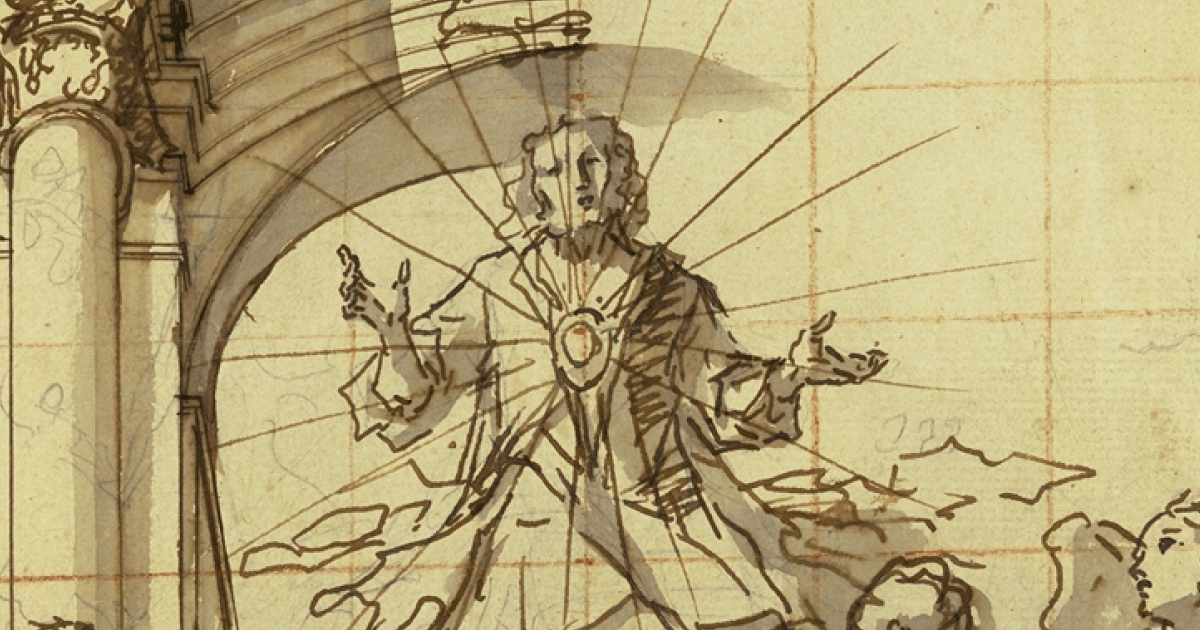
The Heart of Jesus Christ

Fr Thomas Crean OP
More
Related
Min read
share

In the book of Psalms, we read these words: “My heart is become like wax, melting in the midst of my bowels” (Ps. 21:15). Writing about AD 150, St Justin Martyr observed that this verse of Scripture was a prophecy of what Christ would experience in the Garden of Gethsemane. “It is written in the memoirs of the apostles,” St Justin explained to a Jewish interlocutor, “that His sweat ran down to the earth as drops of blood, and that His heart quaked and dissolved within Him, in order that we may know that the Son, in accordance with His Father’s will, really did endure this for our sakes, and that we might not imagine that as Son of God, He had no feeling for all that happened and befell Him” (Dialogue with Trypho, 103).

In other words, the Heart of Jesus is a part of the doctrine of the Incarnation. Not just in the obvious sense that His body was formed by the Holy Spirit with all the organs that human nature requires, but also insofar as the word “Heart” implies the affectivity of Jesus Christ.

What is “affectivity”? The word itself is abstract and somewhat rare, but what it names are assuredly the least abstract of things: love, and the desire to give and receive it; sorrow, perhaps at separation from a beloved person, or at the prospect of separation, or at death itself; the desire for reunion, and joy when it occurs; pain, when love or friendship is slighted or betrayed, or taken too much for granted, or if a loved person acts in a way unworthy of himself.

All such “movements of affectivity”, and others also, existed in Jesus Christ, yet differently from how they exist within us. Our affectivity is fallen: hardly ever is either our love or our sorrow wholly free from some degree of selfishness. They easily turn sentimental, or possessive. We grow angry, or bitter, or at least irritated, if a friend causes us pain or even inconvenience. Or else we are simply inconstant: “Man born of a woman,” says Job, “never continues in the same state” (Jb. 14:1-2).

None of these things is true of Jesus Christ. Just as His human mind was not darkened by ignorance or error, and just as His human will made no sinful choices, so His human affectivity corresponded perfectly to each person and his or her unique circumstances. An affectivity keen and yet also serene, like Adam’s before the Fall; but infinitely more mysterious than Adam’s, since it was, and is, the affectivity of the God-man.

All this is implied by the worship that we pay to the Sacred Heart, hypostatically united to the eternal Word.

It is to the New Testament, of course, that we must turn if we wish to learn more about the Heart of Christ. He came to bear witness to the truth, to speak of the commandments and counsels of God by which we may be saved. He did not, I think, come primarily to speak of His own Heart; and yet it is inevitable that each of His words will reveal something of it, since, as He Himself says, “out of the abundance of the heart the mouth speaks”. And some of Christ’s words seem to provide us, as it were, with an especially strong echo of the abundance of His Heart. We might think perhaps of such words as these: “Neither will I condemn thee; go, and now sin no more”, or “Many sins are forgiven her, because she has loved much”, or the ending of the parable of the prodigal son, where the father seeks to soften the heart of the stubborn elder brother: “Son, thou art always with me, and all I have is thine. But it was fit that we should make merry and be glad, for this thy brother was dead and is come to life again; he was lost, and is found.”

Yet there are also occasions in the Gospel, especially as the Passion draws near, where the Lord shows us something of His Heart more directly. There are, after all, times when not to have deep feelings would be to fall into the vice of insensibility, and not to manifest them would be either meaningless reserve or a failure of friendship. “Now is my soul troubled,” He says, on the last day of His public ministry; but immediately afterwards, “Father, glorify thy name.” Then, at the Last Supper, “Amen, amen, I say to you, one of you will betray me… He that is dipping his hand with me in the dish, he shall betray me.” In Gethsemane, to the three favoured ones: “My soul is sorrowful even unto death”, and a little later, to Peter alone, “Could you not watch one hour with me?” Then, from the Cross itself: “I thirst.”

He has now entered into His glory. But we should not think that this has diminished the affectivity of Jesus Christ. The Gospel teaches us this too. What does He say to St Peter by Lake Tiberias, when He had now risen again? “Simon son of John, lovest thou me more than these?” The Catholic philosopher Dietrich von Hildebrand, who has written marvellously well on our subject, comments as follows on these words:

“The appeal to the love of Peter reveals the unfathomable mystery that Christ seeks our love, that he wants not only to be obeyed but also to be loved… If the words mihi est data omnis potestas in coelo et in terra, ‘all power in heaven and on earth has been given to me’, spoken immediately before the Ascension, are the ultimate revelation of Christ’s divinity, the manifestation of his absolute Lordship, these words are the last effusion of his Sacred Heart. They breathe an ineffable meekness and gloriously tender love.”

I recommend von Hildebrand’s book The Heart as a way of entering more deeply into this mystery.

Continue reading with a free account

Create a free account to read up to five articles each month
Create free account

You have # free articles remaining this month.

Subscribe to get unlimited access.
Sign up

subscribe to the catholic herald today

Our best content is exclusively available to our subscribers. Subscribe today and gain instant access to expert analysis, in-depth articles, and thought-provoking insights—anytime, anywhere. Don’t miss out on the conversations that matter most.
Subscribe