

The imagery and iconography of Christmas centres on the beauty of new birth and the sight of complete innocence and purity presented to us in a baby, the infant whom the angel commanded his parents to name Jesus, ‘Saviour’.
This sight of a baby saviour stretches the elasticity of our conceptual imagination further than it can easily travel. In this child, we find ourselves, as the prologue to the Gospel of John describes, building a span or a bridge between the Intelligence, the Logos, that holds the universe in being, and this invasion of time and space by that Mind in the form of living matter, emerging as both vulnerability and infancy.
This contrast between the timelessness of the Creator and infancy, or however we try to conceive of total and ultimate power and the mortal vulnerability of a baby, the power that creates all matter, time and space, and the vulnerability of birth and infancy, is enough to stretch the elasticity of our imagination further than many of us can easily manage. But the impact Christmas ought to have upon us, both in mind and heart, does not end there. It only begins there.
We are about to find ourselves having to enlarge the tents of our minds and hearts even further. As the Feast of Christmas develops, we find ourselves confronted not only by happiness, but by horror. Birth and death, nativity and massacre, are intermingled.
The ways in which we order our conceptual architecture of meaning are going to endure yet another stretch. In the infant Christ, Jesus is presented to us as love incarnate. The risk taken by the Mind that holds the universe in being, to enter time and vulnerability in order to mend our lostness and heal our alienation, will end in rejection, torture and death. He came to his own, and his own knew him not.
Yet he comes so that we may know we are not alone.
He comes so that we may know there is, and that he is, a beginning and an end, and more profound still, that there is a state in which neither beginning nor end defines reality. That conjunction of time and beyond time strains our imagination, but so equally does the vision of omnipotence laid in a manger.
His incarnation provokes a violent response from evil, as might be expected. Instead of simply being shocked by the slaughter of a generation of children, we might expect it. The moment he, as incarnate holy goodness, enters the world, he provokes a moral reaction, and one that was always likely to produce horror. This baby of love creates such cosmic ripples that, in a world infused by evil, the first response by evil, channelled in this case by a paranoid totalitarian ruler, is the murder of innocence on the grandest scale.
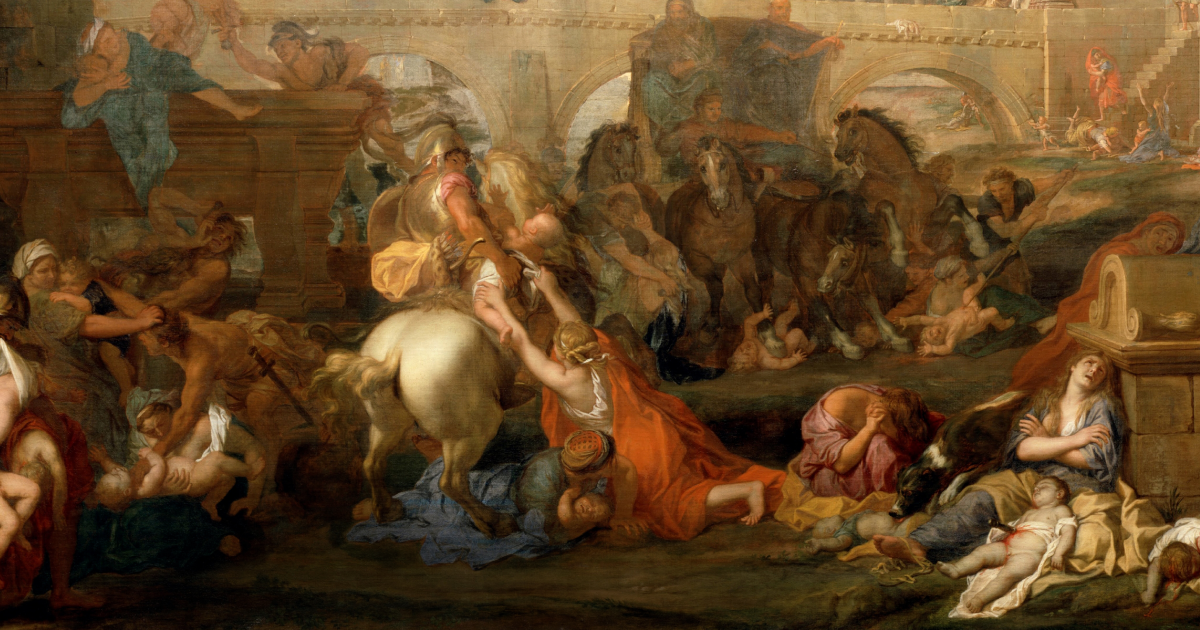
Love provokes pride, compassion provokes rage, forgiveness provokes hate. In a world characterised by a form of moral dualism, at some level we might therefore have expected some grotesque reaction to the incarnation, intuitive or intentional, from the powers that be in the world. That is indeed what we see on the Feast of the Holy Innocents.
Herod, infused, permeated and possessed by evil, responds politically to a challenge to his kingship with ruthless generational execution. But this is no isolated political event. It is also a metaphysical event. As if darkly, spiritually and intuitively, he responds to the birth of love and forgiveness with an explosion of paranoid murderous rage. He was a ruler already practised in assassination. He merely widened his reach.
Gripped by paranoia and insecurity, he clung jealously to his power and attacked anyone he saw as a threat, including members of his own family. In 35 BC, he drowned his brother in law, who was High Priest at the time, making it appear an accident. In 29 BC, Herod suspected his wife, Mariamne, of infidelity and conspiracy. After a show trial, he executed her. Mariamne’s mother and grandfather were also executed. In 7 BC, Herod executed two of his own sons, Aristobulus and Alexander. In 4 BC, he killed his son Antipater. Every execution flowed from Herod’s paranoid delusion that the victim was plotting against him and seeking his throne.
And so we find, initiated by the incarnation, a pattern of moral equivalence emerging. The greater the intrusion of sanctity into the world, the deeper the enraged perversity in response. The greater the love, the more vituperative the hatred.
The Church has often been accused of corruption as it engages with evil and perversity. Few, however, allow for the fact that it can never keep itself impermeable to evil as it struggles with the dynamics of corruption and renewal. We should never be surprised when we see corruption near or even within the Church. The presence of Jesus always draws out darkness like a poultice on a wound. Terrible, awful, tragic and grotesque as the deaths of the Holy Innocents are, might we not expect something like this if Jesus is who the Gospels claim he is?
Jesus will always draw evil into the light, both in our own lives and in the lives of others. For the Christian, we are saved by confession and repentance. For those who reject him, we find the presence of Jesus exposing and almost provoking the rebellious pollution of pride, while confronting and pleading with it and offering salvation.
We live in a morally conflicted universe in which the gift of free will has unleashed the power of choosing evil. Our only refuge is Jesus himself, to whom we have access through penitence, penance and forgiveness.
The Feast of the Holy Innocents should, and does, make us pause, as it forms part of our interpretation of the incarnation as a confrontation with and challenge to evil. It reminds us of the cost of love, a cost that God was willing to pay himself and which he pays on the Cross. That cost will continue to emerge wherever the life of God, the love of God and the presence of God are welcomed, celebrated and lived, because they will always produce a reaction rooted in rebellion, hatred and perversity.
The Feast of the Holy Innocents should prepare us for the fact that, in the New Year, we will enter another round of conflict. The conflict is what it always is. It is a profound struggle between evil clinging to power and influence, and the unstoppable attraction of love that presents each of us with life rather than death, forgiveness rather than condemnation, hope rather than despair, penitence rather than pride, heaven rather than hell.
We should go into the New Year with our eyes wide open, knowing that we have signed up for this life of conflict, but also knowing that victory is given to us. The Holy Innocents, as the first of so many martyrs, were fast tracked to heaven.