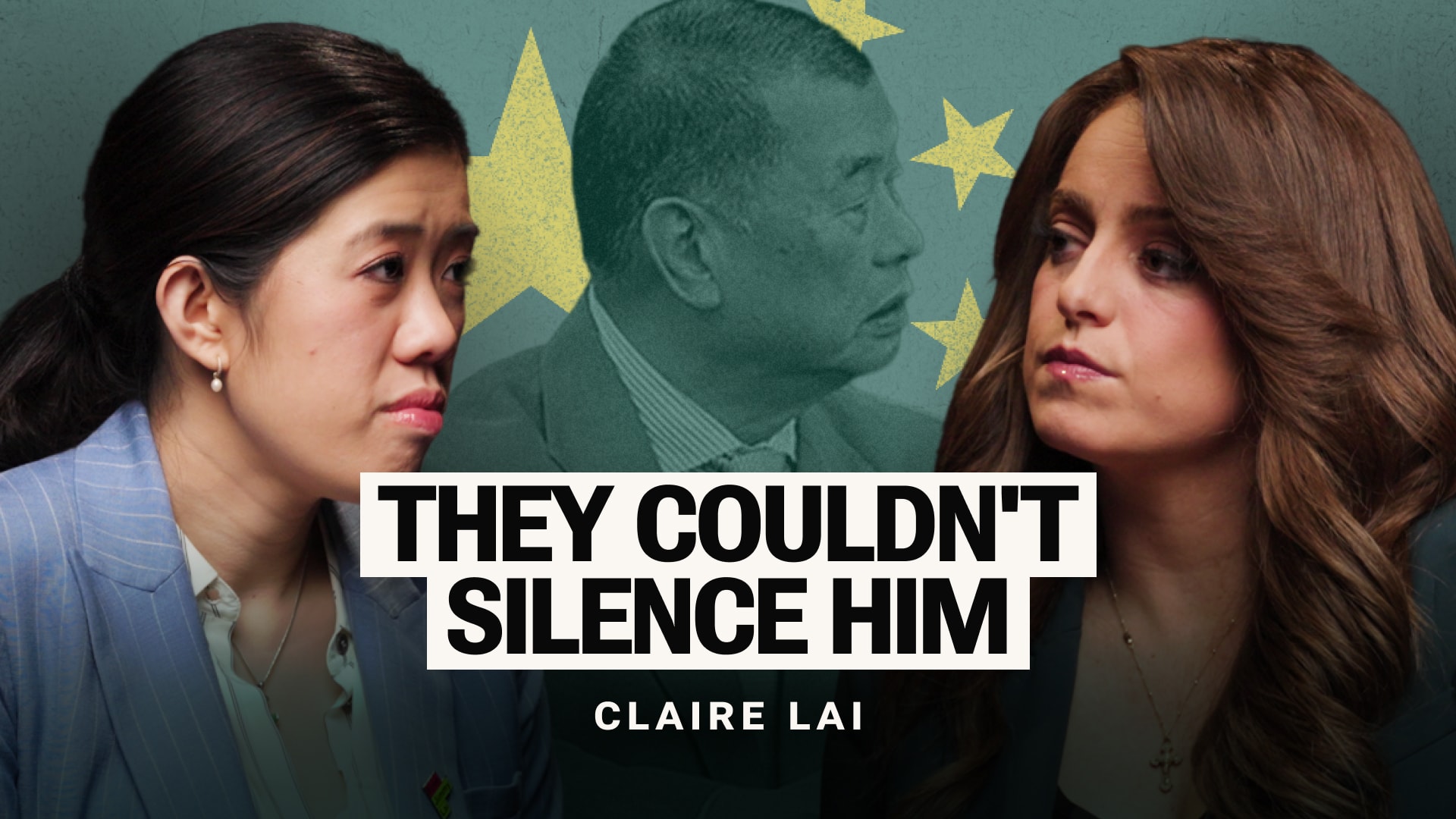
In this episode of In Conversation With, Mary Margaret Olsen sits down with Claire Lai, the daughter of Jimmy Lai, founder of Apple Daily and one of Hong Kong's most prominent pro-democracy voices, who has been held in Stanley Maximum Security Prison since his conviction under the National Security Law. As of this recording, it has been 1,927 days.
The law itself is Claire's first subject. Enacted on the 1st of July 2020, it was, she says, designed with her father specifically in mind and applied to acts committed before it existed. Around 99 per cent of the evidence used to convict him dates to before the law's enactment and concerns activity that was lawful at the time: peacefully advocating for China to honour the promises it made to Hong Kong. The handful of acts cited from after the law came into force amount, in her account, to ordinary political commentary, including a remark her father made about the closure of a Chinese consulate that the prosecution characterised as a request for foreign sanctions. It defies, she says, any natural language or logic to read it that way.
The conditions of his imprisonment are the conversation's most difficult passage. His cell is roughly 45 square feet and reaches 110 degrees in summer. His blood sugar is checked once every three weeks despite long-standing diabetes. His nails fall off and regrow and fall off again. His teeth are rotting. The window that should give him access to natural air and light has been deliberately blocked. He is held in effective solitary confinement, the floors above and below his entirely emptied. He wakes before dawn to read the gospel and, after the guards stopped allowing him to turn on the corridor light, has begun leaning against the door to make out the words in the dark.
His faith is not incidental to the story but central to it. Jimmy Lai entered the Catholic Church in 1997, the year of the Hong Kong handover, at a moment when, his daughter says, God's love was the only thing capable of turning fear into trust. He fasts on Fridays. Guards, aware of this, place food in his cell and leave it there for hours. He wrote to Claire that he was shivering but did not yield because he looked at his own drawing of the crucifixion and reflected that his suffering pales against what Christ endured. He describes his imprisonment in his letters as being brought back to Jerusalem after years of walking away from it, and says he has found in the silence an abundance he cannot account for by any other means.
The political dimension of the conversation is more hopeful than its central facts might suggest. Britain has raised her father's case in every bilateral engagement with China, at the level of the Prime Minister, the Foreign Secretary and the Chancellor. President Trump has mentioned him by name. Secretary of State Rubio issued a statement calling for his release on the day of sentencing. Claire is careful not to overclaim, but she notes the Trump administration's record on the unjustly detained and says the family hopes, with God's help, that her father will be next.
What she asks of those who cannot do any of that is simpler. Every prayer sustains him. Her father writes in his letters that seeing faithfully lived lives from his cell is like watching flowers bloom, and that it makes him want to plant a garden of his own. Witnesses to the faith, he believes, make it ripple. She asks only that people continue to speak about him and that he not be forgotten.