




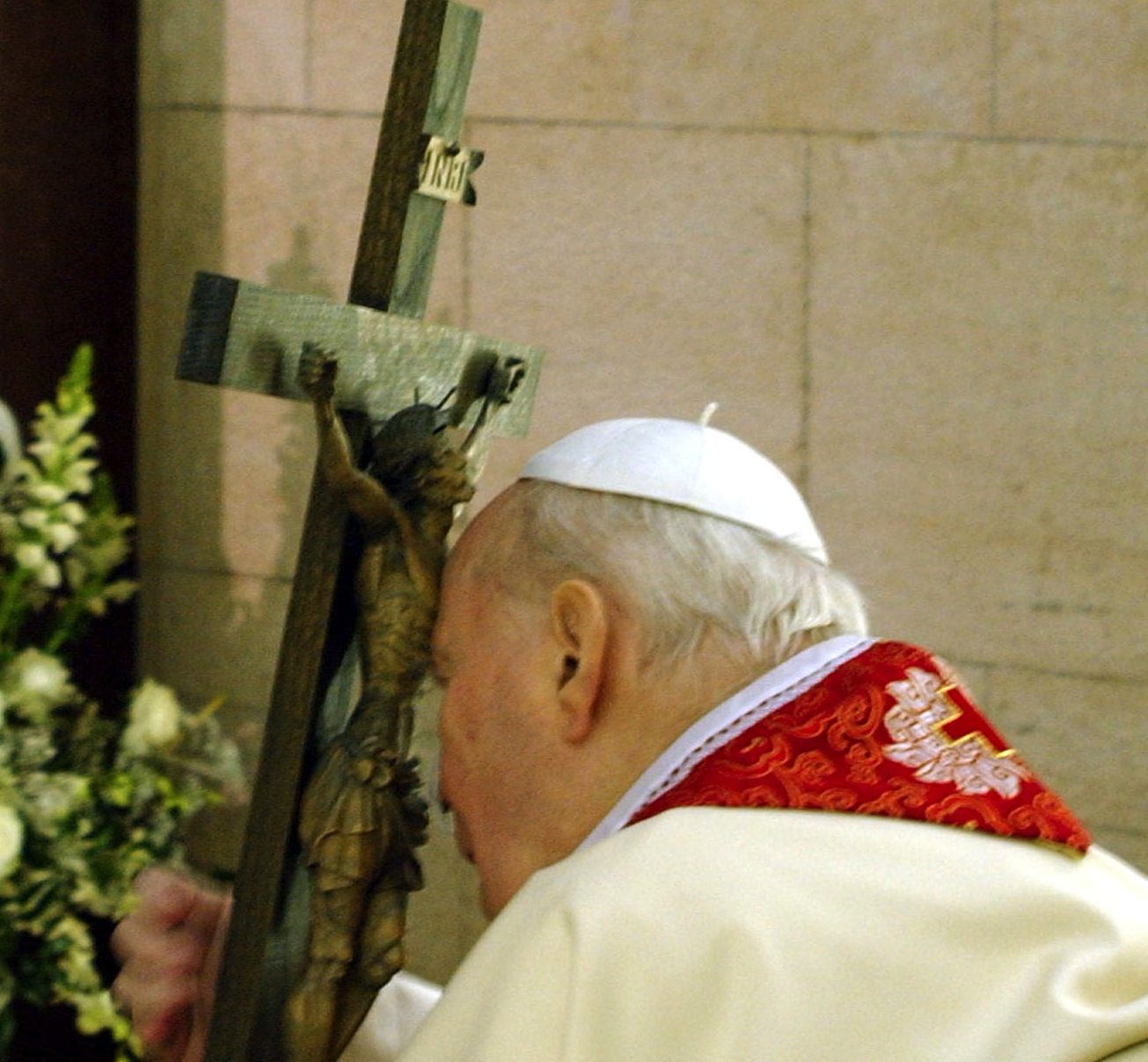
New York I had the great honour to preach the Seven Last Words devotion during the tre ore – the sacred three hours – of Good Friday afternoon at St Patrick’s Cathedral at the invitation of Cardinal Timothy Dolan. I took as my theme the occasion of Good Friday falling on March 25, which happens rarely – in 1910, 1921, 1932, 2005, 2016 and not again until 2157. March 25 is the most important date in all of history. The date is the axis mundi, the date around which the whole history of the world turns. According to the early Church, March 25 was the date of the original Good Friday. In The Spirit of the Liturgy, Cardinal Joseph Ratzinger explained the importance of March 25: “Jewish tradition gave the date of March 25 to Abraham’s sacrifice … This day was also regarded as the day of creation, the day when God’s word decreed: ‘Let there be light.’ It was also considered, very early on, as the day of Christ’s death and eventually as the day of his conception. This is most illuminating. It seems clear to me that we have to recapture this cosmic vision if we want once again to understand and live Christianity in its full breadth.” Many of us have heard that the date of Christmas was set at December 25 to counter a pagan festival in honour of Mithras; and then the Annunciation, March 25, was set nine months earlier. It’s the opposite. It was March 25 that was the key date for the early Christians, as Ratzinger reminded us: “Astonishingly, the starting point for dating the birth of Christ was March 25th … The decisive factor was the connection of creation and Cross, of creation and Christ’s conception.” So it was a conviction that the original Good Friday was eight days before the “kalends of April” – March 25 – that led the early Christians to assign that day to His conception, the feast of the Annunciation. Christmas follows nine months later. The liturgical confirmation that Good Friday was March 25 is that the Church marks that date as the feast day of the Good Thief. Like most saints, he is assigned the date of his death as his dies natalis in heaven. And no saint has a more clear birthday than the Good Thief – “Today you will be with me in paradise!” English Catholics know that the Roman Martyrology also lists Margaret Clitherow on March 25 – she was martyred on that date in 1586 for hiding priests under Elizabeth I. That year in England, March 25 was Good Friday, as England was still following the Julian calendar, having refused to accept the papal reform of the calendar by Gregory XIII in 1582. At that time, England acknowledged the supreme importance of March 25, called Lady Day, by beginning the new year upon it. St Margaret likely benefited, if one might say that, by being martyred on Good Friday. She refused to enter a plea to the charges against her, fearing that at a trial her children would be forced to testify against her, or be tempted to perjury to save her. Those refusing to enter pleas were customarily tortured with the excruciating pain of being crushed under planks weighed down with heavy stones. This would go on for three days. If those accused gave in and entered a plea, it would stop. If not, on the third day they would be killed. Perhaps because Margaret was a woman, or perhaps because, even for Elizabethan executioners it would be a step too far to kill a woman on Easter Sunday, St Margaret’s martyrdom was compressed, literally, into Good Friday afternoon. This year, Easter Week brings to mind St John Paul II. Remarkably, the March 25 Good Friday, rare as it is, occurred both on the first Good Friday of Karol Wojtyła’s life (1921) and on his last Good Friday (2005). It returns now for the Jubilee of Mercy (2016), as if to lift up the great Pope of Mercy, even as John Paul the Great prepares to welcome the youth of the world to Kraków this summer, the city of Divine Mercy. In 2005, John Paul followed on March 25, Good Friday, the Via Crucis from his chapel on television, his failing body wrapped around the Cross. He would die on Saturday night, April 2, a First Saturday and the vigil of Divine Mercy Sunday. That link between the First Saturday devotion of Fatima with the feast of Divine Mercy only exists in a window of six hours. Combined with the March 25 Good Friday, that six-hour window took place precisely once in John Paul’s entire adult life. That his birth in heaven took place precisely then is God’s writing the message of Divine Mercy in bold strokes. March 25 was the heart of jubilee year, to be completed on the other end of the novena of divine mercy with the Feast of Divine Mercy, instituted by John Paul and confirmed with his own death. The heart of the Jubilee Year, and the axis mundi. Fr Raymond J de Souza is a priest of the Archdiocese of Kingston, Ontario, and editor-in-chief of Convivium magazine
1:00 PM
The most important date in history
Fr Raymond de Souza

5 min read



Already a subscriber? Sign in
5freearticles every month
Continue reading with a free account. No card needed.
- Five free articles every thirty days, on any device you sign in on
- The Catholic Herald newsletter, every morning
- Subscribe whenever you like for everything: every article and the magazine
Related articles
 Newsroom
Church leaders urge Drumcree dialogue: ‘Too much is at stake’
The Catholic and Church of Ireland Archbishops of Armagh have urged a renewed commitment to peace and reconciliation amid the Drumcree stand-off
Corrie Douglas-Young Newsroom
Thousands of Irish children to join global Rosary campaign
Corrie Douglas-Young Newsroom
TikTok priest urges young people to stand with persecuted Christians
Nathalie Raffray Newsroom
Baby born at 25 weeks reunites with neonatologist two years after leaving hospital
The Catholic Herald Newsroom
Joe Biden honoured by Planned Parenthood after defending abortion rights
Christine Rousselle
subscribe to the catholic herald today
Our best content is exclusively available to our subscribers. Subscribe today and gain instant access to expert analysis, in-depth articles, and thought-provoking insights—anytime, anywhere. Don’t miss out on the conversations that matter most.
Subscribe



