
In his first book, Saint Mary Magdalene: Prophetess of Eucharistic Love, Fr Sean Davidson offered a series of profound reflections on the life and virtues of the apostle to the apostles. Now Fr Davidson has done a great service to the Church by producing a new book, this time on St John the Baptist.
The book is published by Emmaus Road, and its title – Prophet of Fire: The Witness of St John the Baptist – is instructive. John the Baptist is not only a prophet but the greatest of the prophets. In the mysterious workings of divine providence, more than 400 years elapsed between the death of Malachi and John’s conception in the womb of Elizabeth. When this near half-millennium of prophetic silence was finally broken, it was because the fullness of time had finally arrived and the advent of the Messiah had come. The Catechism puts it beautifully: “In John’s sight, the Spirit thus brings to completion the careful search of the prophets and fulfils the longing of the angels” (§719).
Why fire? Fr Davidson shows us that the epithet has its roots in the Old Testament, such as in Psalm 97 when it speaks of fire going before the Lord. Christ Himself lauds John as “a burning and shining lamp” (John 5:35). We might also look to the Baptist’s own description of his life mission. To him belonged the vital task of preparing the way for the One who was coming to set fire on the earth: “I baptise you with water; but he who is mightier than I is coming, the thong of whose sandals I am not worthy to untie; he will baptise you with the Holy Spirit and with fire” (Luke 3:16).
St Thomas Aquinas notes that the baptism of fire proclaimed by John the Baptist can be understood in several ways. According to one interpretation, the fire is merely another way of describing the Holy Spirit. A second view holds that the fire refers to redemptive suffering and its role in purging us of sin. Even after receiving the Holy Spirit in his soul, the Christian retains the wound of concupiscence. Hence the trials we experience in this life serve as a form of spiritual purification that burns away the dross of sin that clings to our souls. St Paul explains: “[T]he fire will test what sort of work each one has done” (1 Cor 3:13).
There may well be truth in all these interpretations. In any event, what is clear is that we would do well to rediscover and reclaim John the Baptist’s status as one of the most outstanding saints of our tradition. At times the East has been more effective in this task. By the honorific Prodromos, they celebrate John’s unique role as the great forerunner of the long-awaited Messiah. Meanwhile, in the West, recent centuries have seen an admirable flowering of devotion to St Joseph, the foster father of Jesus, but perhaps this has unintentionally led to the Baptiser no longer receiving the recognition that he deserves.
Of course, there need not be any competition between these two pillars of Christian virtue. Without in any way downplaying Joseph’s extraordinary sanctity, Western Catholics should remember that it is John the Baptist who boasts the more ancient feast day, and it is John who has long been among the small handful of saints whose intercession is sought in the traditional form of the Confiteor. Nor can we forget Our Lord’s provocative words: “Truly, I say to you, among those born of women there has risen no one greater than John the Baptist; yet he who is least in the Kingdom of Heaven is greater than he” (Matt 11:11).
Fr Davidson’s reflections remind us not to interpret this scripture too woodenly. Both Our Lady and Christ Himself were born of women, and the Church has obviously never claimed that John ranks before them. We should remember that Jesus often uses hyperbole when He wishes to emphasise a point, and in any case it is evident that the second half of the verse clarifies the meaning of the first half. John the Baptist is the greatest of the Old Testament saints by virtue of his singular role in salvation history. And yet he was martyred early in Jesus’s ministry, before the establishment of the Church and her sacraments through which the Kingdom of Heaven is made present on earth.
We are told that the least in the Kingdom of Heaven is greater than the Baptist. This suggests that the greatness Our Lord has in mind is greatness of office rather than holiness. Presumably we will never rival John’s sanctity, but as Christians we enjoy privileges and graces that he could only dream of. Be that as it may, this courageous prophet of fire still has plenty to teach us in our modern world when Mother Church finds herself exposed and assaulted on every side.
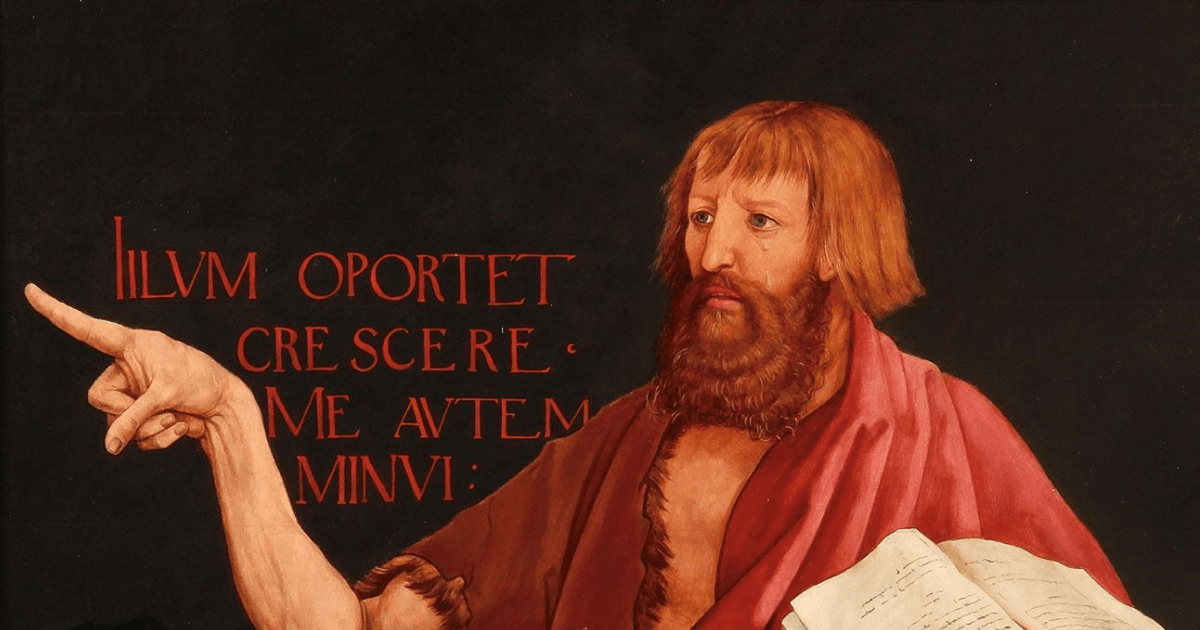
In Matthias Grünewald’s breathtaking Isenheim Altarpiece, John the Baptist is placed prominently at the side of the crucified Christ. In his left hand, John holds the writings of the prophets. His right hand points towards the Saviour, and Grünewald has elongated the Baptist’s index finger to make it disproportionate to the rest of his body. It is a small detail, but one that underscores John’s lifelong mission to direct all men to the Lamb of God who takes away the sins of the world.
The Fathers loved to point out that even the timing of the solemnity of John the Baptist’s nativity speaks to his heartfelt desire to magnify the Lord. On one level, the solemnity, which dates back to the 4th century, falls on June 24, reflecting the reality that John was born six months before Jesus (see Luke 1:36). But at a deeper level, the celebration coincides with the summer solstice when the long summer days begin to get shorter. In this way, nature herself embodies the truth of John’s declaration concerning Jesus: “He must increase, but I must decrease” (John 3:30). While the daylight decreases following John the Baptist’s birthday, it begins to increase again following the winter solstice, which falls just before Christ’s own birth at Christmas.
At the end of his book, Fr Davidson elucidates the deep joy that John felt over his prophetic mission. He who leaped for joy in the womb of Elizabeth discovered that joy again when the divine bridegroom stood before him at the dawn of His earthly ministry. “The friend of the bridegroom, who stands and hears him, rejoices greatly at the bridegroom’s voice; therefore this joy of mine is now full” (John 3:29).
As the forerunner of the Messiah, John the Baptist announced this joy to the world, and he would herald it again when he entered Hades ahead of Christ’s descent. In an age obsessed with self-promotion, John’s example of humility, courage and unwavering fidelity to the bridegroom is one that we should seek to recover.

.png)