




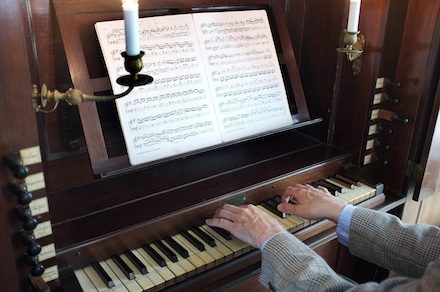
The Church organist is in a strange position, half in and half out of the service – partly why I like it. In some churches, if I am lucky, I am hidden away from the vicar and the congregation, so if the service is boring I can do silent practice on the keyboard or read the psalms, helpfully reprinted at the back of the best hymn book: the English Hymnal. The other advantage, from an oldie’s point of view, is that you don’t have to keep standing up all the time. I have never considered myself a proper organist, although I have been playing in churches for more than 50 years. I am a pianist who plays the organ, but I can’t do the pedals, which is what a proper organist has to be able to do. My job has been little more than playing hymns, something I have always enjoyed doing so long – that is, that I am allowed to choose the hymns myself. Nowadays, when organists are in short supply, it is easier to get agreement on this point from vicars or priests. Despite my many years as a not very committed Anglican, I am a baptised Catholic and was confirmed four years ago at Douai Abbey in Berkshire, after which I became a part-time organist for a short time in a local Catholic church. I realised then that the Church of England, which has ruined most of its churches and jettisoned its famous Book of Common Prayer still had one advantage over the Catholics in its vast repository of hymns, many of them the work of famous poets and composers. Not that that has stopped the C of E’s politically correct brigade from moving in on the hymns, even the famous ones, to bring them into line with current thinking: “He who would valiant be” is changed in Anglican Hymns Old and New to “All who would valiant be”, lest women should feel excluded. Hymns Old and New rewrites “Onward Christian Soldiers” as “Onward Christian Pilgrims” – anything military being considered incompatible with modern, forward-looking Christianity. The wonderful Remembrance Day hymn “O Valiant Hearts” will be found in neither of the two hymn books and I have always had difficulties with vicars when I say I want to include it. They like, instead, to have “Our God, Our Help in Ages Past”, so long as we leave out verse five: “Time like an ever-rolling stream/ Bears all its sons away/They fly forgotten, as a dream/ Dies at the opening day.” The author Isaac Watts has already been found guilty of male chauvinism in the C of E, which has re-written the third line with masterful banality as “Will bear us all away”. But when the theme is remembrance, “they fly forgotten” sends out the wrong message to the faithful and the veterans. It is a little unfair to castigate the Catholics for the poor quality of their hymns since many of them, particularly the new ones, are shared by both communions. A particular favourite with the Catholic congregation I played for was “Colours of Day”, with a dreary tune and fairly meaningless words: Go through the park, on into the town The sun shines on, it never goes down The light of the world is risen again The people of darkness are needing our friend Someone should have told the three people credited with writing these lines that “friend” doesn’t rhyme with “again”. Still, credit to the Catholic Hymn Book for sticking to “Onward Christian Soldiers” – but for how long? Since the Church of England pinched the words of the English Mass for its new communion service – even the sign of peace – the Catholics should retaliate by pinching all the best Anglican hymns. To be fair to them, they have been drifting this way for sometime, though failing often to realise that a good hymn is a combination of good words and good music (witness Newman’s “Praise to the Holiest in the Height” combined with the tune “Richmond”). But when I go to Mass now, they tend to use the tune but not the words. The wonderful Welsh melody “Hy frydol” (harmonised like so many hymns by Ralph Vaughan Williams) accompanies the words “Alleluia, sing to Jesus! His the sceptre, his the throne”. But only a few Sundays ago I was expected to sing “Christ the long-awaited saviour, joyfully we recognise...” Something has been lost, you have to agree. Well, I should be grateful at least for the presence of an organist: many Anglican village churches, which are increasingly being turned into cafeteria offering teas and breakfasts with full toilet facilities, have discovered that modern organs can be programmed to play hymns automatically. That’s one less thing for the church wardens to worry about. They could even save a bit of money and the vicar will be free to choose the hymns he likes. Organists, already a fast-declining species, could well be extinct before long. Richard Ingrams is a former editor of Private Eye and The Oldie. He is writing a book on Ludovic Kennedy This article first appeared in the print edition of The Catholic Herald (18/7/14)
12:53 PM
The organist is dead
A great English Christian figure is in danger of dying out
Richard Ingrams

6 min read



Already a subscriber? Sign in
5freearticles every month
Continue reading with a free account. No card needed.
- Five free articles every thirty days, on any device you sign in on
- The Catholic Herald newsletter, every morning
- Subscribe whenever you like for everything: every article and the magazine
Related articles
 Newsroom
Church leaders urge Drumcree dialogue: ‘Too much is at stake’
The Catholic and Church of Ireland Archbishops of Armagh have urged a renewed commitment to peace and reconciliation amid the Drumcree stand-off
Corrie Douglas-Young Newsroom
Thousands of Irish children to join global Rosary campaign
Corrie Douglas-Young Newsroom
TikTok priest urges young people to stand with persecuted Christians
Nathalie Raffray Newsroom
Baby born at 25 weeks reunites with neonatologist two years after leaving hospital
The Catholic Herald Newsroom
Joe Biden honoured by Planned Parenthood after defending abortion rights
Christine Rousselle
subscribe to the catholic herald today
Our best content is exclusively available to our subscribers. Subscribe today and gain instant access to expert analysis, in-depth articles, and thought-provoking insights—anytime, anywhere. Don’t miss out on the conversations that matter most.
Subscribe



