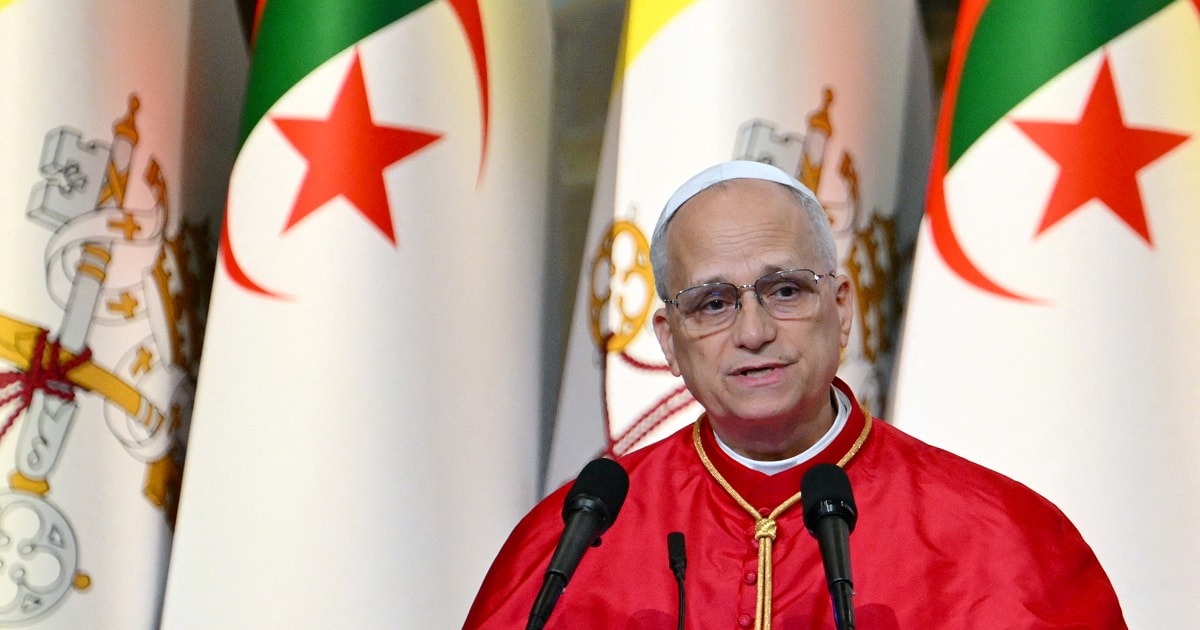


A bizarre and erroneous narrative has been peddled in recent days that the Holy Father, Pope Leo XIV, panders to Islam and has remained silent over the persecution of Christians.
Much stems from his Algeria visit earlier this week, where the 70-year-old Pontiff visited the Martyrs’ Memorial, which honours those who died in the war that ensued when Algeria sought independence from France. Some have tried to present this as a bending of the cap to the Islamic forces which sought freedom from a Catholic power. Whilst it is correct to say that Algerian independence led to the marginalisation of Christianity in public life, as well as the exodus of Catholic European settlers, French colonial power was a far cry from a model of Catholic integralism. Indeed, in 1958, the first year of the Algerian War of Independence, the French constitution was adopted to establish the Fifth Republic, stating: “France is an indivisible, secular (laïque), democratic and social Republic.”

It has also been pointed out that the Pope chose not to visit the Tibhirine monastery, the site where, 30 years ago, seven Trappist monks were kidnapped and murdered. However, the holy men, raised to the altar of the Blessed in 2018 by Cardinal Becciu, gave their lives as an instrument of interreligious dialogue, choosing to stay during the Algerian civil war out of solidarity with the local Muslims, with whom they had bonded by teaching French and providing employment at the monastery’s farm. For the monks of Tibhirine, few insults could be greater than an attempt to ignite interreligious hostilities in their memory.
It should also be noted that a papal trip can rarely cover every base. The Augustinian and missionary Pope would likely have felt a strong inclination to visit the site where men had travelled from a distant country to serve an impoverished community. However, concessions due to time, and to the host country, will always be a necessity.
Those who continue to claim this as cowardice should pay closer attention when, in other circumstances, the Pope has used international trips as an opportunity to demonstrate respect, but also distance, from the religion of Islam, particularly during his visits to Islamic places of worship.
Popes visiting mosques is an entirely 20th-century development, but Pope Leo is the first Pope to refuse to pray inside one. That is quite a feature, considering the conservative pedigree of John Paul II and Benedict XVI. Happy to remove his shoes and enter into silent reflection, Pope Leo has declined to pray. Beginning during his trip to Turkey at the end of last year, when he politely declined the invitation of a Blue Mosque imam to pray, it happened again during his Algeria visit, when he stood beside Imam Mohamed Mamoun al Qasimi and before the mihrab of Algeria’s Grand Mosque, again choosing not to pray.
Equally misplaced is the accusation that he has remained silent on the persecution of Christians, one of the gravest human rights violations of the 21st century.
It took the Pope less than a week after his May 8 election to call the world’s attention to the persecuted Church. Speaking to representatives of the Eastern Churches, who suffer much of the brunt of the Islamic extremism that the Church faces, he encouraged them, saying: “Who better than you can sing a song of hope even amid the abyss of violence? Who better than you, who have experienced the horrors of war so closely that Pope Francis referred to you as ‘martyr Churches’?” The Holy Father continued: “From the Holy Land to Ukraine, from Lebanon to Syria, from the Middle East to Tigray and the Caucasus, how much violence do we see!”
A month later, speaking to Conventual Franciscans and Trinitarians gathered for their general chapter in Rome, he asked that the brothers “may not cease to remember in your prayer and in your daily efforts those who are persecuted due to their faith”. Five days later, during his Wednesday General Audience, Pope Leo remembered the “vile terrorist attack” on the Mar Elias church in Damascus, and told Christians in the Middle East: “The whole Church stands with you.”
On October 10, he praised Aid to the Church in Need, saying “we do not abandon our persecuted brothers and sisters”, and said the Church must labour to secure their God-given freedoms. On November 16, during the Angelus, he said that “Christians today are still suffering from discrimination and persecution in various parts of the world”, before explicitly naming Bangladesh, Nigeria, Mozambique and Sudan.
On January 9, 2026, during his address to the diplomatic corps accredited to the Holy See, Pope Leo said that “the persecution of Christians remains one of the most widespread human rights crises today”, calling out “especially” the “religiously motivated violence in Bangladesh, in the Sahel region and in Nigeria, as well as the serious terrorist attack last June on the parish of Saint Elias in Damascus”. He also pointed particularly to the “jihadist violence in Cabo Delgado, Mozambique.”
In a world where the liberal media, particularly the UK’s state-funded broadcaster, seek to explain away the persecution of Christians at every possible juncture, having a pontiff who embraces the opportunity to mention their plight is both expedient and necessary.
Ultramontanism, leading to an unnecessary and un-Catholic deference to the papacy, should be avoided. But when the Holy Father’s rhetoric and actions are clear, Catholics should be the first in line to defend the Chair of St Peter.