


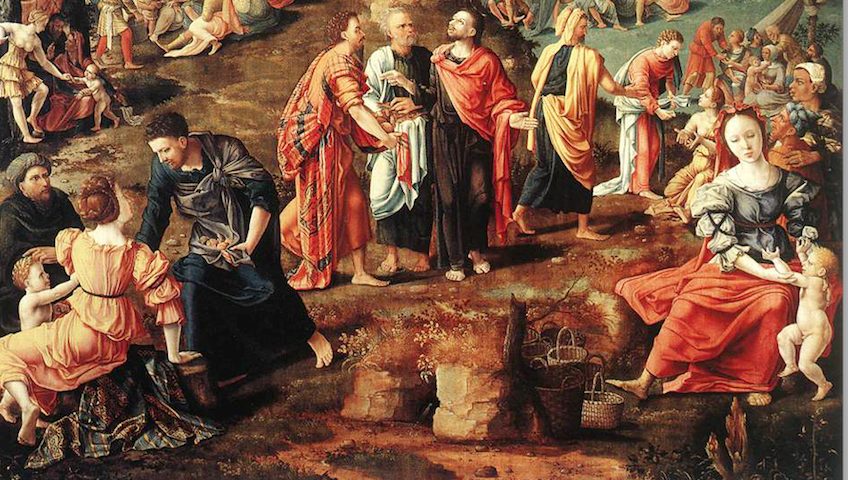
Hunger, both physical and spiritual, is the most instinctive driving force of our humanity. Without food, the most basic necessity, we die. Without the love and understanding that we crave, we withdraw into barren isolation. Hunger sustains life, but, at the same time, has the power to destroy it. Hunger can, as we know, become a catastrophic addiction when it leads us in the wrong direction. This applies both to the food we eat and the longings that drive our relationships. Throughout the psalms, hunger is the longing that brings us to God. We long for God as the deer longs for running streams. As the watchman longs for daybreak, so we wait on the Lord. We recognise this deep hunger, both within ourselves and our world, and yet we are frequently powerless to satisfy that hunger. Such was the plight of the man who brought his modest offering of grain and barley loaves to the prophet Elisha. He was directed to feed the people with the little that he had brought to the altar. Not surprisingly he protested: “How can I serve this to a hundred men?” We feel the same inadequacy when confronted the world’s famine and conflict. We know that, by ourselves, we have neither the resources nor the love to heal a broken world. The prophet Elisha trusted not in the little that we have, but in the generosity of the God to whom it is offered. “Give it to the people to eat, for the Lord says this: ‘They will eat and have some left over.’” St John’s Gospel prefaces the long discourse on the Bread of Life with a similar incident. Feeling compassion for the hungry multitude, Jesus asked Philip where they might buy bread to feed them. The passage tells us that “he only said this to test Philip”. We, like Philip, are sorely tested when we face our own inner poverty. We know that there are the situations in which our own faith, hope and love will not suffice. The narrative reveals that the little we have, our five loaves and two fish, when surrendered to the Lord, become God’s abundance. So it is in the celebration of the Eucharist. When we surrender the little that we are, we become Christ’s dwelling place. In today’s readings, St Paul exhorts us to charity, complete selflessness, gentleness and patience. Once again, let us bring the little we have to the blessing of the Lord. It is in Christ alone that our poverty becomes God’s sufficiency. This article first appeared in the latest edition of the Catholic Herald magazine (24/7/15). Take up our special subscription offer – 12 issues currently available for just £12!
11:00 AM
The prophet Elisha trusted in the generosity of God
Seventeenth Sunday of the Year, 2 Kgs 4:42-44; Eph 4:1-6; Jn 6:1-15 (Year B)
Bishop David McGough

3 min read



Already a subscriber? Sign in
5freearticles every month
Continue reading with a free account. No card needed.
- Five free articles every thirty days, on any device you sign in on
- The Catholic Herald newsletter, every morning
- Subscribe whenever you like for everything: every article and the magazine
Related articles
 Newsroom
Church leaders urge Drumcree dialogue: ‘Too much is at stake’
The Catholic and Church of Ireland Archbishops of Armagh have urged a renewed commitment to peace and reconciliation amid the Drumcree stand-off
Corrie Douglas-Young Newsroom
Thousands of Irish children to join global Rosary campaign
Corrie Douglas-Young Newsroom
TikTok priest urges young people to stand with persecuted Christians
Nathalie Raffray Newsroom
Baby born at 25 weeks reunites with neonatologist two years after leaving hospital
The Catholic Herald Newsroom
Joe Biden honoured by Planned Parenthood after defending abortion rights
Christine Rousselle
subscribe to the catholic herald today
Our best content is exclusively available to our subscribers. Subscribe today and gain instant access to expert analysis, in-depth articles, and thought-provoking insights—anytime, anywhere. Don’t miss out on the conversations that matter most.
Subscribe



