



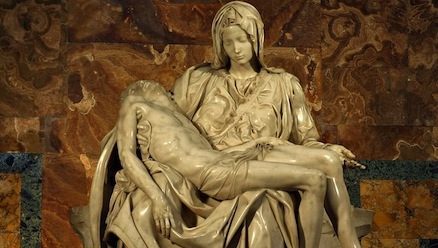
Today, in case you have forgotten, is the feast of Our Lady of Sorrows, which falls the day after the feast of the Exaltation of the Holy Cross. Our Lady of Sorrows is a very popular devotion in Italy, and pictures of the Mater Dolorosa, or Santa Maria Addolorata, are everywhere, and are particularly associated with mourning. Whenever a death is announced in Italy, it is done by a poster put up in the quarter of the town where the deceased lived, usually with a picture of the Addolorata at the top. If you use the word ‘Addolorata’ in Malta, it means one thing only, namely the cemetery, which is dedicated to Santa Maria Addolorata. So many dear friends now lie there that I have developed an understanding of what the devotion to Our Lady of Sorrows is all about. Incidentally, the Addolorata is a masterpiece of funerary architecture, the work of Emmanuel Luigi Galizia, and probably the most important exemplar of Maltese Victorian neo-Gothic, an admittedly small, but very rewarding, field. There are some pictures worth browsing online. Galizia also produced some very fine neo-Moorish work. Galizia deserved to be better known, and surely there is no better place to contemplate the Seven Sorrows of Our Lady than walking around the Addolorata Cemetery, reading the inscriptions on the tombstones. The attraction of this devotion is that it reminds us we are never alone in grief, and that Our Lady sympathises with us, and knows what we suffer, because she suffered it more – infinitely more. This concept of sympathy is what makes the only truly great representation of Our Lady of Sorrows so arresting. I have in mind of course Michelangelo’s Pietà, the one that is found in the Vatican Basilica, in the first chapel on the right as you go in. Michelangelo created several other renditions of the same subject, but this is the only one he finished. I never really used to appreciate this sculpture, but I am now older and perhaps wiser than I was, and now I think I understand it the more. The clue is in the title. While the sculpture shows Our Blessed Lady holding the body of Her Son, just taken down from the Cross, the emphasis is not on grief, per se, but on compassion, or pity, for that is what is meant by the Italian word pietà. After the Passion of Christ, comes the Compassion of Mary; Christ suffers, and she suffers with Him. Or is the pity and compassion not simply confined to the Madonna: is the statue eliciting a response from us? Look what the world has done to Christ through hardness of heart: how can we , seeing this, not feel pity? Michelangelo’s sculpture, as you would expect, is a sophisticated theological work. To contemplate it is to experience an inkling of what redemption entails. We are stony-hearted beasts; but through the grace of Christ, we can become like she who sits holding her dead Son (soon to rise) in her lap: full of love, faith, compassion, pity, and dignity. Happy feast of Our Lady of Sorrows! Happy contemplation!
1:41 PM
The redemptive power of Our Lady of Sorrows is perfectly encapsulated by Michelangelo's Pietà
To contemplate one of the great artist's masterworks it is to experience an inkling of what redemption entails
Fr Alexander Lucie-Smith

4 min read



Already a subscriber? Sign in
5freearticles every month
Continue reading with a free account. No card needed.
- Five free articles every thirty days, on any device you sign in on
- The Catholic Herald newsletter, every morning
- Subscribe whenever you like for everything: every article and the magazine
Related articles
 Newsroom
Church leaders urge Drumcree dialogue: ‘Too much is at stake’
The Catholic and Church of Ireland Archbishops of Armagh have urged a renewed commitment to peace and reconciliation amid the Drumcree stand-off
Corrie Douglas-Young Newsroom
Thousands of Irish children to join global Rosary campaign
Corrie Douglas-Young Newsroom
TikTok priest urges young people to stand with persecuted Christians
Nathalie Raffray Newsroom
Baby born at 25 weeks reunites with neonatologist two years after leaving hospital
The Catholic Herald Newsroom
Joe Biden honoured by Planned Parenthood after defending abortion rights
Christine Rousselle
subscribe to the catholic herald today
Our best content is exclusively available to our subscribers. Subscribe today and gain instant access to expert analysis, in-depth articles, and thought-provoking insights—anytime, anywhere. Don’t miss out on the conversations that matter most.
Subscribe



