



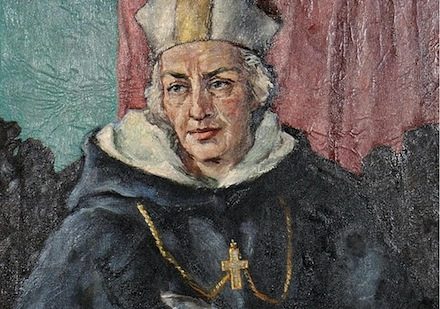
Some historians argue that the first Renaissance took place in the 12th and 13th centuries, and that this era was as culturally important as the later Italian Renaissance. One of the chief luminaries of the period (along with Thomas Aquinas, Bonaventure and Bernard of Clairvaux) was Albert the Great. Widely viewed as the greatest scholar of the Middle Age, the Dominican friar was known as Albertus Magnus even during his lifetime and is now one of only 35 Doctors of the Church. Born at the end of the 12th century, Albert came from an aristocratic family in Bavaria. He studied at Padua University, learning Aristotle. At some point he had an encounter with the Virgin Mary and in the 1220s joined the Dominican order. He studied at Bologna, another of the universities that had sprung up in Europe during the first Renaissance. He then taught for several years in Cologne and, in 1245, became master of theology there. He then taught theology in Paris, where one of his students was a young Thomas Aquinas. It was Albert who was the first to comment on Aristotle and helped to spread his ideas within the Church. He also studied the work of Muslim thinkers such as Avicenna and Averroes. In 1260 Albert was made Bishop of Regensburg, where he was known for his humility, choosing to walk around rather than ride a horse. After three years, and now well into his 60s, he retired, although he continued to figure in public life. In 1270 he preached the Eighth Crusade. He also helped to mediate between various feuding parties and defended Aquinas from charges of heresy. When Aquinas died, aged 49. Albert was greatly grieved. His own health declined in 1278 and he died two years later in Cologne. His relics are still in the city, at the Dominican St Andreas church. St Albert’s impact on European civilisation was truly enormous, spreading Aristoleian ideas into science. As he wrote in De Mineralibus: “The aim of natural philosophy [science] is not to simply to accept the statements of others, but to investigate the causes that are at work in nature.” His theological works changed the way that countless people thought.
2:38 PM
The saint who taught Thomas Aquinas
St Albert the Great (November 15) widely viewed as the greatest scholar of the Middle Age
Staff Reporter

2 min read



Already a subscriber? Sign in
5freearticles every month
Continue reading with a free account. No card needed.
- Five free articles every thirty days, on any device you sign in on
- The Catholic Herald newsletter, every morning
- Subscribe whenever you like for everything: every article and the magazine
Related articles
 Newsroom
Church leaders urge Drumcree dialogue: ‘Too much is at stake’
The Catholic and Church of Ireland Archbishops of Armagh have urged a renewed commitment to peace and reconciliation amid the Drumcree stand-off
Corrie Douglas-Young Newsroom
Thousands of Irish children to join global Rosary campaign
Corrie Douglas-Young Newsroom
TikTok priest urges young people to stand with persecuted Christians
Nathalie Raffray Newsroom
Baby born at 25 weeks reunites with neonatologist two years after leaving hospital
The Catholic Herald Newsroom
Joe Biden honoured by Planned Parenthood after defending abortion rights
Christine Rousselle
subscribe to the catholic herald today
Our best content is exclusively available to our subscribers. Subscribe today and gain instant access to expert analysis, in-depth articles, and thought-provoking insights—anytime, anywhere. Don’t miss out on the conversations that matter most.
Subscribe



