




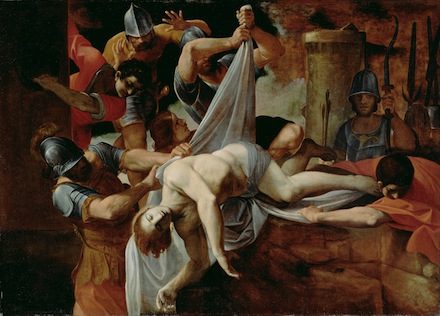
St Sebastian has become as important a part of the history of art as of the history of Christianity itself. Although originally depicted as an older, bearded man, the saint was soon depicted as an idealised, and even erotic, figure of a young man, tied to a tree and shot with arrows. What we know of St Sebastian comes from the famous fourth-century Bishop of Milan, St Ambrose, who in a sermon stated that Sebastian came from the city and was celebrated there. He was popular with soldiers and athletes. As a result, he was presented as an image of the body beautiful and his medals were worn at sporting events. According to later biographies of Sebastian, which may also come from Ambrose, the saint came from the province of Gallia Narbonesis, which roughly corresponds to the Languedoc, Provence and Rhone Valley. He was educated in Milan and came to be a captain in the Praetorian Guard under Diocletian and Maximian. The former was ferociously anti-Christian and Sebastian was at this point already of the faith (whether by birth or adoption we don’t know) which he kept a secret. After encouraging Mark and Marcellian, two prisoners in his care who were facing execution for refusing to sacrifice to the empire, Sebastian then converted their parents and 76 other people. Among these were some important officials in Roman society. When word reached the emperor he was furious. Sebastian was led to a field to be shot with arrows. It is said that the arrows filled his body, yet when his body was retrieved it was found that he was still alive. Taken to a Christian safe house, Sebastian performed a miracle by giving a girl back her sight and then, seeing the emperor in the street, shouted abuse at him. The emperor, unsurprisingly, had him killed, beaten to death and his body thrown into ancient Rome’s sewage system. Numerous miracles were attached to the young man and he was thought to protect from the plague, which began to ravage Italy as the light of ancient civilisation faded amid barbarian invasion and depopulation. Indeed, the Lombard king who deposed Roman rule was also a devotee. His earliest representation appears at a mosaic in Ravenna dating from the mid sixth century. Another from Rome made in 682 shows an old man in a gown. The nude Sebastian only appeared towards the end of the Middle Ages as the Renaissance revived the civilisation of Rome.
2:59 PM
The saint who was popular with soldiers and athletes
St Sebastian (January 20) was captain in the Praetorian Guard
Ed West

3 min read



Already a subscriber? Sign in
5freearticles every month
Continue reading with a free account. No card needed.
- Five free articles every thirty days, on any device you sign in on
- The Catholic Herald newsletter, every morning
- Subscribe whenever you like for everything: every article and the magazine
Related articles
 Newsroom
Church leaders urge Drumcree dialogue: ‘Too much is at stake’
The Catholic and Church of Ireland Archbishops of Armagh have urged a renewed commitment to peace and reconciliation amid the Drumcree stand-off
Corrie Douglas-Young Newsroom
Thousands of Irish children to join global Rosary campaign
Corrie Douglas-Young Newsroom
TikTok priest urges young people to stand with persecuted Christians
Nathalie Raffray Newsroom
Baby born at 25 weeks reunites with neonatologist two years after leaving hospital
The Catholic Herald Newsroom
Joe Biden honoured by Planned Parenthood after defending abortion rights
Christine Rousselle
subscribe to the catholic herald today
Our best content is exclusively available to our subscribers. Subscribe today and gain instant access to expert analysis, in-depth articles, and thought-provoking insights—anytime, anywhere. Don’t miss out on the conversations that matter most.
Subscribe



