
December 24, 2025
December 24, 2025

The sound of the season: choirs, carols, and moral memory

Min read
share

As Advent slips into Christmas, it is the time above all others when the nation’s choral forces step into a spotlight. And often as not, they are turning out Messiahs by the dozen in London during the next few weeks, though one to aim for is the performance by Polyphony with the Age of Enlightenment Orchestra at St John’s Smith Square on 23 December. A dream team in action.

But that said, no one does the standard choral formula of carols, anthems, and readings better than the Birmingham-based Ex Cathedra, who like to spice the mix with seasonal numbers from South America, giving their conductor Jeffrey Skidmore the chance to march up and down with a drum, but otherwise combine crisp professionalism with warm-blooded humanity that not all professional ensembles manage.
Catch them on tour at Hereford Cathedral (10 December), St Martin-in-the-Fields, London (12 and 15 December), and St Paul’s, Birmingham (19, 20, and 22 December). As for marching up and down with drums, an element of choreography is something many choirs adopt these days, and I am not sure I care for it.

But talking recently to Graham Ross, who runs the high-profile choir at Clare College, Cambridge, he made the fair point that by long liturgical tradition choirs do process, “and since different parts of a building speak in different ways, there is an enjoyable challenge in figuring out how to make the space work and bring fresh life to the repertoire”.

Considering the repertoire itself, assembling Christmas programmes is not easy. As Ross says, “They come round annually and you have to reinvent the wheel, finding different things to last year but not losing touch with the familiar carols people expect. You are juggling adventure with comfort. And there is a lot to juggle, given that the average item on a Christmas programme only lasts three minutes”.

For the Clare Choir, this year’s programmes home in on John Rutter, the king of modern carol writing, who has just turned 80 and has close connections with Clare in that he once had Ross’s job as its music director. To mark his birthday, the choir has just issued a Rutter disc on the Harmonia Mundi label. And if you want to hear them live, they give Christmas concerts in Cambridge (6 December), St John’s Smith Square, London (13 December), and Wiltshire Music Centre, Bradford on Avon (18 December).

In London, the centre of activity for Christmas choral events is, as always, Smith Square, where their annual festival (6 to 23 December) functions like a marketplace for the elite. Besides Polyphony and Clare, you will hear the Tallis Scholars, Voces 8, Gesualdo 6, and much more.

Catholics will appreciate that Christmas continues to Candlemas, although you would not know it from the concert calendar, where festivity tends to stop dead on 24 December.

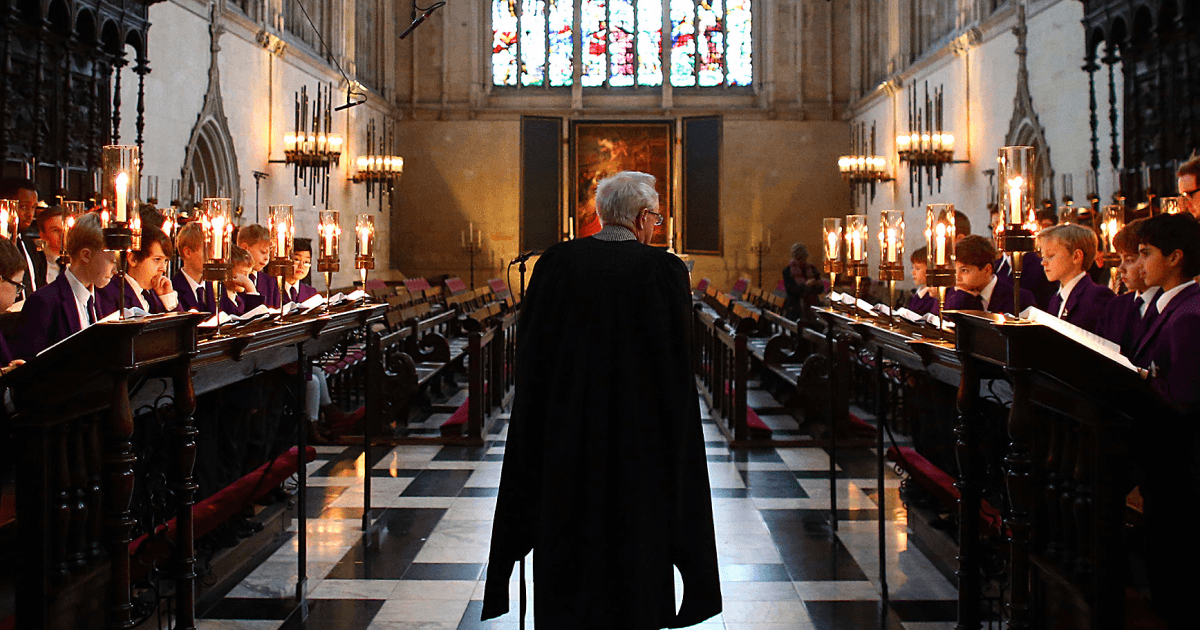
So in the ensuing January dearth, look out for the Choir of Christ Church Oxford at Wigmore Hall on 5 January. And meanwhile, Daniel Hyde winds down from the intense seasonal exposure he gets as music director at King’s Cambridge with an organ recital at the Royal Festival Hall on 12 January.

Not that the monster of an instrument at the Royal Festival Hall, 8,000 pipes at the last count, really invites winding down. Something I cherish as a sort of winding up to Advent and Christmas is the Britten Weekend that runs on the composer’s home turf, Aldeburgh, around the time of his birthday, which fortuitously occurs on the feast of St Cecilia, patron saint of music.

This year’s Weekend also marked the anniversary of the end of the Second World War, when Britten and Yehudi Menuhin travelled to Germany to give concerts in the just-liberated Bergen-Belsen concentration camp. And it is a well-known story that among the inmates who heard them play was the cellist Anita Lasker-Wallfisch, who would later come to England and co-found the English Chamber Orchestra.

Accordingly, the English Chamber Orchestra were featured in the Weekend, alongside Anita’s cellist son Raphael Wallfisch, for a rare performance of Arthur Bliss’s Cello Concerto. But the Weekend’s highlight was an event remembering the brave young Munich students who, in the midst of Nazi Germany, formed the so-called White Rose resistance movement, for which they paid with their lives.

We heard music they would have known and sung in the 1940s German choirs that some of them belonged to, performed here by the latter-day vocal ensemble Sansara. And there were readings from letters they wrote in prison, awaiting execution. But comparably powerful was a sequence of choral settings by the 82-year-old composer Philip Moore of prayers written by the Lutheran pastor Dietrich Bonhoeffer as he too awaited execution in a Nazi prison camp. Combining dignity, conviction, and helplessness, with emotions amplified by music, they stand testament to horrors most of us today are spared. And thanks be to God for that.

As Advent slips into Christmas, it is the time above all others when the nation’s choral forces step into a spotlight. And often as not, they are turning out Messiahs by the dozen in London during the next few weeks, though one to aim for is the performance by Polyphony with the Age of Enlightenment Orchestra at St John’s Smith Square on 23 December. A dream team in action.

But that said, no one does the standard choral formula of carols, anthems, and readings better than the Birmingham-based Ex Cathedra, who like to spice the mix with seasonal numbers from South America, giving their conductor Jeffrey Skidmore the chance to march up and down with a drum, but otherwise combine crisp professionalism with warm-blooded humanity that not all professional ensembles manage.
Catch them on tour at Hereford Cathedral (10 December), St Martin-in-the-Fields, London (12 and 15 December), and St Paul’s, Birmingham (19, 20, and 22 December). As for marching up and down with drums, an element of choreography is something many choirs adopt these days, and I am not sure I care for it.

But talking recently to Graham Ross, who runs the high-profile choir at Clare College, Cambridge, he made the fair point that by long liturgical tradition choirs do process, “and since different parts of a building speak in different ways, there is an enjoyable challenge in figuring out how to make the space work and bring fresh life to the repertoire”.

Considering the repertoire itself, assembling Christmas programmes is not easy. As Ross says, “They come round annually and you have to reinvent the wheel, finding different things to last year but not losing touch with the familiar carols people expect. You are juggling adventure with comfort. And there is a lot to juggle, given that the average item on a Christmas programme only lasts three minutes”.

For the Clare Choir, this year’s programmes home in on John Rutter, the king of modern carol writing, who has just turned 80 and has close connections with Clare in that he once had Ross’s job as its music director. To mark his birthday, the choir has just issued a Rutter disc on the Harmonia Mundi label. And if you want to hear them live, they give Christmas concerts in Cambridge (6 December), St John’s Smith Square, London (13 December), and Wiltshire Music Centre, Bradford on Avon (18 December).

In London, the centre of activity for Christmas choral events is, as always, Smith Square, where their annual festival (6 to 23 December) functions like a marketplace for the elite. Besides Polyphony and Clare, you will hear the Tallis Scholars, Voces 8, Gesualdo 6, and much more.

Catholics will appreciate that Christmas continues to Candlemas, although you would not know it from the concert calendar, where festivity tends to stop dead on 24 December.

So in the ensuing January dearth, look out for the Choir of Christ Church Oxford at Wigmore Hall on 5 January. And meanwhile, Daniel Hyde winds down from the intense seasonal exposure he gets as music director at King’s Cambridge with an organ recital at the Royal Festival Hall on 12 January.

Not that the monster of an instrument at the Royal Festival Hall, 8,000 pipes at the last count, really invites winding down. Something I cherish as a sort of winding up to Advent and Christmas is the Britten Weekend that runs on the composer’s home turf, Aldeburgh, around the time of his birthday, which fortuitously occurs on the feast of St Cecilia, patron saint of music.

This year’s Weekend also marked the anniversary of the end of the Second World War, when Britten and Yehudi Menuhin travelled to Germany to give concerts in the just-liberated Bergen-Belsen concentration camp. And it is a well-known story that among the inmates who heard them play was the cellist Anita Lasker-Wallfisch, who would later come to England and co-found the English Chamber Orchestra.

Accordingly, the English Chamber Orchestra were featured in the Weekend, alongside Anita’s cellist son Raphael Wallfisch, for a rare performance of Arthur Bliss’s Cello Concerto. But the Weekend’s highlight was an event remembering the brave young Munich students who, in the midst of Nazi Germany, formed the so-called White Rose resistance movement, for which they paid with their lives.

We heard music they would have known and sung in the 1940s German choirs that some of them belonged to, performed here by the latter-day vocal ensemble Sansara. And there were readings from letters they wrote in prison, awaiting execution. But comparably powerful was a sequence of choral settings by the 82-year-old composer Philip Moore of prayers written by the Lutheran pastor Dietrich Bonhoeffer as he too awaited execution in a Nazi prison camp. Combining dignity, conviction, and helplessness, with emotions amplified by music, they stand testament to horrors most of us today are spared. And thanks be to God for that.

share

subscribe to the catholic herald today

Our best content is exclusively available to our subscribers. Subscribe today and gain instant access to expert analysis, in-depth articles, and thought-provoking insights—anytime, anywhere. Don’t miss out on the conversations that matter most.
Subscribe